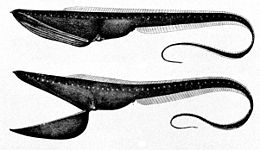
Oceanic Ichthyology Engraving Edited by George Brown Good and Tarleton Hoffman Bean (1896)
The species was described by the French zoologist Leon Vayan. A sample of the holotype was caught during the third oceanographic voyage of the vessel Travailleur in 1882 [4] and presented to the French Academy of Sciences in December 1882. The following year, Theodore Gill and Ryder described five more specimens caught during the expedition aboard the Albatross, classifying them as a new species named after Spencer Fullerton Baird Gastrostomus bairdii (now the youngest synonym) [5] .
The length of the body is up to 62 cm [6] [7] , according to other sources up to 75-100 cm [8] . A characteristic feature of this fish is a very large jaw and an elongated throat with a leathery bag, which resembles those of pelicans and similarly helps it catch prey (hence the Latin name of the species). The oral cavity has a large capacity: in fish with a size of 35 cm and a body volume of about 9 cm³, the volume of the oral cavity can reach 100 cm³ [6] . In the upper part of the mouth, from its edge to the mouth of the esophagus, there is a clear strip of tissue parallel to the axial skeleton of the fish, and in the back part - in the form of finger-shaped strips. Histologically, the presence of glandular cells filled with acidophilic protein granules was demonstrated in this tissue. Nielsen et al. Suggested that these cells produce digestive enzymes or toxic substances that affect prey caught in the mouth and probably remain in it for some time before swallowing and digestion [6] .
The brain skull is only 1/10 the length of the entire skull [6] . The jaws are many small curved teeth, arranged in several rows. The eyes are small, the front and back nostrils are in front of the eyes, close to each other. An unusual feature common to the genera Saccopharynx and Eurypharynx is the presence of six pairs of crevices between the gill arches instead of five typical for teleost fishes. The holes are surrounded by circular muscles [9] .
The length of the mouth is about 1/3 of the total body length, the rest is a thin eel-like body, passing into the tail thread, at the end of which there is a photophore (luminous organ). Against the backdrop of a huge mouth, the body looks extremely small. The elongated body has a long and flexible tail, fitted at the end with a photo -structure with a simple structure. In live fish, it is pink or red [10] . It is believed that photophore at the end of the tail can be used to attract prey in the animal's mouth, but this behavior has never been observed in nature [10] .
Fish do not have scales , swim bladder , ribs , pyloric appendages, caudal and pelvic fins. Dorsal and anal fins long. Many bones of a skull are reduced, or have completely disappeared. Skeleton greatly reduced. The spine is surrounded by spaces filled with lymph. The brain weighs 17.9–20 mg [11] . On both sides of the dorsal fin there is a bright line or groove with an unknown function. The dorsal and anal fins end in the middle of the body length. The side line consists of a series of convex tubes instead of holes. Body color is monochromatic black. The body is relatively fragile and, as a rule, when released into the fishing nets, it is severely damaged - first of all, the long jaws and the tail of the fish [6] .
The gastrointestinal tract is partially black, mainly in the oral cavity [12] .
The heart is removed from the skull, at the level of the 18th vertebra, located very close to the abdominal surface of the body. The thick pericardium, which is the main defense of the heart, shines through the translucent skin of the fish. Pericardial fibers are closely related to the skeleton of the pectoral fins, which is another anatomical feature of this species.
There is sexual dimorphism . Degenerative changes are observed in males after puberty: the olfactory organs increase, the teeth and jaws decrease. It is believed to mate only once in a lifetime. Spermatogenesis in males occurs synchronously. Gonads have a lobar structure, presumably they are hermaphroditic, polycyclic ovaries [12] . Gonads increase during puberty in the abdominal cavity of fish, inhibit the stomach and intestines, causing their atrophy, and after the end of reproduction, the animal most likely dies [13] .
They feed on fish, crustaceans , cephalopods and plankton . In the work of Nielsen the content of the gastrointestinal tract was evaluated in 120 copies; in 85% of the samples, the stomachs were empty, the animals were too damaged, or the digested contents could not be assessed. In the stomachs of 87 individuals, mollusks were found, in 37 - fish, in 15 - cephalopods, in 8 - tunicates [6] .
Probably catching prey, fish, through the gills gets rid of water and swallows it. It is believed that, like other elongated deep-water fish, this species occupies an upright position and follows the silhouettes of small organisms against the background of residual sunlight penetrating this depth. Since the stomach of this fish is not as elastic as that of other members of the order Saccopharyngiformes, the fish probably feeds on rather small organisms. Investigation of muscles during swallowing demonstrated the prevalence of striated muscles over red muscles, which suggests a strategy for hunting from shelter, rather than active pursuit of prey [14] .
Fry resemble eel leptocephalus .
Circulating globally. They are found in the oceans, from Iceland (65 ° N lat.) To 48 ° S. sh., at depths of 500–3000 m [15] . Previously described as rare, it is now considered to be a fairly common species [6] .