Razuan lark [1] , or Razsky small lark [2] , or Razo island lark [2] ( lat. Alauda razae ), is a bird species from the family of larks (Alaudidae) [3] . The range is limited to the island of Razu , owned by Cape Verde .
| Razuan Lark | |||||||||||||||||||||||||||||||||||
| Scientific classification | |||||||||||||||||||||||||||||||||||
|---|---|---|---|---|---|---|---|---|---|---|---|---|---|---|---|---|---|---|---|---|---|---|---|---|---|---|---|---|---|---|---|---|---|---|---|
| |||||||||||||||||||||||||||||||||||
| International scientific name | |||||||||||||||||||||||||||||||||||
Alauda razae ( Alexander , 1898 ) | |||||||||||||||||||||||||||||||||||
| Synonyms | |||||||||||||||||||||||||||||||||||
| |||||||||||||||||||||||||||||||||||
| Security status | |||||||||||||||||||||||||||||||||||
Content
Description
Pretty small birds. Size 14-18 cm. Males are larger than females.
Status
The size of the Razuan Lark population is estimated at between 200 and 1,000 birds. At the same time, one male has two males. The reproductive rates of these birds are low; giant geckos prey on them. And although there are no dangerous mammals on the island of Razu, the probability of accidental delivery of the latter with catastrophic consequences for the lark population remains.
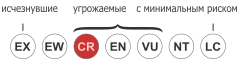
IUCN has granted the tax havens “ Endangered ” (CR) [4] . The possibility of creating a reserve population on another island is being discussed.
Gallery
Eggs
Chicks
Razu Island with a nest in the center of the image
Notes
- ↑ Vinokurov A.A. Rare and endangered animals. Birds: Ref. allowance / ed. V. E. Sokolova . - M .: Higher school, 1992. - S. 324. - 446 p. : ill. - 100,000 copies. - ISBN 5-06-002116-5 .
- ↑ 1 2 Boehme R. L. , Flint V. E. The Bilingual Dictionary of Animal Names. Birds. Latin, Russian, English, German, French / Ed. ed. Acad. V. E. Sokolova . - M .: Rus. lang., "RUSSO", 1994. - S. 267. - 2030 copies. - ISBN 5-200-00643-0 .
- ↑ Nicators, reedling, larks : [ eng. ] / F. Gill & D. Donsker (Eds). // IOC World Bird List (v 9.1). - 2019 .-- DOI : 10.14344 / IOC.ML.9.1 . (Retrieved May 18, 2019) .
- ↑ Alauda razae (English) . The IUCN Red List of Threatened Species . Date of treatment November 26, 2013.
Literature
- Donald, PF; de Ponte, M .; Pitta Groz, MJ; Taylor, R. Status, ecology, behavior and conservation of Raso Lark Alauda razae (English) // Bird Conservation International: journal. - 2003. - Vol. 13 . - P. 13-28 . - DOI : 10.1017 / S0959270903003022 .
- Donald, PF; Brooke An unlikely survivor: the peculiar natural history of the Raso Lark // British Birds: journal. - 2006. - Vol. 99 . - P. 420-430 .
- BROOKE M. de L., FLOWER TP and MAINWARING MC (2010). A scarcity of females may constrain population growth of threatened bird species: case notes from the Critically Endangered Raso Lark Alauda razae. Bird Conservation International 20 : 382–384. DOI : 10.1017 / S0959270910000225 .
- Ratcliffe N., Monteiro LR, and Hazevoet CJ (1999). Status of Raso Lark Alauda razae with notes on threats and foraging behavior. Bird Conservation International 9 : 43–46. DOI : 10.1017 / S0959270900003336 .
- Donald PF (1999). The ecology and conservation of skylarks Alauda arvensis on lowland farmland. Unpublished DPhil thesis, University of Oxford.
- Donald PF, Hille S., Brooke M. de L., Taylor R., Wells CE, Bolton M. and Marlow T. (2007). Sexual dimorphism, niche partitioning and social dominance in the feeding ecology of the Critically Endangered Raso lark Alauda razae. Ibis 149 : 848–852.
- Brooke MC (nd). Widespread Translocation from Autosomes to Sex Chromosomes Preserves Genetic Variability in an Endangered Lark. Journal of Molecular Evolution 70 (3): 242.