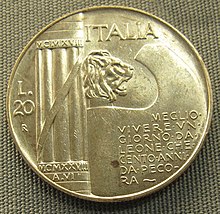

Era Fascista (from Italian. - "Fascist era") - the (chronology), used in fascist Italy . The appointment of Benito Mussolini as prime minister during the march to Rome , October 29, 1922, was the first day of the first year, Anno I , Era Fascista . The calendar was created in 1926 and became official in Anno V (1927) [1] . Each year, Era Fascista was called Anno Fascista (from Italian “the fascist year”) and was abbreviated as AF [2] [3] Many monuments in Italy still bear the dates of Era Fascista .
The dates of Era Fascista often consisted of a Gregorian date and the corresponding year of Era Fascista in Roman numerals , which was part of the appropriation of Roman symbols by . The year Era Fascista was sometimes written as Anno XIX , A. XIX or accompanied by the letters EF [4] The fascist calendar intended to replace the "bourgeois" Gregorian calendar in Italian public life so much that in 1939 newspapers were forbidden to write about New Year's Day [5] .
The tenth anniversary of the march to Rome, Anno X , was called Decennale , which was a reference to the ancient Roman . The central element of propaganda for Anno X was the Exhibition of the Fascist Revolution [6] .
In most of Italy, the calendar was discontinued after the fall of the fascist regime in 1943 ( Anno XXI ), but it continued to be used in the puppet Republic of Salo until the death of Mussolini in April 1945 ( Anno XXII ) [7] .
Notes
- ↑ Edgardo Baldi, Aldo Cerchiari, Enciclopedia moderna italiana , p. 1306
- ↑ Adriano Cappelli, Cronologia, cronografia e calendario perpetuo , Hoepli, 1998, p. 131
- ↑ Matthew Kneale, Rome: A History in Seven Sackings , Simon and Schuster, 2018, p. 296
- ↑ Catherine E. Paul, Fascist Directive: Ezra Pound and Italian Cultural Nationalism , 2016 ,, p. 114
- ↑ Simonetta Falasca-Zamponi, Fascist Spectacle: The Aesthetics of Power in Mussolini's Italy , 2000 ,, p. 105
- ↑ B. Painter, Mussolini's Rome: Rebuilding the Eternal City ,, 2016, p. 26
- ↑ Paolo Monelli, Mussolini: An Intimate Life , 1953, p. 288