Fadrique of Castile ( Spanish: Fadrique de Castilla ; 1223 - 1277 ) - Castilian Infant , Senor de Sanlúcar de Albaida , Helves , Hisirat , Abulhinar , Alpechin , Cambulon , Brenes , Riasuela and La Algeba in Andalusia (12 1269, 1272-1277). He was secretly killed by order of the elder brother of King Alfonso X.
| Fadrique (Friedrich) of Castile | ||||
|---|---|---|---|---|
| Spanish Fadrique de castilla | ||||
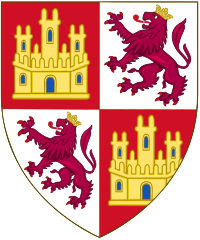 Coat of arms of the Kingdom of Castile and Leon | ||||
| ||||
| Birth | 1223 Guadalajara , Kingdom of Castile and Leon | |||
| Death | 1277 Burgos , Kingdom of Castile and Leon | |||
| Burial place | Holy Trinity Monastery in Burgos | |||
| Kind | Burgundy dynasty | |||
| Father | Fernando III | |||
| Mother | Beatrice of Swabian | |||
| Spouse | Beatrice de Malespina Ekaterina Komnina Dukena | |||
| Children | from first marriage : Beatrice Fadrique de Castile | |||
| Battles | ||||
Biography
Born in 1223 in Guadalajara . The second son of Ferdinand III (1199-1252), King of Castile from 1217 and Leon from 1230, from his first wife, Beatrice of Swabia (1203-1235).
Together with his brothers he participated in the military campaigns of his father against the Moors.
In 1240, Infant Fadrique was sent by his father to the court of the Holy Roman Emperor and King of Sicily Frederick II of Hohenstaufen to seek the inheritance of his mother Beatrice, who died in 1235 . Fadrique was at the court of the emperor for several years, participating in his military operations undertaken against Lombardy and the papacy. In 1245, Infant Fadrique returned to Castile, where he assisted his father during the siege of Jaen , who capitulated a year later.
In 1257, Infant Fadrike tried to get the hand of Princess Christina of Norway (1234–1262), the daughter of King Hakon IV , who then married his younger brother, Philip of Castile .
After the conquest of Seville, the infante Fadrique, dissatisfied with the rule of his older brother Alfonso X , may have participated in the uprising of his brother Enrique in 1255 .
In 1260, Infant Fadrique was expelled from Castile and joined his younger brother Enrique as an itinerant knight in Tunisia , where for several years he served in the service of the Hafsid Sultan Muhammad al-Mustansir and fought against his enemies.
Later, the infantry Fadrique entered the service of the King of Sicily, Manfred, and on his side participated in the battle of Benevento in 1266 . After the defeat of Manfred and the victory of Count Karl of Anjou, Fadrique of Castile returned to Tunisia .
In 1267, during the anti-Anjou rebellion in Sicily, the brothers Fadrique and Enrique of Castile took the side of Conradin, Duke of Swabia . Fadrique of Castile returned to Sicily, where he began to campaign for Conradinus, and his brother Enrique acted for Conradinus in Rome. After the defeat of Conradin at the Battle of Tagliacozzo in 1268 and the capture of Enrique in Canosa di Puglia, the Infant Fadrique was also forced to surrender to the Anjou in Agrigento . Infant Fadrique of Castile was not imprisoned, he was allowed to return to Tunisia .
In 1270, Fadrique participated on the side of the Hafsids in the reflection of the Eighth Crusade .
In 1272, the infantry Fadrique reconciled with the king of Castile Alfonso X , returned to his homeland and became one of the advisers to his older brother. In 1277, Infant Fadrique participated in a succession conspiracy, and was secretly executed by his older brother, King of Castile Alfonso X , in Burgos . He was buried in the monastery of the Holy Trinity in Burgos .
Marriages and children
During one of his trips to Italy, Fadrique of Castile was married by his first marriage to the noble Italian Beatrice de Malespina, daughter of the Marquis of Malespin. The spouses had a single daughter:
- Beatrice Fadrique de Castile (c. 1242-1277), 1st spouse - Tello Alfonso de Meneses, Senior de Meneses and Montealegre, son of Alfonso Telles de Meneses and Elvira Rodriguez Giron, 2nd spouse - Simon Ruiz de Cameros, senor de los Cameros, who was executed in 1277 along with the infantry Fadrique.
In 1274, Fadrique of Castile married for the second time Catherine Comnenus Ducinne (1248–1294), the daughter of despot Epirus Nicephorus I Comnenus Duci , and his first wife, Maria Duca Laskaris, from whom she had no children.
Fadrique also had several illegitimate children:
- Alonso Fadrique (c. 1260–1297), returned from his fathers to Spain in 1272
- Fadrique Fadrique (c. 1260 -?), Did not go with his father to Spain and stayed in Italy, where he left offspring.
Sources
- Arco y Garay, Ricardo del (1954). Sepulcros de la Casa Real de Castilla. Madrid: Instituto Jerónimo Zurita. Consejo Superior de Investigaciones Científicas. OCLC 11366237.
- Ballesteros y Beretta, Antonio (1963). Consejo Superior de Investigaciones Científicas. Academia Alfonso X el Sabio, ed. Alfonso X el Sabio. Murcia: Salvat.
- Diago Hernando, Máximo (1995). "La monarquía castellana y los Staufer: Contactos políticos y diplomáticos en los siglos XII y XIII." Espacio, tiempo y forma. Serie III, Historia medieval (Madrid: Universidad Nacional de Educación a Distancia (UNED). Facultad de Geografía e Historia) (8): 51-84. ISSN 0214-9745.
- Gómez-Moreno Martínez, Manuel (1946). El Panteón de las Huelgas Reales de Burgos. Instituto Diego Velázquez. Consejo Superior de Investigaciones Científicas.
- González Jiménez, Manuel (octubre de 2004). Alfonso X el Sabio (1ª edición). Barcelona: Editorial Ariel SA ISBN 84-344-6758-5 .
Ibáñez de Segovia Peralta y Mendoza, Gaspar; Marqués de Mondejar (1777). Joachin Ibarra, ed. Memorias históricas del Rei D. Alonso el Sabio i observaciones a su chronica. Madrid.