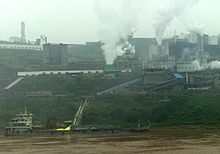
The pollution hypothesis states that when large industrialized countries seek to establish factories or offices abroad, they will often look for the cheapest option in terms of resources and labor, which provide access to land and materials that they require [1] . However, this often occurs due to environmentally harmful methods. Developing countries with cheaper resources and labor tend to have less stringent environmental standards , and, conversely, countries with more stringent environmental standards are becoming more expensive for companies as a result of the costs associated with complying with these standards. Thus, companies that choose to physically invest in foreign countries tend to (re) locate in countries with the lowest environmental standards or with the weakest enforcement.
Content
Three hypothesis scales
- Pollution control costs affect margins, whereby they influence investment decisions and trade flows.
- Pollution control costs are important enough to have a measurable impact on trade and investment.
- Countries set their environmental standards below socially effective levels in order to attract investment or promote their exports [2] .
Scales 1 and 2 have empirical support, but the significance of the hypothesis regarding other investment and trading factors is still controversial. One study showed that environmental standards have a strong negative impact on FDI in a country, especially in sectors with intense pollution, when measured by their employment. However, the same study showed that environmental standards existing in neighboring countries have little impact on trade flows of this country [2] .
Formula and Variations
- Yi = αRi + XiβI + εi
In the above formula, Y is economic activity, R is normative stringency, X is a combination of other characteristics that affect Y, and ε is the error term [1] . Theoretically, by changing the value of R, analysts will be able to calculate the expected impact on economic activity. According to the pollution hypothesis, this equation shows that environmental norms and economic activity are negatively correlated, because the rules increase the cost of basic resources for goods with intensive pollution and reduce the comparative advantages of jurisdictions in these goods. This lack of comparative advantage forces firms to move to countries with lower environmental standards, lowering Y.
There is also an extended formula as shown below:
- Yit = vi + αRit + γTit + θRitTit + X'βit + εit
This extended formula takes into account whether trade liberalization (that is, the level of trade barriers that exist in a country, denoted by T) negatively correlates between economic activity (Y) and strict regulation (R). Some authors argue that trade barriers disproportionately affect the environment, and this equation attempts to quantify the interaction between trade barriers and regulatory rigor and the corresponding effect on output in the economy [1] .
Link to the Kuznets Ecological Curve
The Kuznets Ecological Curve (EKC) is a conceptual model that assumes that pollution levels in a country increase with development and industrialization until a turning point, after which they fall again, as the country uses its increased welfare to reduce pollution concentrations, which suggests the environment in developed countries achieved through a more polluted environment in developing countries [3] . In this sense, the EKC is a potential reflection of the pollution hypothesis, since one of the factors that can stimulate the environmental degradation observed in the pre-industrial economy is the influx of waste from the post-industrial economy. The same transfer of polluting firms through trade and foreign investment can reduce the environmental degradation observed in the inclined part of the EKC, which models the post-industrial (service) economy. This model is true in cases of national development, but may not necessarily be applied locally [4] .
Example
Spent batteries that Americans return for recycling are increasingly shipped to Mexico , where lead is mined using crude methods that are illegal in the United States. This increased export flow is the result of Environmental Protection Agency's stricter new standards for lead pollution, which make domestic processing more difficult and expensive in the United States, but do not prohibit companies from exporting work and pose a risk to countries where environmental standards are low. . In this sense, Mexico is becoming a haven of pollution for the US battery industry because Mexican environmental officials acknowledge that they lack money, labor, and technical capabilities to control the flow. According to The New York Times, in 2011, 20% of used American vehicles and industrial batteries were exported to Mexico, compared with 6% in 2007, which means that around 20 million batteries will cross the border this year. A significant part of this flow was smuggled after it was called scrap metal. [five]
The world map shown here illustrates how e-waste landfills (or places where citizens or transnational corporations in industrialized countries dump their used electronic devices) along with PPP GDP per capita in these countries. [6]
Although PPP GDP per capita is not an ideal indicator of economic development, and e-waste landfills are just one small aspect of pollution sites, this map illustrates how e-waste landfills are often located in poorer relatively pre-industrial countries, which provides some evidence for the pollution hypothesis.
Areas of controversy
The first area of controversy regarding pollution theory is related to the formulas above. Finding the right measure of regulatory stringency (R) is not easy, because we want to know how much more expensive the production in a given jurisdiction than others due to the environmental standards of that jurisdiction. However, the compliance costs arising from these regulations may be expressed in the form of environmental taxes, regulatory delays, threats or lawsuits, product design changes or emission limits [1] . This distribution of costs makes it difficult to quantify R.
Another important criticism of the second formula is that it is difficult to measure regulatory rigidity and trade barriers, as these two effects are probably endogenous, so few studies have attempted to assess the indirect effects of trade liberalization on pollution areas. In addition, governments sometimes enter into inefficient competition to actually attract polluting industries by weakening their environmental standards. However, in accordance with traditional economic theory, wealth-maximizing governments must set standards so that benefits justify costs at the limit. This does not mean that environmental standards will be the same everywhere, because jurisdictions have different assimilation capacities, costs of pollution control and social attitudes towards the environment, which means that heterogeneity of pollution standards should be expected [1] . In general, this means that industry migration to less stringent jurisdictions may not cause problems with efficiency in the economic sense.
A final area of controversy is whether the pollution hypothesis has empirical support. For example, studies have revealed statistically significant evidence that countries with low air quality have a higher coal export coefficient, but the magnitude of the impact is small compared to other variables [7] . Paul Krugman , an economist and Nobel laureate , is skeptical about whether pollution areas have empirical support in economic theory, as he writes: “At the moment, it’s difficult to give the main examples of industries in which the pollution phenomenon exists, while its existence in some areas leads to international negative consequences. However, this does not mean that such examples cannot arise in the future [8] . ”
Scale 3 had empirical arguments opposing it, especially over the past 20 years. Some economists argue that once higher environmental standards are introduced in the country, the large multinational firms present in the country are likely to insist on enforcement to reduce the cost advantage of small local firms. This effect will make countries with strict environmental standards a haven for large companies, which are often associated with higher levels of pollution, which means that smaller companies may be the polluting parties, rather than larger TNCs that are theorized by other proponents of the pollution hypothesis. [9]
See also
- Waste collection
- Environmental racism
- Global Waste Trade
- Pollution in China
- Downward race
- Trading Up (book)
- Toxic colonialism
Sources
- ↑ 1 2 3 4 5 Levinson, Arik. Unmasking the Pollution Haven Effect (Neopr.) // International Economic Review . - 2008. - T. 49 , No. 1 . - S. 223-254 . - DOI : 10.1111 / j.1468-2354.2008.00478.x .
- ↑ 1 2 Millimet. Four New Empirical Tests of the Pollution Haven Hypothesis When Environmental Regulation is Endogenous . Tulane University. Date of appeal April 15, 2013.
- ↑ Ibara. Exploring the Causality between the Pollution Haven Hypothesis and the Environmental Kuznets Curve . Honors projects . Date of treatment April 11, 2013.
- ↑ Moseley, Perramond, Hapke, Laris, William G., Eric, Holly M., Paul. An Introduction to Human-Environment Geography. - Wiley Blackwell.
- ↑ Rosenthal . Lead from Old US Batteries Sent to Mexico Raises Risks , New York Times (December 8, 2013). Date of treatment April 14, 2013.
- ↑ Where does e-waste end up? . Greenpeace. Date of treatment April 17, 2013.
- ↑ Kellogg, Ryan. The Pollution Haven Hypothesis: Significance and Insignificance. - Department of Agricultural and Resource Economics, UC Berkeley, 2006.
- ↑ Krugman, Paul. International Economics Theory and Policy. - Addison Wesley, 2006.
- ↑ Nancy; Birdsall. Trade Policy and Industrial Pollution in Latin America: Where Are the Pollution Havens? (English) // The Journal of Environment & Development : journal. - 1993 .-- January ( vol. 2 , no. 1 ). - P. 137—149 . - DOI : 10.1177 / 107049659300200107 .
[[Category: Development Economics]] [[Category: Economic Globalization]] [[Category: Environmental Economics]] [[Category: Pages with unverified translations]]