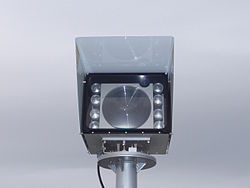
FSO (short for English free-space optics - free space optics, also English wireless optics , WO - wireless optics; Russian atmospheric optical communication line , abbreviated AOLS ) - a type of optical communication using electromagnetic waves of the optical range (as typically infrared ) transmitted through the atmosphere. In English, the term also includes transmission through vacuum or outer space.
Content
- 1 History
- 2 Principle of work
- 3 Application
- 4 In space technology
- 5 Market conditions
- 6 Synergy of wireless optical and radio technologies
- 7 See also
- 8 Notes
- 9 Literature
- 10 Links
History
In 1880, Bell patented a phototelephone ( Photophone ), in which the sunbeam reflected from the mirror was modulated by voice, transmitted through atmospheric space and transmitted to a solid selenium cell [1] .
Principle of Operation
Wireless optical systems are based on technologies for organizing high-speed communication channels through infrared radiation, which make it possible to transfer data (text, sound, graphic data) between objects through atmospheric space, providing an optical connection without the use of fiberglass.
Laser communication of two objects is carried out only through a point-to-point connection. The technology is based on the transmission of data by modulated radiation in the infrared part of the spectrum through the atmosphere. The transmitter is a powerful semiconductor laser diode . The information enters the transceiver module, in which it is encoded by various noise-resistant codes, modulated by an optical laser emitter and focused by the optical system of the transmitter into a narrow collimated laser beam and transmitted to the atmosphere.
On the receiving side, the optical system focuses the optical signal on a highly sensitive photodiode (or avalanche photodiode ), which converts the optical beam into an electrical signal. Moreover, the higher the frequency (up to 1.5 GHz), the greater the amount of information transmitted. Then the signal is demodulated and converted into signals of the output interface.
The wavelength in most implemented systems varies between 700–950 nm or 1550 nm, depending on the laser diode used.
The key principle of AOLS is based on a compromise: the longer the downtime due to adverse weather conditions (fogs) the customer allows, the longer the communication channel.
Sometimes AOLS includes a backup radio channel [2] .
Application
Wireless optics is considered as a solution:
- on sections of the last mile in urban areas (for communication between high-rise buildings, business centers and network nodes);
- for organizing communications from operator’s communication nodes to base stations of cellular networks with large volumes of transmitted digital traffic (3G, LTE);
- for communication of objects when cable laying is impossible (industrial zone, highlands, railway) or the cost of this laying is high;
- as a temporary communication channel, as well as in cases where it is urgent to organize a communication channel (hot reserve);
- when a closed communication channel is required that is immune to radio interference and does not create them (airports, proximity of radars, power lines);
- if necessary, reduce delays [3] compared with cable lines.
In space technology
Currently, the optical (laser) signal has been successfully transmitted over a distance of several hundred thousand kilometers. In particular, a record achievement in this sense is the reception of a laser signal from the MESSENGER automatic station. The signal from an onboard laser emitter (infrared diode neodymium laser) was successfully received by an earth receiver at a distance of 24 million km.
Market Status
The best-known manufacturers of FSO systems are: LightPointe Communications Inc. (USA), fSona Communications Corp. (Canada), “Optical TeleSystems” (laser modems “Lantastica TZR”, St. Petersburg); "Bridge" , (Artolink systems, Ryazan) ;.
Synergy of Wireless Optical and Radio Technologies
The most promising direction for the development of AOLS is the combination of atmospheric communication with a radio relay communication system. By combining the capabilities of infrared systems when working in heavy rain and radio systems in heavy fog, it allows you to create gigabit wireless point-to-point connections at distances of up to 3 kilometers with an operator accessibility of 99.999%. At the same time, 97–99% of the time in a year, data is transported through the AOLS (FSO) system, which is resistant to radio interference and does not create them, and in the remaining 1-3% of the time, the transport is provided by a millimeter-wave system. In addition to high availability, this combination allows you to build a system with duplicate channels.
See also
- Optical telegraph
- Infrared channel
Notes
- ↑ Bell's Speech Archived November 13, 2004 on the Wayback Machine in front of the American Association for the Advancement of Science in Boston on August 27, 1888
- ↑ Hybrid equipment based on radio and laser technologies / FIRST MILA # 1/2007
- ↑ Archived copy (inaccessible link) . Date of treatment September 13, 2016. Archived July 6, 2016. Low latency data transmission using wireless and wired communications / Proc. International Conference on Space Optical Systems and Applications (ICSOS) 2012, 9-1, Ajaccio, Corsica, France, October 9-12 (2012) “In free space optic wireless (FSO) systems, signals can propagate with the speed c, so that the latency would be smaller than in optical fiber communication (OFC) systems »
Literature
- Free-Space Optics: Propagation and Communication. - ISBN 978-1-905209-02-6 .
- Free Space Optics: Enabling Optical Connectivity in Today's Networks. - ISBN 067232248X .
Links
- Using FSO atmospheric optical link in data networks
- 4.5 kilometers of FSO connection with operator reliability. Practical results // "Technologies and means of communication" # 6/2008