SEIS ( Seismic Experiment for Interior Structure , from English - “Seismic experiment of internal structure”) [2] is a French seismometer and the main scientific instrument installed on the InSight spacecraft. Developed by the National Space Research Center (CNES). It is expected that SEIS will carry out seismic measurements on Mars , which will allow a better understanding of its internal structure. Analyzing the passage of seismic waves through the shell of Mars, the researchers hope to determine the depth and composition of each of its layers [3] .
| Seismic Experiment for Interior Structure | |
|---|---|
 Testing apparatus | |
| Manufacturer |  CNES CNES |
| Operator |  NASA NASA |
| Tasks | seismic activity data collection on Mars |
| Launch | May 5, 2018 , 11:05 UTC [1] |
| Landing on a celestial body | November 26, 2018 , 19:52:59 UTC [1] |
On April 6, 2019, a seismometer recorded for the first time in history a marsh shake [3] . Three more signals were recorded on other days - March 14, April 10 and 11. But they were even weaker. However, they may also be of seismic origin [4] .
Device
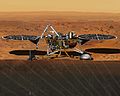
Artistic representation of the SEIS seismograph, deployed on the Martian surface (right). On the left is the HP 3 tool penetrating the surface.

Sectional illustration showing the internal components of SEIS.

Notes
- ↑ 1 2 mars.nasa.gov. Quick Facts | Mission (eng.) . NASA's InSight Mars Lander. The appeal date is April 26, 2019.
- ↑ Dmitry Erusalimsky. The eerie sounds of the first "marsh tremor" Were published . Moskovsky Komsomolets . The appeal date is April 26, 2019.
- ↑ 1 2 The French seismometer recorded the first marshaking Unopened . Tass The appeal date is April 26, 2019.
- ↑ InSight discovered “Marshake” for the first time in history , April 24, 2019