Elli ( Greek Κ / Δ Έλλη ), originally Fei Hong , was an armored cruiser of the Chao Ho type, which was in the first half of the 20th century in service with the Greek fleet. In Greek historiography, it is classified as a light cruiser . Named after the victory of the Greek fleet over the Turkish at Cape Ellie in the First Balkan War . He participated in the First World War . Cruiser Ellie was sunk by an Italian submarine in peacetime, August 15, 1940, which became one of the main topics of Greek military propaganda in the ensuing Greek-Italian war .
| Ellie | |
|---|---|
| Κ / Δ Έλλη | |
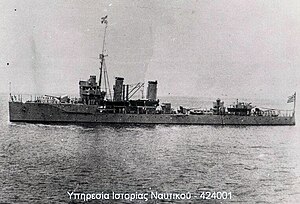 Light cruiser Ellie | |
| Service | |
 Greece Greece | |
| Class and type of vessel | armored cruiser type "Chao Ho |
| Organization | Royal Navy of Greece |
| Manufacturer | USA |
| Construction started | June 14, 1911 |
| Launched | May 9, 1912 |
| Commissioned | 1914 |
| Withdrawn from the fleet | 1940 |
| Status | Sunk on August 15, 1940 |
| Main characteristics | |
| Displacement | 2115 t |
| Length | 98 m |
| Width | 12 m |
| Draft | 4.3 m |
| Reservation | deck: 19-25 mm |
| Engines | 3 steam turbines |
| Power | 8000 h.p. |
| Mover | 3 screws |
| Speed | 21.5 knots |
| Sailing range | 7,000 miles at 10 knots |
| Crew | 232 |
| Armament | |
| Artillery | 3 x 152 mm 2 x 66 mm |
| Flak | 3 x 40 mm Vickers Mk 2 guns |
| Mine torpedo armament | 2 × 19-inch torpedo tubes max 100 min |
Content
- 1 Ship Construction - Inclusion in the Greek Navy
- 2 During the First World War
- 3 Period of the Asia Minor Campaign
- 4 On the eve of World War II
- 5 Drowning of the Cruiser Ellie
- 6 Subsequently
- 7 After the war
- 8 today
- 9 notes
Ship Construction - Incorporation into the Greek Navy
The ship was ordered to the United States by the Chinese government in 1911, under the name Fei Hong , being the third and last in the series ship of this type ( Cruiser type "Chao-Ho" ). However, after the Xinhai revolution of 1912-13, the Chinese government interrupted the order. On the eve of World War I , on June 30, 1914, Greece hastily purchased the battleships Lemnos and Kilkis built in 1905 in the USA. Despite its low-speed (max. 17 knots) and a small freeboard [1] for the ocean, battleships were a significant replenishment for the Greek fleet. At the same time, the Greek government purchased the last of the Chao-Ho type light cruisers in the USA, which the Chinese refused, and the construction of which the American firm New York Shipbuilding completed in late 1913 - early 1914 . The cruiser was named "Ellie", in honor of the victory of the Greek fleet over the Turkish in the First Balkan War.
During World War I
With the outbreak of World War II, the confrontation between Greek Prime Minister E. Venizelos , who called for the country's entry into the war on the side of the Entente, and King Germany, who was oriented towards Germany, who insisted on neutrality, led to a national split . On September 16, 1916, Venizelos and former fleet commander Admiral Pavlos Kunturiiotis formed the revolutionary Entente of the National Defense in the Macedonian capital of Thessaloniki, the friendly Entente [2] , while the Entente considered the government in Athens to be at least unfriendly. The French government ordered Admiral Dartizh du Fournier ( Louis Dartige du Fournet , (1856-1940) occupy Piraeus , demand the expulsion of the German ambassador from Athens [2] and occupy the base of the royal Greek fleet in Salamis [2] October 25 ( November 7 ), in an atmosphere of split the Greek fleet and the lack of clear orders from the king, the French fleet occupied Salamis almost without problems.The French confiscated and mobilized almost all the ships of the Greek so-called “light fleet” under the French flag and with French crews (light cruiser Ellie, 14 destroyers, 5 destroyers). As you unfold Greek x divisions on the Macedonian Front , the Allies began to return the confiscated ships to the Greek Navy in 1917. Almost all ships, including the cruiser Ellie, were returned. Immediately after the end of World War I, French Prime Minister Georges Clemenceau asked E. Venizelos to send Greek troops to the south of Russia, in support of the French units landed there and the “White Movement.” Venizelos responded positively, proposing a whole corps of the small Greek army in 3 divisions, that is, forces exceeding the French Kie. The proposal was made in exchange for supporting the territorial claims of Greece in East Thrace and Asia Minor , which retained their native Greek population in the territory [2] . As for the fleet, at the end of 1918 the Greek fleet had 19 ships, whose size and autonomy allowed them to operate in the Black Sea: 13 ships took part in the Ukrainian campaign of the Greek army , 6 were not used, including the cruiser Ellie, due to technical unavailability.
The Asia Minor Campaign Period
At the beginning of 1920, in France, on the cruiser Ellie, simultaneously with the flagship of the fleet, the armored cruiser Georgios Averof , modernization work was carried out. Ellie has acquired modern air defense weapons and equipment for transporting and laying up to 100 sea mines . Meanwhile, since 1919, Greece was involved by the Allies in the Asia Minor Campaign . However, since November 1920, when King Constantine again came to power in Greece, Italy, and then France, they began to openly support the Turks. Throughout the three years of the Asia Minor campaign, the main task of the Greek fleet was to block the coast of Asia Minor, in order to prevent the supply of Kemalists forces with weapons, ammunition and other supplies. In one of the most famous episodes of this blockade, the cruiser "Ellie" Greek pilot (Psarudakis), who landed his plane in the fog in the Italian zone of occupation, was imprisoned by Italians until the end of the war. However, from the prison, Psarudakis managed to transmit information to the Ministry of Athens in Athens that new Italian planes would be delivered to the Turks on an Italian ship. The Ellie cruiser was sent to intercept. During the inspection, 8 new Italian fighters of the Ansaldo A-1 Balilla type were found and confiscated, which were delivered to Tata near Athens. Monarchist rule and geopolitical change ultimately led to the Asia Minor catastrophe . The Greek army left Asia Minor . August 26 / September 7, the squadron in Smyrna, consisting of the battleships Lemnos and Kilkis , the cruiser Ellie, the destroyers Aspis and Sfendoni , and the auxiliary cruiser Naxos, under the command of Rear Admiral G. Kalamidas , was ordered to leave the city. The battleships were the first to leave, followed by the Ellis and destroyers. The last was the Naxos. With the departure of the Greek squadron from Smyrna, the orchestras of the Italian battleship Cayo Duilio and the French cruisers Waldeck-Rousseau and Ernest Renan , respecting allied military etiquette, performed the Greek national anthem, which in Greek historiography and today's journalism, at best, causes bitter irony [3] .
Without leaving Smyrna Bay, the squadron anchored off the coast of the Vourla Eritrean Peninsula at night. That same night, the captain of the battleship Kilkis, I. Theofanidis was ordered to lead the squadron, which, in addition to his battleship, included Ellie and the destroyers Aspis and Velos . The task of the squadron was the fire support of units leaving from Smyrna to Cesme. The operation began on August 27 / September 8 and ended on September 3/16. The remaining ships of the fleet performed a similar task in other regions of Ionia. In particular, with the fire support of the Tetis destroyer , it became possible to evacuate from the Dikili to Lesbos on the steamers Ionia and Etolia the heroic Separate Division , and 3,000 refugees who came to the coast with the division [4] .
The vanguard of the Turkish army entered Smyrna on August 28 / September 9, after which this predominantly Christian city was burned down by the Turks, and the Christian population was massacred . It is noteworthy that in this last period of the Asia Minor campaign, under the command of Captain P. Ioannidis to Elli, the future king of Greece, Prince Paul , served.
On the eve of World War II
Greece's meager financial resources did not allow a significant increase in naval forces. Researcher Dimitris Halon believes that to a large extent the limitation of the pre-war financial opportunities of the Greek state was due to the fact that after 1922 Greece was forced to shelter 1.25 million refugees from Asia Minor and East Thrace and that this problem remained acute until the outbreak of World War II [ 5] . The country was forced to limit the purchase of expensive new ships, the composition of the fleet for the most part remained unchanged from the First World War, and a few subsidies were directed to the fortification program, supplying the fleet ships with the necessary ammunition
Despite the fact that the Greek merchant fleet was already involved in the outbreak of war , through the Anglo-Greek War Trade Agreement signed in January 1940, the government of General Metaxas declared his neutrality and tried to keep Greece out of the war. Numerous Italian provocations on the eve of the war were either hushed up or attributed to "unknown" planes and ships. On July 12, 1940, 3 Italian planes bombed and machine-gun fire at the Orion auxiliary vessel when it serviced the lighthouse on Gramvousa Island. Hurrying to the rescue of Orion, the destroyer Idra was also bombarded in Greek territorial waters [6] .
The Orion, whose shape resembled a tanker, was attacked 2 more times over the next 2 months [6] . On July 31, 1940, an Italian plane dropped 4 bombs on 2 Greek destroyers stationed in Navpakta , but did not hit its targets [6] . On August 2, an Italian plane dropped 6 bombs on an A-6 boat of Greek customs in the Gulf of Corinth [6] .
Drowning Cruiser Ellie
The culmination of Italian provocations and challenges came on August 15, 1940. On this day, Orthodox Greece celebrates the Assumption of the Virgin and the main celebration takes place on the island of Tinos , in the Church of the Annunciation . By tradition, the Navy sent a ship to the island, the crew of which was an honor guard when carrying out the miraculous icon of the Virgin. In 1940, this honor was granted to the old cruiser Ellie, who anchored in the Tinos raid. It was on this day, in peacetime, that the Italian submarine Delphino attacked Elli in the Tinos raid. Three torpedoes were fired against the Ellie, one of which hit a cruiser in the vicinity of the boiler room, which caused a fire and sinking of the ship. Killed nine junior officers and sailors, 24 were injured. The Italian submarine also attempted to torpedo the Elsie and Esperos passenger ships, but the torpedoes launched on them only damaged part of the berth.
Torpedoing and drowning at the pier, in peacetime, the "unidentified" submarine of the old cruiser, was, in the expression (after the war) of the Italian ambassador in Athens, Emmannuel Grazzi, a "heinous action" against a non-military ship [6] .
Grazzi writes that "there was not even the slightest doubt in the soul of the Greek people" about who committed this act and that the result of the "crime on Tinos" was "an almost miraculous unification of the Greek people", previously divided by political passions [6] .
Subsequently
The fragments of the torpedoes were raised, and fleet experts unequivocally determined that these were Italian torpedoes. However, the Greek government, trying to avoid a war with Italy, continued to claim that it was a submarine of unknown nationality.
But to avoid the war failed. The Greek-Italian war began 2 months later, on October 28th. The nationality of the submarine that drowned Elli in peacetime and on the day of the Orthodox holiday was now not only not hushed up, but became one of the main aspects of Greek military propaganda, playing on the offended religious feelings of Orthodox Greece and feelings of retribution for treachery in peacetime. In the last shots of S. Polenakis, a small propaganda animated animated film that became famous during the war, the Muse of History throws Mussolini into the sea, he goes to the bottom and sits his ass on the mast of the cruiser "Ellie" [7] .
After the war
After the war, Italy paid reparations for damage to Greece during the years of the country's occupation. Compensation for the Elli sunk before the start of the war was considered separately. In 1950, in compensation for the Ellie, Italy transferred the cruiser Eugenio di Savoy , which also received the name Ellie (Κ / Δ Έλλη II), to the Greek Navy. "Ellie II" was withdrawn from the Greek fleet in 1973.
Today
In 1982, the Greek fleet received in Holland a frigate "Ellie" of the Cortenar type , which marked the beginning of a series of frigates of this type that are part of the Greek fleet to this (2019) day.
- On the Tinos embankment there is a monument to the sailors of the cruiser Elli who died in peacetime.
- Every year, on August 15, the Virgin is celebrated on the island of Tinos . Along with church festivals, the ceremonial in memory of the cruiser "Ellie" was established. Representatives of the government and fleet command drop a wreath from a warship at the site of the death of the cruiser, "into the sea grave of Ellie." Most often this happens with the frigate "Ellie" [8] [9] .
Notes
- ↑ Πολεμικό Ναυτικό - Επίσημη Ιστοσελίδα - Κιλκίς ΒΒ-23 (1914-1931)
- ↑ 1 2 3 4 Τριαντάφυλος Α. Γεροζήσης, Το Σώμα των αξιωματικών και η θέση του στη σύγχρονη Ελληνική κοινωνία (1821-1975), εκδ. Δωδώνη, ISBN 960-248-794-1
- ↑ Μικρα Ασια - Οταν Η Καρδια Σπαραζει Και Δεν Ξεχνα | Filonas.Gr
- ↑ http://www.army.gr/files/File/epitheorisi/200904_merarxia.pdf
- ↑ Historisches Marinearchiv - Griechische Schiffsverluste im 2. Weltkrieg (link not available)
- ↑ 1 2 3 4 5 6 Ο Γκράτσι γράφει, εκδ. Παπαζήση 2008, ISBN 978-960-02-2262-3
- ↑ https://www.youtube.com/watch?v=KeHco1EBhzs
- ↑ https://national-pride.org/2017/08/16/%CE%B5%CE%BF%CF%81%CF%84%CE%B1%CF%83%CE%BC%CF%8C% CF% 82-% CE% BA% CE% BF% CE% B9% CE% BC% CE% AE% CF% 83% CE% B5% CF% 89% CF% 82-% CE% B8% CE% B5% CE% BF% CF% 84% CF% 8C% CE% BA% CE% BF% CF% 85-77% CE% B7% CF% 82-% CE% B5% CF% 80% CE% B5 /
- ↑ http://www.real.gr/archive_koinonia/arthro/ebdominta_tria_xronia_apo_ti_bythisi_tou_katadromikou_elli-273246/