Radio engineering troops of the Air Defense Forces of the USSR ( RTV Air Defense of the USSR ) - a branch of the Air Defense Forces of the Armed Forces of the USSR , performing radio technical support tasks for anti-aircraft missile forces and fighter aircraft in the USSR Air Defense Forces [1] .
| Radio engineering troops of the Air Defense Forces of the USSR | |
|---|---|
 Military insignia Radio Engineering Forces of the USSR Air Defense | |
| Years of existence | 1952–1992 |
| A country |  the USSR the USSR |
| Subordination | Commander of the Soviet Air Defense Forces |
| Enters into | Air Defense Forces |
| Type of | type of army |
| Includes | connections and parts |
| Function | radio engineering support of the Air Defense Forces of the country |
| Commanders | |
| Famous Commanders | See list |

1939
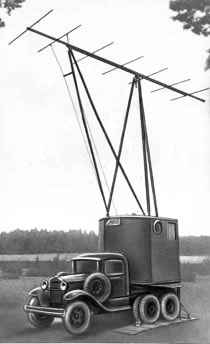
1940

In service since 1956

In service since 1959

In service since 1965

In service since 1971

In service since 1974
Content
History
Radio-technical troops lead their history from the Armed Forces Air Defense Forces (Airborne Monitoring, Alert and Communication Troops), which were established in April 1918 [1] .
Radiolocation in VNOS Troops
Initially, the VNOS Troops monitored the airspace by observing through optical instruments and listening through primitive sound amplifiers that captured the noise of aircraft engines. Since 1933, began scientific design work on the radar of aircraft.
In early 1934, a group of employees of the Central Radio Laboratory, headed by Yu. M. Korovin, carried out an experiment in which reflected radio signals from an airplane were recorded at a distance of 70 kilometers. In July of the same year, tests were carried out on the radio detection equipment of Rapid aircraft with a detection range of up to 3 kilometers.
By 1938, the first radar station in the world, the RUS-1 (code number “Reveny”) was created, which was tested in combat practice during the Soviet-Finnish war of 1939-1940 . The abbreviation "RUS" was disclosed as the "radio trap of aircraft."
By the autumn of 1939, the radar RUS-2 (code “Redut”) was created, which entered service in July 1940 and was widely used during the Great Patriotic War to detect German aircraft and target air defense fighters on them.
Organizationally, the Armed Forces Assemblies from December 1938 were subordinated to the Head of the Air Defense Directorate of the Red Army , and in the structure of military districts - to the deputy air force commanders for air defense .
During the Great Patriotic War, the formations of the radar RUS-2 were represented by separate radio engineering battalions as part of the air defense divisions and air defense corps .
At the end of World War II, the rapid development and perfection of radar stations left as unnecessary optical control and sound control devices for the airspace, which were gradually removed from the equipment of the VNOS Troops.
In April 1946, the Service of the Head of the Airborne Artillery of the National Defense Forces was created as part of the Headquarters of the Air Defense Forces of the country
On December 15, 1951, the USSR Council of Ministers entrusted the Ministry of War with the task of creating a unified radar system, which was supposed to reliably ensure the detection of air targets, warning and targeting of air defense weapons [2] [1] .
Creation of a kind of troops
On January 15, 1952, a directive of the USSR Military Minister was issued, according to which all the formations that had radar stations were combined with the service facilities of the VNOS Troops and on this basis the VNOS Radio Engineering Troops ( RTV VNOS ) were created.
June 30, 1954 was introduced the post of commander of the arm of the army - Head of Radio Troops VNOS . From this date, the radio engineering troops became an independent branch of the troops in the structure of the Air Defense Forces of the country. By the beginning of 1955, all visual observation posts in the states of VNOS units along the state border were replaced by radar units.
On April 17, 1956, the Radio Technical Forces VNOS were renamed the Air Defense Radio Engineering Forces of the Country ( RTV Air Defense System ) with the introduction of the corresponding position - the Head of the Radio Radio Technical Forces of the country .
By the end of the 1950s, the creation of three types of troops was completed in the Air Defense Forces of the country: Air Defense Aviation , Anti-aircraft Missile Forces, and Radio Engineering Troops [2] [1] .
Organizational structure of radio engineering troops
The organizational structure of the country's air defense RTV in the second half of the 1950s remained almost unchanged until the collapse of the USSR .
Radio engineering troops were represented by military units and formations that were part of the air defense divisions and air defense corps , which in turn were part of individual air defense armies (11 associations ) and air defense districts (Moscow and Baku). In 1986, of the two existing air defense districts, only the Moscow air defense district remained.
A special line in the USSR Air Defense Forces should be the only association of radio engineering troops that existed in its entire history, which was created in 1977 - this is the 3rd separate army of special-purpose missile attack warnings . This association carried out the task of over -the- horizon long-range radar detection of the launch and flight of strategic missiles of a potential enemy and the task of tracking space. This association, which was created in the country's air defense RTV, was withdrawn from its composition and was subordinate to the Command of the forces of anti-missile and anti-space defense .
Initially, in the 1950s, in each of the air defense divisions, in a single number, radio regiments were created, which consisted of 2 to 3 separate radio engineering battalions or from 6 to 10 separate radio engineering companies . Subsequently, in the 1970s and 1980s, some regiments were deployed to radio engineering brigades , which also in a single number were part of the air defense divisions and air defense corps. Brigades differed from the regiments in a large number of battalions (from 4 to 6). In total, 36 separate radio-technical brigades [3] and 29 radio-technical regiments [4] were in the last stage of the existence of the USSR Armed Forces as part of the country's air-defense system.
Also, radio engineering troops were represented by units in the state of military units and formations of anti-aircraft missile forces and air defense aviation. As part of each anti-aircraft missile battalion from an anti-aircraft missile brigade or anti-aircraft missile regiment, there was a radio engineering unit deploying a radar of various types [5] .
Western assessment of the characteristics of the USSR Air Defense Air Defense
According to Western experts, the RTV Air Defense of the USSR differed from similar troops in Western countries with the approach to the technical equipment of the troops.
The principal difference in the modernization of weapons was the maintenance of outdated radar types on combat duty. According to experts, the outdated early warning systems still complemented the radar coverage and created a reserve for more advanced models, which significantly complicated the air attack on a similar air defense system, because to accomplish the same goal, the aircraft of the potential enemy had to drown not one radar, but several that could work in different frequency bands of radio waves. This factor, in their opinion, made radio electronic warfare against the Soviet air defense system difficult.
Also, according to Western experts, the early shortcomings of the airborne radar systems of the air defense fighters made pilots extremely dependent on ground units of the radio engineering troops when hovering over an air enemy [6] .
Armament of air defense RTV USSR
The improvement of the weapons of the USSR Air Defense Radio Engineering Forces is divided into 4 stages, the first of which begins in the 1930s and belongs to the radar formations of the VNOS Troops.
First stage. 1938–1946
At the first stage, radar stations of the meter-high wavelength range RUS-1 (“Rhubarb”) arrived at the VNOS troops, which were multi-position and could detect the aircraft’s flight through the transmitter-receiver line. A total of 44 radar sets were produced.
In 1940, the first pulsed radar of the RUS-2, which had a range resolution and had two radar installation options (Redut on cars and Pegmatite on trailers), replaced. Radar RUS-2 became the main radar reconnaissance air enemy during the Great Patriotic War.
By 1944, a three-coordinate P-3A radar was developed, which could measure target height using a two-tier antenna and a goniometer.
The first stage is characterized by the initial development of radar stations [7] .
Second phase. 1946-1962
At this stage of development, the development of centimeter-range radar is typical.
The first models of centimeter radars were the P-50 Observatory introduced into the armament of VNOS troops in 1949 and the P-20 Periscope in 1951. In the radar, circular indicators appeared with a luminance mark and a sector one, the growth of the detection range and the height of target detection increased, the accuracy of radar measurements of coordinates increased. Systems of protection against passive interference, frequency tuning radar transmitters were created.
In 1956, the P-30 radar was adopted, and later, the P-35, P-37, 1L-118 Lira rangefinders, which, unlike their foreign counterparts, differed in ease of implementation and reliability at high tactical and technical characteristics.
Simultaneously with the centimeter range radar, the meter-range radar came into service. So in 1950, the P-8 was adopted, and in 1956, the P-10 and P-12.
Also at the second stage, the radar of intermediate decimeter range was put into service. In 1956, the P-15 was adopted for the low-altitude field, and the P-35 and PRV-10 range-range radar complexes of the range-altimeter radar. In 1962, the P-80 Altai Radar was adopted with the PRV-11 altimeter.
Of the powerful radar meter range in 1962, the P-14 meter range was adopted with a large-size mirror antenna.
In 1962, the first nationwide radar identification of “friend-foe” - “Silicon-2M” was introduced, which was installed on all radars [7] .
The third stage. 1962-1977
Since 1962, the third stage of weapons development begins, for which several factors are typical:
- an increase in the average power, modulation complexity, and an improvement in the coherence degree of the probing signals;
- improving the quality and growth of the size of the radar antenna systems;
- introduction of a complex of methods and technical means of protection against interference, including adaptive ones;
- development of a passive location system for active jammers;
- automation of the extraction, collection, processing and transmission of radar information.
During this period, radio engineering troops received over a certain period more advanced samples of radio altimeters:
- for high-altitude purposes - PRV-11 (1962), PRV-13 (1969), PRV-17 (1975)
- for low-altitude targets - PRV-9, PRV-16.
The main principle of operation of the radar station at the third stage was the complex (“RLDr + PRV”) - combining the work of the radio altimeter (PRV) and the radar rangefinder (RLDr).
The main radar complex (RLK) of the radio engineering troops was the RLK 5N87 adopted in 1972, which had a high range and height of target detection and had noise immunity. In the 1980s, the radio engineering troops received its upgraded modification of the RLK 64G6.
In 1969, on the basis of the P-14 radar, a special long-range radar P-70 Lena-M was created, for the first time a complex linear frequency-modulated (chirp) probing signal was used, thanks to which the radar obtained a high energy potential.
Also in the third period, in order to remove radar reconnaissance lines into the sea and ocean, a special-purpose radar Liana was created, which was installed on a Tu-126 aircraft, which made it possible to survey the airspace at a distance of up to 2000 kilometers from the coast.
For installation in remote areas, P-95 “Bug” and P-96 “Oskol” radars were created, which were installed for security with radio transparent cover for antennas [7] .
The fourth stage. 1977–1992
The fourth stage in the development of radar technology is due to new technical capabilities and increased requirements for informativity, noise immunity and survivability of the radar of the radio engineering troops.
These requirements became the reason for the rejection of the complexes in which radio altimeters and radar range finders operated together. For these reasons, we had to abandon the RLDR + PRV-type complexes and would again return to the three-axis circular radar. At the same time, another approach was chosen, which was to use multi-channel in the elevation plane.
In 1978, the three-coordinate decimeter range radar early warning 5H69 (ST-67) with an antenna of two large mirrors was put into service. In 1979, the three-coordinate radar low-altitude field 5N59 was mastered and in 1981 the 19J6 radar. These complexes were made with the widespread use of digital signal processing and radar information technology.
In 1978, for radio engineering troops in mountain positions, the Periscope-V radar 5U75 entered service. Its upgraded version 57U6 entered the army in 1984. These systems could be controlled remotely, had automatic control of the technical condition and digital filtering of signals.
In 1977, almost the entire digital equipment of the ground-based radar interrogator (NRZ) of its “own — someone else's” Password system was sent to equip the troops.
In 1982, the three-dimensional radar meter of the 55Zh6 Sky range was put into service.
In general terms, the fourth stage of the development of weapons of radio engineering troops is characterized by the difference from the previous stages by the level of technology and the fundamental possibilities it provides for building advanced radars [7] .
Commanders of the Air Defense Forces of the USSR RTV
- Lieutenant-General Moskovchenko Nikolai Nikolayevich - 1956-1961;
- Lieutenant-General Valentin Vasilievich Druzhinin - 1961-1966;
- Major General Georgy Alexandrovich Gichko - 1966-1969;
- Lieutenant-General Beregovoi Mikhail Timofeevich - 1969-1983;
- Lieutenant General Sechkin Nikolai Vladimirovich - 1983-1987;
- Lieutenant-General Dubrov Grigori Karpovich - 1987–1992.
See also
- USSR Air Defense Forces
Notes
- ↑ 1 2 3 4 Team of authors. article "Radio Engineering Troops" // Soviet Military Encyclopedia / Ed. Ogarkov N.V. - M .: Military Publishing , 1979. - T. 7. - p. 25. - 693 p. - 105 000 copies
- ↑ 1 2 Bedrov Yu. P., Knyazev A. S., Nerastenko A. A. Radio engineering troops: pages of history // “Aerospace Defense”: Monthly Journal. - M .: Design Bureau-1 Joint-Stock Company, 2015. - № 1 . - ISSN 2587-7992 .
- ↑ Radio technical brigades RTV Air Defense of the USSR on the historical site of Michael Holm
- ↑ Radio shelves RTV air defense of the USSR on the historical site of Michael Holm
- ↑ Feskov V.I., Golikov V.I., Kalashnikov K.A. Chapter 4. "The Air Force and the Air Defense Forces of the USSR" // "Soviet Army during the Cold War (1945-1991)". - Tomsk: Tomsk University Press, 2004. - p. 178-180. - 246 s. - 500 copies
- ↑ James D. Crabtree. On Air Defense (The Military Profession). - Westport : Praeger , 1994. - p. 113. - 256 p. - ISBN 9780275949396 .
- ↑ 1 2 3 4 Team of authors. Introduction // “Basics of building radar stations of radio engineering troops” (textbook) / Ed. Tyapkina V. N .. - Krasnoyarsk: Publisher SFU , 2011. - 536 p. - ISBN 978-5-7638-2480-3.