“Pinwheel” is the colloquial name for the closed system of party and government telephone communications in the USSR .
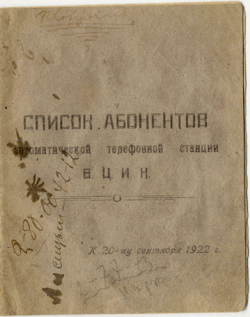


It was originally created at the direction of Vladimir Lenin as an internal telephone exchange of the Kremlin . It received the unofficial ( slang ) name “pinwheel”, because unlike a regular telephone network, where at that time the connection was through an operator, the subscribers connected to each other using a PBX and a disk dialer (“pinwheel”). In the future, the system expanded rapidly, and was also provided with access to other systems of government and military communications (the so-called “ HF ”), which were often also called by the people “turntable”. More precise are the names:
- ATS-1 (the most prestigious communication system for subscribers of the highest category - top government officials, ministers, deputy ministers);
- ATS-2 (a wider network of city government communications - for example, ATS-2 devices have directors of departments of federal ministries, heads and deputy heads of federal services and agencies).
The presence of a “turntable” was an important status indicator of belonging to the highest rank of posts in the Soviet nomenclature .
The regularly upgraded system of government telephone exchanges continues to operate to the present. As such, the “turntable” is not protected (intended for conducting secret negotiations), however, it is linked to other government systems of secure communication of long-term cryptographic strength, including mobile radiotelephone ( “Caucasus” ), etc.
Content
A Brief History of Turntables
- September 1918 - a 100-number switch CB-100/20 was installed in the telephone room of the Kremlin.
- 1922 - an automatic telephone exchange (VTSIK automatic telephone exchange) was installed in the Kremlin, the number of subscribers reached 300 people, some of the telephones were installed at the highest party and Soviet figures at home.
- 1947 - for the needs of GUO MGB the “Integral-Gradient” duplex mobile radio communication system (installed on cars) and the “Red Square” radio-mobile communication system (to provide radio communications for events on Red Square and other places) were created.
- 1948 - with the introduction of the urban telephone exchanges of the machine system, the capacity of the Kremlin office telephone network was increased by 1000 numbers.
- 1954 - the capacity of the government telephone exchange (PABX) in the Kremlin is 3,500 numbers due to the installation of switching equipment of a ten-step domestic production system for 1000 numbers, the 4-channel Ai-Petri-Pamir mobile radio communication system with information closure and radio range without retrieval of 50-60 km.
- 1960s : the countries of the socialist camp organized their networks of government communications, for which they were given stations and RF communications equipment and security equipment, codes for which were manufactured in the USSR and sent to their destinations by diplomatic mail.
- 1963 - a radio system on the Red Square "North" was developed and manufactured to communicate operational personnel during events on Red Square and in other places.
- 1967 - the “Dew” Duplex, radio-mobile, ultra-short-wave, unclassified communication system came into operation (in the late 1960s, time-sensitive classified equipment was installed in the vehicles of subscribers of the highest category).
- 1967 - 1968 - work was carried out to introduce “Coral” temporary security classification equipment and “Laguna” guaranteed resistance to the field network of government communications.
- 1968 - at the end of the year 184 settlements were included in the network of automatic telephone government communications.
- 1970s - in the government telephone networks, the transition to the use of telephones designed according to special requirements was made.
- 1978 - a dedicated city government automatic telephone system for the highest category of subscribers for 1000 numbers was commissioned, which received the name ATS-1, and the existing city government communications network (PABX) with a capacity of 5,000 numbers was renamed to ATS-2.
- 1979 - by a resolution of the Central Committee of the CPSU and the Council of Ministers of the USSR No. 558-183 of June 13, 1979, a new "Regulation on Government Communications" was approved, according to which government communications in the USSR were created:
- international;
- intercity;
- City: Moscow and the Moscow region, Leningrad and the Leningrad region (ATS Smolny ), etc .;
- with moving objects;
- field.
- 1980 - ATC-2 capacity was brought up to 6,000 telephone numbers.
- 1982 - on the basis of foreign quasi-electronic equipment, the capacity of ATS-1 was increased to 2000 numbers.
- 1983 - the domestic quasi-electronic station for the government communications network ATS-2 was commissioned in the Kremlin, and the capacity of the ATS-2 network was 7,000 numbers in Moscow and 10,000 numbers in the country (including zone stations).
- 1997 - about 300 cities and special facilities were covered by government communications, over 20 thousand subscribers were provided with telephone communications, more than 1600 authorities and various organizations were covered by documentary communications, and radio communication complexes with mobile facilities serving more than 3 thousand subscribers were operated in 79 cities.
Interesting Facts
- The telephone number of the “turntable” F.E. Dzerzhinsky is 007 .
- Since the 1970s, four-wire devices, usual from a circuitry point of view, have been used as “pinwheel” phones, the distinguishing feature of which is the emblem of the USSR on the dialer and increased protection against radio leakage (shielding of parts, graphite spraying inside the case).
- In the Soviet Union there was a strict rule, according to which only the owner of the device was obliged to answer the calls of ATS-1. In his absence, the special duty officer was supposed to pick up the phone with the words: "Comrade’ s name apparatus. " After the collapse of the USSR, the rules quickly began to recede into the past, ministers began to take out the ATS-2 and even the ATS-1 to the reception room. As a result, dial-up for government communications began to take up almost as much time as for regular urban communications, and the prestige of the “turntable” fell sharply. Restoration of strict rules began in 1996 by order of V. S. Chernomyrdin [1] .
- The Museum of Government Communications has been opened on the territory of the FSO Academy in Orel .
See also
- Spark 2
Notes
- ↑ “The burden of telephone responsibility was placed on officials” , Kommersant newspaper No. 69 dated 04/23/1996, p. 2