Theodoric I (about 485 - 533/534 ) - king of the Franks from the Merovingian dynasty in 511 - 533/534 . Rules in Reims and Metz (future Australia ). The eldest son of King Clovis I.
| Theodoric I | |||||||
|---|---|---|---|---|---|---|---|
| lat Theudoricus | |||||||
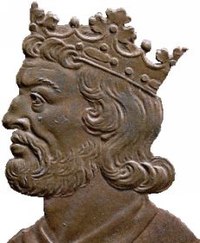 Image of Theodoric I with a bronze medal by Jean Dacier. Around 1720. | |||||||
| |||||||
| Predecessor | Clovis I | ||||||
| Successor | Theodebert I | ||||||
| Birth | about 485 | ||||||
| Death | 533/534 | ||||||
| Kind | Merovingians | ||||||
| Father | Clovis I | ||||||
| Mother | concubine | ||||||
| Spouse | 1st: Esther Visigoth 2nd: Suavegota | ||||||
| Children | From 1st marriage: son: Theodebert I From 2nd marriage: daughter: Theodekhilda | ||||||
Biography
Historical Sources
The main biographer of Theodoric I is Gregory of Tours , bishop of the city of Tour . And the chronicler Fredegar , who recorded his Chronicle in the 7th century , and the anonymous author of the Book of the History of the Franks , who lived in the 8th century , mostly repeat Gregory of Tours without making significant derogations from his text. Also, some information about Theodoric can be obtained from Vidukind Korveysky in his work “Acts of the Saxons”, in particular, it tells about the relationship of Theodoric with Thuringians and Saxons . The Quedlinburg Annals also narrate the same, but in a more concise form. The name Theodoric consists of two parts - the roots of theut (that is, “people”, “people”) and ric (which translates as “leader”, “king”); that is, "Theodoric" in Frankish means "King of the people . "
The Origin of Theodoric
Gregory of Tours [1] and other chroniclers [2] consider Theodorich’s mother, nowhere named by name, to be a concubine, although it is more likely that she was the daughter of one of the Frankish kings, most likely the king of the Ripuar francs with residence in Cologne Sigibert Lame . In the eyes of Christian priests and monks who wrote their chronicles in those days, a marriage that was not sanctified by the church was invalid, and therefore they call her a concubine, and her son Theodorich is recognized as illegitimate. However, judging by the fact that Theodorich, as the eldest son, received a share in his father’s inheritance almost greater than his half-brothers, he says that in the eyes of the Franks he was a completely legitimate son. Judging by the fact that it was Theodorich who got the lands of the Ripuar francs, his mother should belong to the ruling house of the kings of these Rhine francs .
Kingdom of Theodoric I
Theodorich, the only one of the sons of Clovis, had already reached adulthood during his father's lifetime and even commanded troops in the years 507-508 in the war against the Visigoths . Under his leadership, the Franks occupied Auvergne , and also captured the cities of Albi and Rodez [3] .
After the death of Hlodwig I in 511, the Frankish kingdom was divided into four parts between his sons: Theodorich, Chlodomyr , Hildebert I and Hlotare I [4] . Theodoric received about a third of the kingdom, and the rest of the land was divided into approximately equal parts between his brothers.
The kingdom of Theodoric included the following lands: the old Ripuar regions east of the Rhine , lands along the Rhine and Moselle , areas along the upper reaches of the Meuse with the cities of Tul and Verdun , as well as the districts of Basel , Chalon and Reims . The boundaries of the brothers' possessions in Aquitaine cannot be precisely determined. It is only known that Auvergne belonged to Theodorich. He also probably retained the cities of Albi and Rodez , captured by him during the war with the Visigoths. Its capital was first Reims , and then Metz .
Reflecting Dan Attack
During the reign of Theodorich, the people of the northern Danes seafarers attacked his state. Their king, Hohilaiich, sailed with his warriors up the Rhine and ravaged the Hattuari district. Theodorich’s son, Theodebert, came out with an army to meet the aliens and, after a successful battle, took their captured prey and prisoners from them. Khokhilaykh fell in battle [5] . This Khokhilaykh, about which Gregory of Tours talks, is undoubtedly identical to the Gaut king Higelak, mentioned in the Anglo-Saxon epic about Beowulf . It tells of the death of Higelac, who attacked the Franks with his squad and was defeated by them. Together with Higelak, his son Herdred died in battle. Unfortunately, in Beowulf there are no details about the Franks, Theodoric and his son Theodobert, who defeated the Danes.
Gregory of Tours, talking about this raid of Danes, as usual, does not give any dates. Most historians date this event to 515 . However, there is dating back to 521 , which seems preferable, since the son of King Theodebert, born about 503 , could hardly have controlled the reflection of the invasion at such a young age.
The War of Burgundy
In 524, Theodoric, together with his half-brother Khlodomir, waged war with the Burgundy king Godomar II , despite the fact that he was married to Godomar's niece. After Chlodomyr fell, fighting the Burgundians near Weserons , his siblings Hildebert I and Hlotar I killed two of his three young sons and divided his kingdom. Theodoric at first remained aloof from the massacre arranged by the brothers, but a little later he demanded his share in the legacy of the murdered brother and received the regions of Troyes , Sans , Auxerre and Limoges .
The Thuringian War
Since the beginning of the VI century, the expansionist aspirations of the Franks were directed primarily at the Thuringian state, whose possessions stretched from the Elbe to the Danube . However, during the life of the Ostrogothic king Theodorich the Great , on whose niece Amalaberge the king of Thuringians Hermenefred was married, Theodorich I of Frankus did not dare to openly attack the Thuringians, allied with the Ostrogoths [6] .
Thuringia at that time was divided between the brothers Hermenefred, Baderich and Bertahar . About what part of the kingdom of Thuringians each of the brothers owned, and in what dependence was one to the other - nothing is known. Meanwhile, Hermenefred in 525 killed his brother Bertahar and seized his possessions. Then in 529 the king of Thuringians made an alliance with Theodorich I against his other brother, Baderich, promising the king of the Franks half of his brother’s kingdom: “If you kill him, we will equally divide his kingdom . ” Theodorich went on a campaign, the defeated Baderich was killed and Theodorich returned to his kingdom. However, Hermenefred did not give him the promised, which caused the open hostility of Theodoric [7] .
Conquest of Thuringia
In 531, Theodoric I, remembering the treachery of the King of Thuring, Hermenefred , called for the help of his brother Chlothar I , and together they opposed the King of Thuring. In the battle near the Unstrut River, the Thuringians first managed to lure the Franks into an ambush. On the plain where the battle was supposed to take place, they dug ditches, covering them with turf with dense grass, creating the appearance of a flat field. When the battle began, many Frankish horsemen fell into these ditches. However, the Franks, taking advantage of numerical superiority, still defeated, and the Thuringians rushed to run to the Unstrut River. There was such a massacre of those fleeing that the riverbed was blocked by a pile of corpses. Franks over corpses crossed over like on a bridge to the other side [8] . The poet Venantius Fortunat dedicated a poem entitled “De excidio Thoringiae” (“On the Death of Thuringia”) to this beating of the Thuringians.
Germenefred fled to the Skiting fortress (modern Burgsheidungen ) [9] . However, then the kings of the Franks quarreled over the fact that Theodoric I planned to kill his brother Chlothar I. Secretly preparing armed men, he invited his brother to his place, allegedly for secret negotiations. Armed people were hiding behind the curtain, but Hlotar noticed their legs. Thus the conspiracy failed. Wanting to hush things up, Theodorich presented Hlothar with a large silver dish, but then, consumed by greed, sent his son Theodebert , who accompanied his father on the campaign, to pick up the dish back. Hlothar returned the dish, refused to continue the war and went home [8] .
Then Theodorich called for the help of the Saxons , and they sent him a 9,000th army. Together with them, he besieged Skiting , where Hermenefred took refuge with the remnants of his squad. The first assault did not bring victory to either side. Theodoric secretly entered into negotiations with the Saxons with Hermenefred and reached an agreement with him that the Thuringians recognize the supreme power of the kings of the Franks, and that both kings would attack the Saxons, which are dangerous for both of them. However, when the Saxons learned about the negotiations, on the night of October 1, 531, they suddenly attacked the fortress, captured it and killed most of the Thuringians there [10] .
Germenefred fled to remote areas of Thuringia , but then returned, believing the promises of Theodorich. The Frankish king showered him with gifts, but once, when they were talking on the fortress wall of the city of Tolbiac ( Zülpich ), someone pushed Hermenefred from the wall, he fell and was killed to death. Obviously, Theodorich’s cunning was not complete here [11] .
The Franks captured the whole of Thuringia , with the exception of the part of the kingdom that lay north of the Unstrut River, which was subdued by the Saxons . This was the end of the Kingdom of Thuringia [12] [13] [14] [15] .
Fight for Auvergne
In 531 , when King Theodorich was occupied on the other side of the Rhine by the Thuringian War, and even rumors spread of his death in this war, there was an uprising of the Gallo-Roman population of Auvergne against Theodorich. At the head of the rebels was Arkady, the grandson of the poet and writer of the late Roman Empire, Sidonius Apollinaria . Arkady wanted Auvergne to go to Hildebert I. Perhaps he and his associates hoped that Auvergne would be able to gain greater political independence during the struggle of both brothers. Be that as it may, Arkady hastened to send messengers to Paris , the capital of Hildebert, with an offer to seize the country. Hildebert gathered an army and set off immediately. He went to the foot of the mountain, on which stood the city of the Overnians, now Clermont , but found the gates locked. It seemed that the inhabitants were afraid to get caught if the rumor about Theodorich’s death turned out to be false, or maybe they were looking for an opportunity to completely free themselves from the power of the Franks. But Arkady, with the help of his supporters, broke the constipation of the gate and let the Franks in [16] . After the capture of the capital, the rest of the country was not slow to submit to Hildebert, but this submission was very precarious, and consisted of an oath to be faithful and to extradite several hostages.
While all this was arranged, the news came that Theodorich was returning victorious from the war against the Thuringians. With this news, Hildebert, leaving a weak garrison in the capital of Auvergne, hurried to Paris, fearing an attack on his own possessions. But two years passed, and King Theodorich made no attempt to return the cities that ceased to recognize his power over himself. The country remained formally subordinate to King Hildebert, but was ruled by the Gallo-Romans on his behalf, namely the party of Arcadius, who probably achieved all the honors that made up the purpose of his intrigues.
War of the Visigoths
In the early 530s, hostilities began between the Franks and the Visigoths . After the death of Clovis I, the Visigoths gradually expanded their territory north of the Pyrenees . In order to return the lost territories, the Frankish kings Theodoric and Hlotar sent their elder sons Theodebert and Guntar in 532 . Guntar reached Rodez and, for some unknown reason, turned back. Theodobert advanced to Beziers , captured the fortress of Dio and plundered it. Then he sent ambassadors to another fortress called Cabriere (Latin Capraria, lit. “Goat”) to tell the inhabitants that if they do not surrender, then this whole area will be put to fire and all those who remain there will be captured. And at that time there lived a matron named Deoteria , a very efficient and intelligent woman whose husband left home and died in the city of Beziers. She sent ambassadors to the king with recognition of the power of the Franks. Then Theodobert went to the fortress and entered it peacefully, and when he saw that the people had obeyed him, he did no harm there. And Deoteria came out to meet him, and when he saw that she was beautiful, he kindled with love and began to live with her [17] .
The Capture of Clermont
Meanwhile, Hlotar and Hildebert , on their return from Spain , intended to attack Burgundy ( 532 ). They invited Theodorich, but he refused. However, the Franks who obeyed him announced: "If you refuse to go to Burgundy with your brothers, then we will leave you and go after them . " Theodoric, remembering the infidelity of the inhabitants of Auvergne , answered them: "Let's go to Clermont , and I will bring you to a country where you will find gold and silver as you want, take herds, slaves and clothes in abundance . " And at the time when his brothers fought in Burgundy, Theodorich set out from his capital Metz on a campaign to Auvergne [18] .
As soon as the soldiers of King Theodorich stepped on the rich plains of the Lower Auvergne , they began to rob and destroy, sparing neither churches nor other holy places. Fruitful trees were cut down and houses devastated to the ground. The Franks finally besieged Clermont , whose inhabitants, seeing from the height of the walls robberies and fires in the vicinity, decided, under the guidance of their bishop Quintian, to resist to the last possible opportunity. But, in spite of all efforts, the inhabitants of Clermont could not stand long against the large and longing army for production: the city was taken and plundered. The king, in his anger, wanted to even the walls to the ground, but the next night after giving this order, Theodoric experienced a seizure of somnambulism during sleep; he got out of bed and, having run, not knowing where he was, was stopped by his guard, who urged him to shield himself with the sign of the Cross. This circumstance was enough to compel the king to mercy: he spared the city and prohibited the looting of 8 miles (12.8 km) in a circle; [19] True, when such a ban came out, there was nothing more to rob.
Ruin of Auvergne
Having taken possession of the capital of Auvergne , Theodorich began to attack in turn all the fortified places where the inhabitants locked themselves with everything that they had precious. He burned the castle of Tigern (now Tien ), Where there was a wooden church, burnt from the fire. In the impregnable fortress of Lovolotra (now Vollor ), where the Franks penetrated as a result of treason, they chopped it into pieces, at the foot of the altar itself, the priest Prokul, they destroyed the fortress, and took the inhabitants captive. The city of Brivat ( Briud ) was plundered, and the Church of St. Julian devastated, despite many miracles, the rumor of which, however, forced Theodoric to return part of the spoils and punish those soldiers who violated respect for the shrine. In Itsodore, the famous monastery was turned, according to contemporaries, into the desert. Marlac Castle (Merliak) resisted for a long time; this place was strengthened by nature itself: sheer cliffs surrounded it, and within its walls springs from the earth beat. The Franks were already desperate to take possession of this place, as an unexpected incident handed over to their hands the 50 men of the garrison who had gone out on the forage. They brought the bound prisoners to the fortifications of the city and let them know that they would kill them on the spot if the castle was not surrendered. Love for fellow countrymen and relatives prompted Merliak's defenders to open the gates and pay a ransom of one trience (a gold coin weighing 1.52 g) for each person captured [20] .
After hiding all the fortifications and dividing the spoils, long rows of carts and prisoners, surrounded by Frankish soldiers, stretched from Auvergne to the north of Gaul . People of all conditions, spiritual and secular, among whom there were especially many children, young men and girls, francs sold in all the places through which they passed. As for Arkady, whose treachery caused such a ruin for the country, at the first rumor of an invasion of the Franks, having left his mother Placidina and his father Altsimu to the mercy of fate in Clermont , he fled from the city and took refuge in Bourges , on the land of his patron Hildebert . Both women, after conquering the country by the Franks, were captured in the vicinity of the city of Cahors , deprived of their property and sentenced to exile [21] . Theodorich tried to establish peaceful relations with Hildebert and concluded a non-aggression agreement with him, supported by the transfer of numerous hostages from senatorial houses by both parties. However, despite this, conflicts could not be avoided, and the hostages became serfs [22] .
Leaving Clermont, Theodorich left in it to guard his relative Sigivald [20] . However, this Sigivald committed many atrocities there. Namely: he himself took property from different people, and his servants constantly committed thefts, murders, raids and various kinds of crimes; and no one in their presence dared to utter a hoot [23] . Annoyed by this, Theodoric killed Sigivald with his sword in 533 and secretly sent a letter to his son Theodebert , inviting him to kill Sigivald, the son of Sigivald, who was then at Theodobert. But Theodobert did not want to kill him, as he was the last godfather. But the letter sent to him by his father, he gave to read to Sigivald himself, and suggested that he run away, which Sigivald did, taking refuge in Italy [24] .
Suppression of the Munderich Rebellion
Meanwhile, a certain Munderich , who posed as a royal relative, gathered a crowd of supporters around him and declared himself king. According to The Life of St. Gundulf ( XII century ), this Munderich was the son of Chloderich , who killed at the instigation of Clovis I his father, King of the Ripuar Franks Sigibert Lame . After that, Clovis sent murderers who killed Chloderich himself, and appropriated his kingdom. Munderich, apparently at that time was at a young age and could not prevent this. Having reached maturity, he probably decided to win his kingdom from the son of Clovis Theodorich.
Theodorich sent an army to capture Munderich by force and punish him. Upon learning of this, Munderich, having no strength to defend himself, took refuge with all his property in the walls of Vitry fortress and tried to gain a foothold there with all those whom he persuaded to join him. Theodoric army, encircling the fortress, besieged it for seven days, however, it had no success. Then the king sent one of his people named Aregizil to Munderich with a promise to forgive the latter if he voluntarily surrendered. Aregizil, laying his hands on the sacred altar, vowed that Munderich would remain unharmed upon leaving the fortress. Поверив ему, Мундерих со своими людьми вышел за ворота, но тут же был атакован воинами Арегизила. Перед тем, как пасть в неравной битве, Мундерих и его люди сразили как самого Арегизила, так и многих из его солдат. Имущество Мундериха отошло казне [25] .
В целях налаживания добрососедских отношений, наметился брак между сыном Теодориха Теодебертом и дочерью короля лангобардов Вахо Визигардой [26] [27] .
Умер Теодорих после тяжелой болезни в конце 533 или начале 534 года , на 23-ем году своего правления [24] . Из всех сыновей Хлодвига Теодорих был самым деятельным и энергичным. История этого периода явила нам Теодориха и его сына Теодоберта более четко очерченными, чем сыновей Хлодвига от Клотильды . И не случайно Теодорих, кроме «Истории» Григория Турского , попадает также и в «Хронику» Фредегара и в «Историю саксов» Видукинда .
Жёны и дети
- предположительно, с 502 года [28] — предположительно, Эстер Вестготская , дочь Алариха II , короля вестготов . Она упоминается только в поздних генеалогиях (начиная с XVII века ), которые в качестве подтверждения её существования ссылаются исключительно на мнение историка начала этого века Обера ле Мира. К тому же, уже в XVIII веке это мнение подвергалось сомнению как не основанное на каких-либо достоверных источниках. Однако надо учесть тот факт, что сын Теодориха Теодеберт во время правления отца был уже взрослым мужчиной и никак не мог быть рождённым бургундской принцессой, на которой Теодорих женился уже в середине своего правления (приблизительно в 522 году). Значит, разумно предположить, что до брака с Суавеготой Бургундской у Теодориха уже была первая жена (или хотя бы наложница), которая и родила ему наследника престола Теодеберта. Известно также, что где-то около 502 года Хлодвиг I и Аларих II заключили договор о признании границ [29] , и очень даже вероятно, что этот договор был скреплён браком между старшим сыном Хлодвига и дочерью вестготского короля. Но к этому мнению надо относиться осторожно, так как оно не подтверждается данными первоисточников.
- Теодеберт I (около 503 — 548 ) — король Австразии
- предположительно, с 522 года [30] — предположительно, Суавегота Бургундская . Григорий Турский в своей « Истории франков » повествует, что Теодорих взял в жены дочь короля Бургундии Сигизмунда , однако не называет её по имени [31] . Всеобъемлющий справочник по генеалогии, так называемый Europäische Stammtafeln утверждает, что жену Теодориха звали Суавегота (ум. 566). Предположительно, это мнение основано на упоминании Суавеготы франкским историком и хронистом X века Флодоардом в « Истории Реймсской церкви ». Этот источник сообщает, что «королева Суавегота» завещала одну треть «ville Virisiaci» (совр. Верзи ) церкви Реймса во времена епископа Мапина , с правом присвоения доходов от него (так называемый узуфрукт ) в пользу «вышеупомянутой королевы дочери, Теодехильды» , добавляя, что последняя позже подтвердила пожертвование во времена епископа Эгидия . Идентификация королевы Суавеготы как жены короля Теодориха зависит от идентификации Теодехильды как их дочери, каковая идентификация остается до конца неопределенной. Поэтому не может быть окончательно установлена связь между Суавеготой, упоминаемой Флодоардом, и дочерью короля Бургундии Сигизмунда, упоминаемой Григорием Турским. Тем не менее, хронология соответствует такой связи; епископство Мапина датируется около 536—560 годов, а Эгидия — около 560—590. Ещё один факт, способствующий такому отождествлению, заключается в следующем: как известно, первой женой Сигизмунда была дочь короля остготов Теодориха Великого Острогота [32] . Наличие в именах Суавеготы и Остроготы одного корня «гота» , указывающего на их готское происхождение, вполне может подтверждать, что Суавегота была дочерью Сигизмунда и Остроготы.
- предположительно, дочь Теодехильда . Прокопий Кесарийский пишет, что «некий муж, по имени Гермегискл, правил варнами » и «он взял себе в законные жены сестру франкского короля Теодеберта, так как недавно у него умерла его прежняя жена» . Сын Гермегискла от первого брака Радигис позже, после смерти своего отца, женился на своей собственной мачехе. Впоследствии «он отпустил от себя сестру Теодеберта и женился на бриттийке » [33] . Сообщение Прокопия служит явным доказательством, что у Теодеберта была сестра, а у Теодориха, соответственно, дочь. Возможно, эту его дочь звали Теодехильда. Помимо «Истории Реймской Церкви» Флодоарда, где Теодехильда, как уже говорилось выше, названа дочерью королевы Суавеготы, имя Теодехильды упоминается также ещё в двух источниках. Венанций Фортунат в конце VI века написал эпитафию для «королевы Теодехильды» , сообщая, что «брат, отец, супруг, дед и предки» последней были «королевского происхождения» . Григорий Турский, в одной из своих малоизвестных работ, отмечает возвращение трибуна Нуннина из Оверни и прибытие в Осер «во времена … королевы Теодехильды» после того, как он отдал дань, которую собрал с франков, той же самой королеве. (Указание на Осер может предполагать, что Теодехильда, после того как она побывала замужем за двумя королями варнов, уехала жить в Бургундию , где в то время правил король Гунтрамн .)
Вероятно, что все эти три источника ссылаются на одну и ту же персону; единственное упоминание персоны с таким же именем для второй половины VI века относится к конкубине короля Хариберта I , которая была дочерью пастуха и вряд ли могла удостоиться у своих современников именоваться королевой. Немногие персоны были названы в современных им источниках королевами, что значительно ограничивает возможность случайных совпадений. Тем не менее, ни один из этих источников прямо не говорит, что Теодехильда была дочерью короля Теодориха. Однако, общее употребление корня «Теоде-» в первой части обоих имён может служить доводом в пользу близкого родства. Остается ещё одна возможная ниточка, чтобы отследить дальнейшее. Кристиан Сеттипани указывает, что её племянник, король Теодебальд, унаследовал престол в 547 году «при регентстве своей тёти Теодехильды» . Тем не менее, этот автор не приводит ссылок на источники, на которых он основывается. Следовательно, в настоящее время невозможно проверить, содержится ли в этих первоисточниках решающая связь между фразой «его тётя» и именем «Теодехильда» .
- предположительно, дочь Теодехильда . Прокопий Кесарийский пишет, что «некий муж, по имени Гермегискл, правил варнами » и «он взял себе в законные жены сестру франкского короля Теодеберта, так как недавно у него умерла его прежняя жена» . Сын Гермегискла от первого брака Радигис позже, после смерти своего отца, женился на своей собственной мачехе. Впоследствии «он отпустил от себя сестру Теодеберта и женился на бриттийке » [33] . Сообщение Прокопия служит явным доказательством, что у Теодеберта была сестра, а у Теодориха, соответственно, дочь. Возможно, эту его дочь звали Теодехильда. Помимо «Истории Реймской Церкви» Флодоарда, где Теодехильда, как уже говорилось выше, названа дочерью королевы Суавеготы, имя Теодехильды упоминается также ещё в двух источниках. Венанций Фортунат в конце VI века написал эпитафию для «королевы Теодехильды» , сообщая, что «брат, отец, супруг, дед и предки» последней были «королевского происхождения» . Григорий Турский, в одной из своих малоизвестных работ, отмечает возвращение трибуна Нуннина из Оверни и прибытие в Осер «во времена … королевы Теодехильды» после того, как он отдал дань, которую собрал с франков, той же самой королеве. (Указание на Осер может предполагать, что Теодехильда, после того как она побывала замужем за двумя королями варнов, уехала жить в Бургундию , где в то время правил король Гунтрамн .)
| Династия Меровингов | ||
| Predecessor: Хлодвиг I | король Австразии 511 — 533 / 534 | Successor: Теодеберт I |
Notes
- ↑ Григорий Турский . History of the Franks, Prince II , 28.
- ↑ Видукинд Корвейский . Деяния саксов, кн. I, 9. , Кведлинбургские анналы
- ↑ Григорий Турский . History of the Franks, Prince II , 37.
- ↑ Григорий Турский . History of the Franks, Prince III , 1.
- ↑ Григорий Турский . History of the Franks, Prince III , 3.
- ↑ Прокопий Кесарийский. Война с готами, кн. I, гл. 12 .
- ↑ Григорий Турский . History of the Franks, Prince III , 4.
- ↑ 1 2 Gregory of Tours . History of the Franks, Prince III , 7.
- ↑ Видукинд Корвейский . Деяния саксов, кн. I, 9.
- ↑ Видукинд Корвейский . Деяния саксов, кн. I, 9—12.
- ↑ Григорий Турский не называет имён убийц (III, 8); Фредегар в своей «Хронике» (III. 32) сообщает, что Герменефреда убил Теодоберт I, сын Теодориха. У Видукинда Корвейского (I, 10 — 13) описание конца жизни Герменефреда (Ирминфрида), короля тюрингов, и Теодориха (Тиадрика), короля франков , носит уже полулегендарный характер, как, впрочем, и весь рассказ о вторжении и упрочении саксов в области тюрингов . Используя народные предания и саги, Видукинд сообщает, что Ирминфрид после победы саксов, союзников франков, над тюрингами бежал, но Тиадрик решил хитростью вызвать его к себе. Ирингу, оруженосцу Ирминфрида, который находился тогда при Тиадрике, он велел убить Ирминфрида, пообещав ему богатые дары и власть в государстве, что тот и сделал. После этого Тиадрик приказал Ирингу удалиться прочь. Разгневанный Иринг пронзил мечом самого Тиадрика. Таким образом, эпизод о гибели Ирминфрида (Герменефреда) в устной народной традиции трансформировался, приобретя сказочный характер.
- ↑ Григорий Турский . History of the Franks, Prince III , 7, 8.
- ↑ Фредегар . Хроника, кн. III, 32.
- ↑ Книга истории франков , 22.
- ↑ Видукинд Корвейский . Деяния саксов, кн. I, 9-13.
- ↑ Григорий Турский . History of the Franks, Prince III , 9.
- ↑ Григорий Турский . History of the Franks, Prince III , 21—22.
- ↑ Григорий Турский . History of the Franks, Prince III , 11.
- ↑ Григорий Турский «Жития святых отцов», IV
- ↑ 1 2 Gregory of Tours . History of the Franks, Prince III , 13.
- ↑ Григорий Турский . History of the Franks, Prince III , 12.
- ↑ Григорий Турский . History of the Franks, Prince III , 15.
- ↑ Григорий Турский . History of the Franks, Prince III , 16.
- ↑ 1 2 Gregory of Tours . History of the Franks, Prince III , 23.
- ↑ Григорий Турский . History of the Franks, Prince III , 14.
- ↑ Григорий Турский . History of the Franks, Prince III , 20.
- ↑ Павел Диакон . История лангобардов, кн. I , ст. 21.
- ↑ Это примерная дата, существует разброс датировок у разных исследователей
- ↑ Григорий Турский . History of the Franks, Prince II , 35.
- ↑ Это примерная дата, также как предыдущая
- ↑ Григорий Турский . History of the Franks, Prince III , 5.
- ↑ Иордан. О происхождении и деянии гетов
- ↑ Прокопий Кесарийский. Война с готами, кн. IV, гл. 20.
Literature
- Gregory of Tours . History of the Franks = Historia Francorum . - M .: Nauka , 1987 .-- 464 p.
- Фредегар . Хроника / / The Fourth Book of the Cronicle of Fredegar with its continuations. — London: Thomas Nelson and Sons Ltd, 1960.
- Прокопий Кесарийский . Война с готами // Прокопий Кесарийский. Война с готами. О постройках / Пер. С. П. Кондратьев . — М. : Арктос, 1996. — 167 с. — ISBN 5-85551-143-X .
- Видукинд Корвейский . Деяния саксов, кн. I. — М. : Наука , 1975.
- Лебек С. Происхождение франков. V—IX века / Перевод В. Павлова. — М. : Скарабей, 1993. — Т. 1. — 352 с. — (Новая история средневековой Франции). - 50,000 copies. — ISBN 5-86507-001-0 .
- Кведлинбургские анналы (до 909 года) . Архивировано 25 августа 2011 года.
- Арзаканян М. Ц., Ревякин А. В., Уваров П. Ю. История Франции. - 1st ed. — М. : Дрофа, 2005. — 474 с. — ISBN 5-7107-6229-6 .
- Всемирная история. Энциклопедия . — М. : Государственное издательство политической литературы., 1957. (Средние века: Т.3)
- История средних веков. — 4-е изд. — М. : Издательство Московского университета «Высшая школа», 2003. — 640 с. — ISBN 5-211-04818-0 .
- История Франции. — М. , 1972—1973.
- Ле Гофф Ж. Цивилизация средневекового Запада . — Екатеринбург: У-Фактория, 2005. — 560 с. — ISBN 5-94799-388-0 .
- Chédeville А. La France au Moyen Age . Архивная копия от 26 сентября 2007 на Wayback Machine
- Lot F. La France. Des origines à la guerre de cent ans . — Paris: Librairie Gallimard, 1941. — 278 с.
- Lot F. Naissance de la France . — Paris: Librairie Arthème Fayard, 1948. — 864 с.
- Western Europe . // Rulers of the World. Chronological and genealogical tables on world history in 4 vols. / Compiled by V.V. Erlikhman . — Т. 2.
Links
- CLOVIS I 481/82—511, THEODERICH I 511—533, CHLODOMER 511—524, CHILDEBERT I 511—558, THEODEBERT I 533—547, THEODEBALD I 547—555 (англ.) . Foundation for Medieval Genealogy. Дата обращения 8 февраля 2012.
- Theuderich I von Frankenkoenig (нем.) . Genealogie Mittelalter: Mittelalterliche Genealogie im Deutschen Reich bis zum Ende der Staufer. Дата обращения 8 февраля 2012. Архивировано 8 февраля 2012 года.
- Генеалогическое древо Меровингов на «Хроносе»