Her Majesty's Royal West Surrey Regiment or literally the Royal Regiment of the Queen (West Surrey) ( English Queen's Royal Regiment (West Surrey) ) is a regiment of infantry of the English and British armies that existed in 1661-1959 [1] . The oldest regiment in the military history of England, which is the second oldest regiment after the Royal Scots regiment. In 1959, merged with the East Surrey Regiment into Her Majesty's one Royal Surrey Regiment , which on December 31, 1966 was combined, in turn, with the Royal Kent Regiment (Her Majesty's personal enthusiasts) , Royal Sussex Regiment and the Middlesex Regiment (personal duke of Cambridge) into a single Regiment of Her Majesty . In 1992, Her Majesty's regiment was merged with the Royal Hampshire Regiment to the Royal Regiment of the Princess of Wales (Her Majesty the Royal Hampshire) [2] .
| Her Majesty's Royal West Surrey Regiment | |
|---|---|
 Cockade of Her Majesty the Royal West Surrey Regiment | |
| Years of existence | 1661 - 1959 |
| A country |
|
| Subordination |  British army British army |
| Included in | Home Counties Brigade |
| Type of | infantry |
| Function | line infantry |
| Number | two regular battalions |
| Dislocation | Barracks Stouton Guildford |
| Nickname | Kirke's Lambs , Lamb Lancers ( The Mutton Lancers ) |
| Motto | Remember the valor of the fallen ( Latin Pristinae Virtutis Memor ); And defeat in victory ( lat.Vel Exuviae Triumphans ) |
| March | Fast : The Braganza Slow : Scipio |
| Participation in |
|
| Predecessor |  2nd West Surrey Infantry Regiment (name until 1881) 2nd West Surrey Infantry Regiment (name until 1881) |
| Successor | Her Majesty's Royal Surrey Regiment ; Her Majesty's Regiment ; Royal Regiment of the Princess of Wales |
| Site | queensroyalsurreys.org.uk |

Names
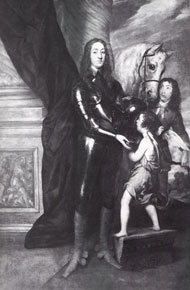
The regiment was formed in 1661 at Putney Heath by order of Henry Mordaunt, 2nd Earl of Peterborough and was named the Earl of Peterborough's Regiment of Foot Infantry Regiment ; how the Tangier Regiment was part of the garrison of the English Tangier, which was part of the dowry of Catherine of Bragan , who married King of England Charles II [3] . According to the traditions of those times, the regiment bore the name of its commander; from one of them, Percy Kirk , inherited the nickname "Lambs of Kirk" ( English Kirke's Lambs ) [4] .
In 1685, the regiment was granted the royal name of Her Majesty Dowager's Regiment of Foot ( Queen Dowager's Regiment of Foot ) in honor of Queen Catherine, the widow of Charles II, and since 1703, Her Majesty's Infantry Regiment ( English of The Queen's Royal Regiment of Foot ) [ 5] . Since 1715, it was called The Princess of Wales's Own Regiment of Foot ( Personal Princesses Regiment of Foot ) in honor of Carolina Ansbach , and after her coronation in 1727, as Queen, it was renamed Her Majesty's Personal Infantry Regiment ( English. The Queen's Own Regiment of Foot ). In 1747, after the approval of the regiment numbers, he became the 2nd Infantry Regiment, and from 1751 was called according to the Royal Decree the 2nd (Royal Her Majesty) Infantry Regiment ( English 2nd (The Queen's Royal) Regiment of Foot ) [6] .
In 1881, after the military reform of Hugh Childers, the regiment was renamed Her Majesty (Royal West Surrey Regiment) ( English The Queen's (Royal West Surrey Regiment) ), becoming a regiment of the western part of Surrey , and since 1921 it was called Her Majesty the Royal Regiment (West Surrey) ( English The Queen's Royal Regiment (West Surrey) ). In 1950, he already bore the name of the Royal Regiment of Her Majesty ( English The Queen's Royal Regiment ), and in 1959 merged with the East Surrey Regiment to the new regiment, Her Majesty's Royal Surrey Regiment [7] .
History
Early years
The regiment went to the English Tangier, where he remained until the port was evacuated in 1684 and returned to England. He participated in the suppression of the rebellion of Monmouth and in the battle of Sedgmoor , where he earned the glory of a bloodthirsty and cruel regiment [8] (however, historians believe that it was very hyped and exaggerated) [9] . After the Glorious Revolution, he swore allegiance to the new king William III , participating in the defense of Derry in 1689 and in the battle on the Boyne River in 1690 [10] ; in 1692-1666 he fought in Flanders during the Nine Years War , fighting under Landen and besieging Namur [11] .
During the Spanish Succession War, the regiment fought in Spain, participating in the battles of Cadiz and the Gulf of Vigo , besieging Valencia, Albuquerque, Alcantara and Ciudad Rodrigo. At the battle of Almans, the regiment was literally completely and completely destroyed [12] . In the Netherlands, in 1703, Tongeren was taken by the regiment in spite of all circumstances, which allowed Lord Overkirk to be regroup all forces until they were captured [13] . Thanks to these successful actions, the regiment was granted the title of “royal” and the motto. The regiment spent most of the 18th century in garrison services, participating in the suppression of Lord Gordon’s rebellion [14] .
Napoleonic Wars
The soldiers of the regiment were in the West Indies in the early days of the wars of the Revolutionary France and participated in the battles already as marines in the English fleet. In particular, Glorious is the first of June , when the soldiers of the regiment served as part of the crews of the Queen Charlotte (flagship), Russell , Defense , Royal George and Majestic [15] . In gratitude for the service in the Navy, the regiment was awarded the insignia - The Sea Crown with the signature "June 1, 1794" ( 1 June 1794 ) on the banner of the regiment [16] . Later, the regiment was sent to the West Indies, where he participated in the capture of Guadeloupe and Trinidad , however, yellow fever mowed down part of the personnel in Guadeloupe. In 1795, the 2nd battalion was formed, the base of which was first the island of Guernsey , and then Martinique ; it was disbanded in 1797, and personnel were included in the 1st battalion [17] . In 1798, the regiment suppressed an uprising in Ireland ; in 1799, it participated in a joint Anglo-Russian expedition to Holland , which ended in failure [18] . In 1800, he participated in an unsuccessful expedition to Ferrol [19] , after her failure, sailed to Egypt : he participated in the battle of Alexandria , repelled its siege and defended Fort Julien [20] .
The regiment also participated in a number of battles of the Iberian Wars : in particular, in the battles of Wimeira and Korunye [21] . After an unsuccessful expedition to Holland, the regiment returned to Spain and continued fighting against the French: in particular, it fought at Fuentes de Onioro besieged Ciudad Rodrigo , fought at Salamanca and unsuccessfully tried to take Burgos [22] . By the winter of 1812, the regiment suffered serious losses, both killed in battle and dead from disease, as a result of which four of its companies combined with the 2nd battalion of the 53rd Shropshire Infantry Regiment in the 2nd temporary battalion, and six companies went home to rest and recover. As part of the 4th division, a temporary battalion fought at the Battle of Vitoria on June 21, 1813, in which the troops of the Duke of Wellington defeated the French and drove them out of Spain. Also, the regiment besieged San Sebastian and fought with the French in 1814 under Ortez and under Toulouse [23] .
Victorian era
In 1839, at the very beginning of the first Anglo-Afghan war, the regiment carried garrison service in Balochistan . It was the core of the forces that stormed the city of Ghazni in the absence of heavy siege weapons and opened the road to Kabul . In November of the same year, the regiment returned to India, simultaneously taking Kalat . Miraculously, the regiment escaped a sad fate in 1842, when rebellious Afghans literally massacred the British garrison of Kabul and almost everyone who tried to escape from the city [24] .
In 1851, during the eighth war of the British against the scythe, the regiment was transferred to the Cape Colony . February 25, 1852 a detachment of 51 people under the command of the sailor Boyland was on the ship " Birkenhead ”, Which went from Simonstown to Port Elizabeth , but crashed on the rocks. Troops gathered on the deck to ensure the safety of women and children boarding lifeboats. The ship sank immediately after the evacuation of women and children: most of the soldiers drowned or died in the mouths of sharks. The heroic act of the personnel served as an example for the crews of other ships [25] . In 1857, the 1st battalion was recreated after the conversion of the 2nd battalion and went to China three years later to participate in the opium war , distinguishing itself in the third battle for the Dagu forts and in the capture of Beijing [26] .
In the 1870s, the regiment, which almost did not affect Cordwell’s reforms , was located in the Stouton barracks in Guildford (1873). Childers' reforms also sidestepped the regiment, so the regiment did not merge with another [27] - but from July 1, 1881 it was called Her Majesty (Royal West Surrey Regiment) [28] . In 1897-1898 he participated in the Tirah campaign in the North-West Frontier Province [29] .
The 1st battalion served in Malta from 1891, and then in India : until 1902 in Rawalpindi , after 1902 in Peshawar near the Khyber Pass on the border with Afghanistan [30] . The 2nd battalion participated in the Third Anglo-Burmese War in 1886–1888, served in South Africa in 1899–1904 and participated in the Second Boer War [31] . The 3rd militia battalion was created on the basis of the 2nd Surrey royal militia battalion (headquarters were located in Guildford ) and in December 1899, with 550 personnel, went to South Africa [32] , returning to Guildford in May 1902 and being honored solemn meeting in the city [33] .
As part of Hugh Childers' reforms, the regiment included two volunteer battalions formed in 1859 and 1860 in case of invasion of the British Isles [34] [35] . The 1st volunteer battalion was created on the basis of the 2nd Surrey Rifle Volunteer Corps (old barracks on Mitcham Road in Croydon ), the 2nd volunteer battalion was created on the basis of the 4th Surrey Rifle Volunteer Corps [36] [37] [38 ] ] [39] [40] [41] [42] . Both volunteer battalions were honored with military honors for participating in campaigns and battles [43] [44] .
In 1908, Secretary of Defense Richard Haldane conducted a series of reforms during which the militia was transformed into a Special Reserve, and the volunteer units became the Territorial Forces [45] [46] [47] . The battalion now included the 3rd battalion of the Special Reserve, the 4th battalion of the Territorial Forces (old barracks on Mitcham Road in Croydon) and the 5th battalion on the Sandfield terrace in Guildford (demolished) [1] [38] [39] .
World War I
Regular troops
The 1st Battalion arrived in Le Havre as part of the 3rd Infantry Brigade 1st Infantry Division in August 1914 [48] and participated in the Battle of Mons , the first battle on the Marne , the first battle on Ypres , the battle on the Ober Range , battle of Los , Battle of Fistuber , the breakthrough of the Hindenburg Line , the battle of Belcourt, the battle of Broadzainde , the massacre of Paschendale and the battle of Arras [49] . The 2nd Battalion arrived from South Africa in Seebrugge as part of the 22nd Infantry Brigade 7th Infantry Division in October 1914 [48] and participated in the Battle of Ypres, the Battle of Ober, the Battle of Festuber, the Battle of Loos and the Battle of the Somme until November 1917, after which he was sent to the Italian Front , where he participated in the Battle of the Piava and the battle of Vittorio Veneto [49] .
Territorial forces
1/4th battalion arrived in India in October 1914 as part of the 131st Surrey Infantry Brigade 44th Infantry Division and served in the North-West Frontier Province throughout the First World War [48] , and in 1919 he participated in the Third Anglo-Afghan War [39] [48] [50] [51] . With him, until December 1915, the 1/5th battalion, later sent to Mesopotamia, served in India [48] .
After sending territorial battalions of the 1st line, the formation of battalions of the 2nd and 3rd lines began - under the names of the 2nd / 4th, 2nd / 5th and so on. For training recruits, the 4th / 4th battalion was created, which was later combined with the 3rd / 5th into the 4th reserve battalion [39] [48] [52] [53] . The 2nd / 4th battalion participated in the Gallipoli campaign , fought in Egypt and Palestine as part of the 53rd Welsh Infantry Division , and then fought on the Western Front of World War I as part of the 34th Infantry Division under the command of the French troops until November 1918 [39] [48] [54] [55] [56] . The 3/4th battalion has been at the front since August 1917 and fought in the 21st Infantry Division battling in the battles of Broadzainde and at Cambrai , and in February 1918 it was divided to prepare the reserve [39] [48] [57] . Also, the 19th and 20th territorial battalions were formed from the reserves of the Home Service [48]
New Army
As part of the Kitchener Army The following battalions were formed: [48]
- 6th (service) battalion - 12th East Infantry Division , Western Front [58]
- 7th (service) battalion - 18th East Infantry Division , Western Front [59]
- 8th (service) battalion - 24th Infantry Division , Western Front [60]
- 9th (service) battalion - training of draftees
- Battersea 10th (service) battalion - formed in Battersea Borough of London, 41st Infantry Division , Western Front [61]
- 11th (service) Lambeth Battalion - formed in the London Borough of Lambeth, 41st Infantry Division , Western Front [61]
- 12th (service) battalion - training of draftees
Other battalions
- 13th (service) battalion - on the Western Front
- 14th (service) battalion - on Thessaloniki front
- 15th (service) battalion - on the Western Front
- 16th (internal service) battalion - in the UK
- 17th (service) battalion - in the UK
- 18th (service) battalion - in the UK
In January 1919, a reception was arranged in Guildford for regiment soldiers who returned from captivity. Each was awarded the Welcome Home medal: on one side was a regiment cockade, on the other the signature “Welcome home to the captive soldiers of Her Majesty’s Regiment” ( eng. Prisoners of War The Queens Regiment Welcome Home ) with Roman numerals MCMXVIII (1918) year) [62] .
Interwar years
In the interwar years, the 1st battalion carried garrison service in the metropolis and in its colonies. The 2nd battalion participated in the Waziristan campaign to pacify the rebellious tribes who did not stop the armed struggle after the Third Anglo-Afghan War . He served in Mandatory Palestine and suppressed the Arab uprising that raged in 1936-1939 [63] . The 4th and 5th battalions were transferred to the Territorial Army As part of the 131st Surrey Infantry Brigade , along with the 5th and 6th battalions of the East Surrey Regiment . In the late 1930s, the 4th Battalion was transformed into the 63rd Her Majesty the Searchlight Regiment of the Royal Artillery [64] . Later, the regiment was divided into the 22nd and 24th battalions of the London regiment , which was disbanded in 1938, and then they became the 6th Bermondsey and 7th Southworth battalions of Her Majesty the Royal West Surrey Regiment and, together with the 5th battalion, entered to the 131st Surrey Infantry Brigade [65] .
World War II
Regular Army
The 1st battalion met the beginning of World War II in India , entered the battle in 1942 against the forces of the Imperial Army of Japan in the Burmese campaign as part of the 33rd Indian Infantry Brigade [66] , 7th Infantry Division , 14th Army - the latter was commanded by Lieutenant General William Slim [67] .
The 2nd Battalion was commanded by Lieutenant Colonel Robert Ross until April 1940: the battalion participated in battles in the Middle East, Syria and Lebanon , and then went to the Far East. The 2nd battalion was a member of the 16th Infantry Brigade 6th Infantry Division (later as part of the 70th Infantry Division ), participated in the fighting special forces of Chindites created by the team leader Orde Wingate [67] . Due to the losses incurred, the 2nd battalion was again transformed into a regular infantry battalion and received the nickname "Malicious infantry" ( English Poor Bloody Infantry ); He served as part of the 29th Infantry Brigade [68] 36th Infantry Division since May 1945 [69] .
Territorial Army
The 1/5th, 1/6th, and 1/7th battalions were battalions of the 1st line of the Territorial Army and were listed in the 131st Infantry Brigade The 44th Infantry Division of Home Counties - Divisions of the 1st line of the Territorial Army. The division was sent to France in 1940 as part of the British Expeditionary Force , where it participated in battles against the Germans and the subsequent evacuation from Dunkirk . After returning to England, the division was commanded by Major General Brian Horrocks for some time. In mid-1942, the division was sent to North Africa , where, as part of the 8th British Army, it fought under Alam al-Half and El Alamein . The 131st brigade participated in battles until the end of the war as part of the 7th Panzer Division [67] , fighting in Tunisia , Italy and Western Europe. In December 1944, due to heavy losses and a shortage of personnel, the 1 / 6th and 1 / 7th battalions were withdrawn from the 131st brigade, and they were replaced by the 2nd battalion of the Devonshire regiment and the 9th battalion of the Durham Light Infantry Regiment withdrawn from the 50th Northumbrian Infantry Division . The 1/6th and 1/7th battalions remained training units until the end of the war [70] . In January 1944, Victoria Cross was awarded the Lieutenant of the 1 / 6th Battalion Alec George Horwood who fought in Burma and served in the 1st Battalion of the Northamptonshire Regiment [71] .
The 2nd / 5th, 2nd / 6th and 2nd / 7th battalions were battalions of the 2nd line of the Territorial Army and were listed in the 35th Infantry Brigade 12th East Infantry Division - divisions of the 2nd line of the territorial army, reserve for the 44th infantry division of home counties. They participated in battles in France in 1940 and suffered huge losses due to lack of experience, as a result of which they were immediately evacuated from Dunkirk and disbanded upon their return to the UK. The 35th Brigade was later renamed the 169th (3rd London) Russian Infantry Brigade , which served in the 56th division until the end of the war. The team participated in the operation "Avalanche" (landing at Salerno), the Anzio-Nettun operation and the North Italian operation [72] .
Her Majesty's 63rd searchlight regiment (former 4th battalion of the West Surrey Regiment) was part of the British Air Defense Command during the Battle of Britain and air raids on London , then the Royal Air Force’s light air defense regiment was converted to Her Majesty’s 127th. He used the 40 mm Bofors L60 cannon to defend Mulberry harbor after landing in Normandy , and then provided the defense of Antwerp at the end of the war [73] [74] . During the war, other battalions were also formed to provide territorial defense or training of soldiers, but all of them did not leave the territory of Great Britain and supported military units already serving outside the country. So, in 1940, the 13th battalion was formed to replenish the personnel of the 80th reserve infantry division [75] . The 14th battalion appeared at the beginning of July 1940 in Dorchester [76] , Lieutenant Colonel Alexander Wilkinson became the commander of the battalion [77] , in October 1940, the battalion was introduced into the 201st Separate Infantry Brigade that guarded the coast. On December 1, 1941, the battalion was transformed into the 99th Royal Light Artillery Regiment (Air Defense Regiment), which served in Italy [78] .
After the war
In 1948, the 2nd Battalion was disbanded, the personnel of which transferred to the 1st Battalion, which was almost disbanded in 1947. The 1st battalion served in Berlin in 1949, then was transferred to Iserlohn as part of a group of British troops on the Rhine , to the 5th Infantry Brigade 23rd Infantry Division , which was listed until 1953. The 1st battalion participated in battles against the Malay National Liberation Army during the war in Malaya 1954-1957, after which he was transferred to Germany. In 1959, Her Majesty's 1st battalion of the Royal West Surrey Regiment merged with the 1st battalion of the East Surrey Regiment On the basis of which the 1st battalion of Her Majesty the Royal Surrey Regiment was created [7] .
Military Honors
According to British traditions, military honors are assigned to those units that have proved themselves in various battles, and represent the application of the symbolic name of the battle to the standard regiment. The following honors have been awarded to the West Surrey: [1]
- Tangier 1662-80, Namur 1695, Ushant, Egypt, Vimiera, Corunna, Salamanca, Vittoria, Pyrenees, Nivelle, Toulouse, Peninsula, Ghuznee 1839, Khelat, Affghanistan 1839, South Africa 1851-2-3, Taku Forts, Pekin 1860, Burma 1885-87, Tirah, Relief of Ladysmith, South Africa 1899-1902
- The Great War (25 battalions) : Mons, Retreat from Mons, Marne 1914 '18, Aisne 1914, Ypres 1914 '17 '18, Langemarck 1914, Gheluvelt, Aubers, Festubert 1915, Loos, Somme 1916 '18, Albert 1916 '18 , Bazentin, Delville Wood, Pozières, Guillemont, Flers-Courcelette, Morval, Thiepval, Le Transloy, Ancre Heights, Ancre 1916 '18, Arras 1917 '18, Scarpe 1917, Bullecourt, Messines 1917, Pilckem, Menin Road, Polygon Wood, Broodseinde, Passchendaele, Cambrai 1917 '18, St. Quentin, Bapaume 1918, Rosières, Avre, Villers Bretonneux, Lys, Hazebrouck, Bailleul, Kemmel, Soissonais Ourcq, Amiens, Hindenburg Line, Épéhy, St. Quentin Canal, Courtrai, Selle, Sambre, France and Flanders 1914-18, Piave, Vittorio Veneto, Italy 1917-18, Suvla, Landing at Suvla, Scimitar Hill, Gallipoli 1915, Rumani, Egypt 1915-16, Gaza, El Mughar, Jerusalem, Jericho, Tell 'Asur, Palestine 1917-18, Khan Baghdadi, Mesopotamia 1915-18, NW Frontier India 1916-17
- Afghanistan 1919
- The Second World War : Defense of Escaut, Villers Bocage, Mont Pincon, Lower Maas, Roer, North-West Europe 1940 '44-45, Syria 1941, Sidi Barrani, Tobruk 1941, Tobruk Sortie, Deir el Munassib, El Alamein, Advance on Tripoli, Medenine, Tunis, North Africa 1940-43, Salerno, Monte Stella, Scafati Bridge, Volturno Crossing, Monte Camino, Garigliano Crossing, Damiano, Anzio, Gothic Line, Gemmano Ridge, Senio Pocket, Senio Floodbank, Casa Fabri Bridge, Menate, Filo, Argenta Gap, Italy 1943-45, North Arakan, Kohima, Yenangyaung 1945, Sittang 1945, Chindits 1944, Burma 1943-45
- 4th, 5th Battalions : South Africa 1900-02
Victoria Cross Knights
- Lieutenant (later Brigadier General) Wallace Duffield Wright (expedition to Kano Sokoto)
- Captain (later Lieutenant General) Bernard Cyril Freiberg ( World War I )
- Junior Lieutenant (Captain) Clement Robertson ( World War I )
- Lance Corporal John William Sayer ( World War I )
- Captain (Lieutenant Colonel) Christopher Bushell ( World War I )
- Lt. Alec George Horwood ( World War II )
Regiment Commanders
- By the names of the commanders
- September 30, 1661: Henry Mordaunt, 2nd Earl of Peterborough [79]
- April 9, 1663: Andrew Rutherford, 1st Earl of Teviot [80]
- June 10, 1664: Henry Norwood [81]
- May 15, 1668: John Middleton, 1st Earl Middleton [82]
- March 5, 1675: William O'Brien, 2nd Earl of Inchuin [83]
- November 10, 1680: Sir Paulms Fairborn (died before assuming office) [84]
- April 19, 1682: Percy Kirk [85]
- December 18, 1691: William Selvin [86]
- June 28, 1701: Sir Henry Bellasis [87]
- Her Majesty's Royal Infantry Regiment (1703)
- February 27, 1703: David Collier, 1st Earl of Portmore [88]
- September 19, 1710: Percy Kirk [89]
- Her Majesty's Personal Infantry Regiment (1727)
- August 12, 1741: Thomas Fowk [90]
- 2nd (Her Majesty the Royal) Infantry Regiment (1751)
- November 12, 1755: John Fitzwilliam [91]
- November 27, 1760: Sir Charles Montagu [91]
- August 7, 1777: Daniel Jones [92]
- November 20, 1793: Alexander Stuart [93]
- December 20, 1794: James Coates [93]
- July 22, 1822: Sir Henry Torrens [94]
- August 25, 1828: Sir William Keppel [95]
- December 23, 1834: Sir James Kempt [96]
- August 7, 1846: Alexander George Fraser, 17th Lord Saltun [97]
- August 29, 1853: Sir John Rolt [98]
- November 9, 1856: Sir James Holmes Shedde [99]
- May 28, 1857: John Spink [100]
- March 15, 1877: Clement Alexander Edwards [101]
- March 25, 1877: Henry Smith [102]
- Her Majesties (Royal West Surrey Regiment) (1881)
- June 6, 1891: Robert Bruce [103]
- October 15, 1891: Frederick Green Wilkinson [104]
- August 29, 1893: Sir Edward Selby Smith [105]
- September 23, 1896: Granville George Chetwind-Stapilton [106]
- April 16, 1902: Sir Thomas Kelly-Kenny [107]
- December 27, 1914: Sir Edmund Owen Fisher Hamilton [108]
- October 13, 1920: Sir Charles Carmichael Monroe [109]
- Her Majesty's Royal (West Surrey) Regiment (1921)
- December 7, 1929: Sir Wilkinson Dent Bird [110]
- May 4, 1939: Sir Ivo Lucius Beresford Wacy [111]
- May 1, 1945: Sir George James Giffard [112]
- September 28, 1954: John Eldem Whitfield [113]
In Culture
- Near Guildford , on the Clendon Park Estate Surrey Infantry Museum was located . In April 2015, it burned down [114] .
- In the movie The King Says! ”In one of the final scenes, when George VI made his appeal about the entry of Great Britain into the war with Germany, the soldiers at the front, listening to the speech on the radio, are briefly shown. The soldiers wear a uniform with a cockade of Her Majesty the Royal West Surrey Regiment on caps, but this is a sample of a cockade until 1922 - in 1922 a new cockade with a signature tape was adopted.
Notes
- ↑ 1 2 3 The Queen's Royal Regiment (West Surrey) [UK ] . Regiments.org. Date of treatment February 27, 2016. Archived October 28, 2005.
- ↑ History of the Regiment . British Army Website . Ministry of Defense. Date of treatment August 6, 2013.
- ↑ The Raising of the Regiment and Tangier 1661–84 . Queen's Royal Surreys. Date of treatment February 28, 2016.
- ↑ Anon (1916) Regimental Nicknames and Traditions of the British Army . London: Gale and Polden. p. 43
- ↑ Swinson, A. (1972) A Register of the Regiments and Corps of the British Army . London: The Archive Press. p. 75
- ↑ The Royal Clothing Warrant, 1751 . Fife and Drum. Date of treatment February 28, 2016.
- ↑ 1 2 Queen's Royal Regiment (West Surrey) (Unavailable link) . National Army Museum. Date of treatment February 28, 2016. Archived March 4, 2016.
- ↑ Kirke's Lambs . The Nuttall Encyclopædia. Date of treatment February 27, 2016.
- ↑ Timmons, SA (2003), Executions following Monmouth's rebellion: a missing link. Historical Research, 76: 286–291.
- ↑ Cannon (1838) p. 20
- ↑ Cannon (1838) p. 23
- ↑ Cannon (1838) p. 31
- ↑ (Queen's) Royal Regiment Tangier, War of the Spanish Succession, Tongres, Garrison Duty in the 18th Century . Queen's Royal Surreys. Date of treatment February 27, 2016.
- ↑ Cannon (1838) p. 38
- ↑ Cannon (1838) p. 39
- ↑ The Colors of The Queen's Royal Surrey Regiments 1959-1967 . Queen's Royal Surreys. Date of treatment January 6, 2019.
- ↑ Cannon (1838) p. 43
- ↑ Cannon (1838) p. 47
- ↑ Sir John William Fortescue, A History of the British Army , Volume IV, Part II, MacMillan & Co, London, 1906, p. 779
- ↑ Cannon (1838) p. 53
- ↑ Cannon (1838) p. 58
- ↑ Cannon (1838) p. 62
- ↑ Cannon (1838) p. 66
- ↑ Afghanistan 1839 (Ghuznee and Khelat) . Queen's Royal Surreys. Date of treatment February 28, 2016.
- ↑ The Birkenhead Disaster . Queen's Royal Surreys. Date of treatment February 27, 2016.
- ↑ Taku Forts 1860 (unreachable link) . Queen's Royal Surreys. Date of treatment February 27, 2016. Archived February 4, 2012.
- ↑ Training Depots 1873–1881 . Regiments.org. Date of treatment October 16, 2016. Archived February 10, 2006.
- ↑ No. 24992, p. Indicate
страницы=when using {{ London Gazette Article }} // London Gazette : Newspaper. - L .. - Iss. 24992 . - No. 24992 . - ISSN 0374-3721 . - ↑ Tirah, India 1897-1898 . Queen's Royal Surreys. Date of treatment February 27, 2016.
- ↑ Naval & Military Intelligence - The Army in India (Eng.) // The Times : Journal. - L. , October 11, 1902. - Iss. 36896 . - P. 12 .
- ↑ Queen's Royal Regiment (West Surrey) . Anglo-Boer War. Date of treatment February 27, 2016.
- ↑ "The War - Embarcation of Troops" (Eng.) // The Times : Journal. - L. , February 21, 1900. - Iss. 36071 . - P. 10 .
- ↑ “The War - Return of Troops” // The Times : Journal. - L. , 12 May 1902. - Iss. 36765 . - P. 10 .
- ↑ Beckett.
- ↑ Spiers, pp. 163-8.
- ↑ Westlake, Rifle Volunteers , pp. 228–9.
- ↑ Beckett, Appendix VII.
- ↑ 1 2 Volunteers at Queens Royal Surreys
- ↑ 1 2 3 4 5 6 Haswell, pp. 122-4.
- ↑ Croydon at Drill Hall Project.
- ↑ Reigate at Drill Hall Project.
- ↑ Croydon at Stepping Forward London.
- ↑ Haswell, pp. 118–9.
- ↑ Leslie.
- ↑ Dunlop, Chapter 14.
- ↑ Spiers, Chapter 10.
- ↑ Territorial and Reserve Forces Act 1907 . Hansard (March 31, 1908). Date of treatment June 20, 2017.
- ↑ 1 2 3 4 5 6 7 8 9 10 Queen's (Royal West Surrey Regiment) . The Long, Long Trail . Date of treatment February 27, 2016.
- ↑ 1 2 The First World War 1914 - 1918: The Queen's (Royal West Surrey) Regiment . Queen's Royal Surreys. Date of treatment February 28, 2016.
- ↑ The Queen's Shrine, Croydon Parish Church, at Queen's Royal Surreys
- ↑ Becke, Pt 2a, pp. 49-54.
- ↑ Queen's at Regimental Warpath
- ↑ Becke, Pt 2b, pp. 75–82.
- ↑ Becke, Pt 2a, pp. 117-23.
- ↑ Becke, Pt 3b, pp. 41-50.
- ↑ Westlake, Gallipoli , pp. 12–3.
- ↑ Becke, Pt 3a, pp. 103–9.
- ↑ Becke, Pt 3a, pp. 27–33.
- ↑ Becke, Pt 3a, pp. 79–85.
- ↑ Becke, Pt 3a, pp. 127–33.
- ↑ 1 2 Becke, Pt 3b, pp. 109–15.
- ↑ Welcome home . Godalming Museum. Date of treatment February 28, 2016.
- ↑ The inter-war years 1919 - 1939: The Queen's Royal (West Surrey) Regiment . Queen's Royal Surreys. Date of treatment February 28, 2016.
- ↑ 63 (Queens) Searchlight Regiment RA (TA) . Blue Yonder. Date of treatment February 28, 2016. Archived on April 5, 2016.
- ↑ Joslen, pp. 316–7
- ↑ 33 Indian Brigade Units . Order of Battle. Date of treatment October 23, 2009.
- ↑ 1 2 3 The Second World War 1939 - 1945: The Queen's Royal (West Surrey) Regiment . The Queen's Royal Surreys. Date of treatment February 28, 2016.
- ↑ 29th Brigade Units . Order of Battle. Date of treatment February 28, 2016.
- ↑ 36th Division . Unit Histories. Date of treatment February 28, 2016.
- ↑ Joslen, pp. 392-3
- ↑ Appendix No. 36445, p. 1478 (English) // London Gazette : newspaper. - L .. - Iss. 36445 . - No. 36445 . - ISSN 0374-3721 .
- ↑ The Italian Campaign . Queen's Royal Surreys. Date of treatment February 27, 2016.
- ↑ Routledge, Table LXV, p. 396; pp. 305, 311; Table XLIX, p. 319; p. 315; Table LI, p. 328.
- ↑ Farndale, Annexes D and M.
- ↑ Joslen 2003, p. 374
- ↑ Time Line 1940 . Queensroyalsurreys.org.uk. Date of treatment October 17, 2016.
- ↑ Time Line 1941 . Queensroyalsurreys.org.uk. Date of treatment October 17, 2016.
- ↑ A 4.2-inch mortar of 'S' Troop, 307th Battery, 99th Light Anti-Aircraft Regiment in action at Cassino, Italy, 12 May 1944 . Imperial War Museum. Date of treatment November 15, 2016.
- ↑ Cannon (1838) p. one
- ↑ Cannon (1838) p. five
- ↑ Cannon (1838) p. 7
- ↑ Cannon (1838) p. eight
- ↑ Cannon (1838) p. 9
- ↑ Cannon (1838) p. 12
- ↑ Cannon (1838) p. 13
- ↑ Cannon (1838) p. 22
- ↑ Cannon (1838) p. 24
- ↑ Cannon (1838) p. 28
- ↑ Cannon (1838) p. 33
- ↑ Cannon (1838) p. 35
- ↑ 1 2 Cannon (1838) p. 36
- ↑ Cannon (1838) p. 37
- ↑ 1 2 Cannon (1838) p. 40
- ↑ Cannon (1838) p. 69
- ↑ Cannon (1838) p. 71
- ↑ Cannon (1838) p. 72
- ↑ No. 20632, p. 2953 (English) // London Gazette : newspaper. - L .. - Iss. 20632 . - No. 20632 . - ISSN 0374-3721 .
- ↑ No. 21472, p. 2417 (English) // London Gazette : newspaper. - L .. - Iss. 21472 . - No. 21472 . - ISSN 0374-3721 .
- ↑ No. 21943, p. 3827 (English) // London Gazette : newspaper. - L .. - Iss. 21943 . - No. 21943 . - ISSN 0374-3721 .
- ↑ No. 22025, p. 2611 (English) // London Gazette : newspaper. - L .. - Iss. 22025 . - No. 22025 . - ISSN 0374-3721 .
- ↑ No. 24440, p. 2396 (English) // London Gazette : newspaper. - L .. - Iss. 24,440 . - No. 24,440 . - ISSN 0374-3721 .
- ↑ No. 24442, p. 2516 (English) // London Gazette : Newspaper. - L .. - Iss. 24442 . - No. 24442 . - ISSN 0374-3721 .
- ↑ No. 26182, p. 3722 (English) // London Gazette : newspaper. - L .. - Iss. 26182 . - No. 26182 . - ISSN 0374-3721 .
- ↑ No. 26224, p. 5987 (English) // London Gazette : newspaper. - L .. - Iss. 26224 . - No. 26224 . - ISSN 0374-3721 .
- ↑ No. 26448, p. 5694 (Eng.) // London Gazette : newspaper. - L .. - Iss. 26448 . - No. 26448 . - ISSN 0374-3721 .
- ↑ No. 26785, p. 5609 (Eng.) // London Gazette : Newspaper. - L .. - Iss. 26785 . - No. 26785 . - ISSN 0374-3721 .
- ↑ No. 27435, p. 3324 (Eng.) // London Gazette : newspaper. - L .. - Iss. 27435 . - No. 27435 . - ISSN 0374-3721 .
- ↑ No. 29030, p. 153 (Eng.) // London Gazette : newspaper. - L .. - Iss. 29030 . - No. 29030 . - ISSN 0374-3721 .
- ↑ Appendix No. 32096, p. 10262 (Eng.) // London Gazette : newspaper. - L .. - Iss. 32096 . - No. 32096 . - ISSN 0374-3721 .
- ↑ No. 335882, p. 1144 (Eng.) // London Gazette : Newspaper. - L .. - Iss. 33582 . - No. 33582 . - ISSN 0374-3721 .
- ↑ Appendix No. 34622, p. 2996 (Eng.) // London Gazette : Newspaper. - L .. - Iss. 34622 . - No. 34622 . - ISSN 0374-3721 .
- ↑ Appendix No. 37056, p. 2282 (English) // London Gazette : newspaper. - L .. - Iss. 37056 . - No. 37056 . - ISSN 0374-3721 .
- ↑ Appendix No. 40286, p. 5499 (English) // London Gazette : newspaper. - L .. - Iss. 40286 . - No. 40286 . - ISSN 0374-3721 .
- ↑ Surrey Infantry Museum at Clandon Park . The Queen's Royal Surrey Regimental Association. Date of treatment October 22, 2012.
Literature
- Maj AF Becke, History of the Great War: Order of Battle of Divisions, Part 2a: The Territorial Force Mounted Divisions and the 1st-Line Territorial Force Divisions (42–56) , London: HM Stationery Office, 1935 / Uckfield: Naval & Military Press, 2007, ISBN 1-847347-39-8 .
- Maj AF Becke, History of the Great War: Order of Battle of Divisions, Part 2b: The 2nd-Line Territorial Force Divisions (57th – 69th), with the Home-Service Divisions (71st – 73rd) and 74th and 75th Divisions, London : HM Stationery Office, 1937 / Uckfield: Naval & Military Press, 2007, ISBN 1-847347-39-8 .
- Maj AF Becke, History of the Great War: Order of Battle of Divisions, Part 3a: New Army Divisions (9–26) , London: HM Stationery Office, 1938 / Uckfield: Naval & Military Press, 2007, ISBN 1-847347- 41-X .
- Maj AF Becke, History of the Great War: Order of Battle of Divisions, Part 3b: New Army Divisions (30–41) and 63rd (RN) Division , London: HM Stationery Office, 1939 / Uckfield: Naval & Military Press, 2007 , ISBN 1-847347-41-X .
- Ian FW Beckett, Riflemen Form: A study of the Rifle Volunteer Movement 1859–1908 , Aldershot: Ogilby Trusts, 1982, ISBN 0-85936-271-X .
- Cannon, Richard. Historical Record of the Second, or Queen's Royal Regiment of Foot . - London: Clowes and Sons, 1838.
- Col John K. Dunlop, The Development of the British Army 1899–1914 , London: Methuen, 1938.
- Gen Sir Martin Farndale, History of the Royal Regiment of Artillery: The Years of Defeat: Europe and North Africa, 1939-1941 , Woolwich: Royal Artillery Institution, 1988 / London: Brasseys, 1996, ISBN 1-85753-080-2 .
- Jock Haswell, Famous Regiments Series: The Queen's Royal Regiment (West Surrey) (The 2nd Regiment of Foot) , London: Hamish Hamilton, 1967.
- Joslen, Lt-Col HF Orders of Battle, United Kingdom and Colonial Formations and Units in the Second World War, 1939–1945. - Uckfield: Naval & Military, 2003 .-- ISBN 1-84342-474-6 .
- NB Leslie, Battle Honors of the British and Indian Armies 1695–1914 , London: Leo Cooper, 1970, ISBN 0-85052-004-5 .
- Brig NW Routledge, History of the Royal Regiment of Artillery: Anti-Aircraft Artillery 1914–55 , London: Royal Artillery Institution / Brassey's, 1994, ISBN 1-85753-099-3 .
- Edward M. Spiers, The Army and Society 1815–1914 , London: Longmans, 1980, ISBN 0-582-48565-7 .
- Ray Westlake, British Regiments at Gallipoli , Barnsley: Leo Cooper, 1996, ISBN 0-85052-511-X .
- Ray Westlake, Tracing the Rifle Volunteers , Barnsley: Pen and Sword, 2010, ISBN 978-1-84884-211-3 .
Links
- Her Majesty's Royal Surrey Regiment Official Website
- The Queen's Royal Regiment Living History Group
- Her Majesty's Society of Historical Reenactors of the Royal West Surrey Regiment
- The Queen's Royal Regiment (West Surrey) (July 14, 2006). Archived February 1, 2008.
- Letters from Major Hugh Pearce of the 8th Regiment Battalion
- The Drill Hall Project
- Stepping Forward: A Tribute to the Volunteer Military Reservists and Supporting Auxiliaries of Greater London