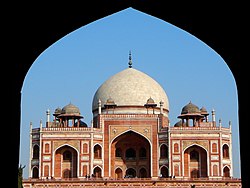
Aivan (also eivan, ivan, lebanon ) - in Islamic architecture means a vaulted room, surrounded on three sides by a wall and open on the fourth side. Ivan can be called:
- A large vaulted hall that opens onto the patio and serves as a reception hall in palaces or places of worship;
- A terrace or open gallery with a flat surface, supported by columns or pillars, in Central Asian dwellings, mosques and other structures [1] .
In Parthian and Sasanian architecture, aivans served as reception rooms in palaces, such as in the Parthian palace of Kukhe-Khoja ( Iran ), or the Sassanian palace of Ktesifon ( Iraq ).
In the Middle Ages, aivans were widely used in the palace and cult architecture of the Middle and Near East , for example, in Isfahan mosques , Servestan palace , in mosques of Bukhara , Samarkand , Herat and many others.
Content
- 1 Gallery
- 2 See also
- 3 notes
- 4 Literature
Gallery
Entrance iwan of Jama Masjid Mosque , Delhi , India
Ivan Juma Mosque , Herat , Afghanistan
Ivan Madrasah in Central Asia
Entrance Aivan Taj Mahal , Agra , India
Input iwan of Qingjing Mosque, Quanzhou , Fujian , China
See also
- Islamic architecture
- Pestak
Notes
- ↑ E. S. Yusupov. Ivan // Dictionary of architecture terms. - St. Petersburg : Leningrad Gallery Foundation, 1994. - P. 15. - ISBN 5-85825-004-1 .
Literature
- Ivan / Starodub T. Kh. // A - Questioning. - M .: Great Russian Encyclopedia, 2005. - P. 309. - ( Great Russian Encyclopedia : [in 35 vols.] / Ch. Ed. Yu. S. Osipov ; 2004—2017, vol. 1). - ISBN 5-85270-329-X .