Strategic Missile Forces of the USSR ( Strategic Rocket Forces ) - a type of armed forces of the USSR. It was equipped with strategic weapons (long and medium-range ballistic missiles) and was intended to carry out strategic tasks.
| Strategic Missile Forces Strategic Rocket Forces | |
|---|---|
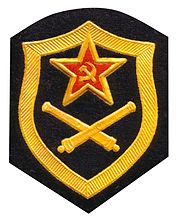 Patch of military servicemen of the Strategic Missile Forces of the USSR | |
| Years of existence | 1959-1992 |
| A country |  the USSR the USSR |
| Included in | Soviet army of the USSR |
| Type of | type of armed forces |
| Includes | unions , connections and individual parts |
| Function | strategic missile forces |
| Number | 260,000 people in 1990 [1] |
| Dislocation | Strategic Missile Forces General Staff in Odintsovo, Moscow region |
| Participation in | |
| Successor | Strategic Rocket Forces of Russia |
| Commanders | |
| Famous commanders | see list |
 External Images External Images | |
|---|---|
 | Dislocation of missile units, formations and objects of the USSR according to the USA in 1957 : locations of units and formations of antiaircraft defense and missile systems, experimental design institutes, plants and factories, training centers, test sites [2] |
| The deployment of the Strategic Missile Forces and the USSR Air Defense Forces according to the United States in 1960 : positions of ICBMs, ballistic missiles, OTRK, SAMs, RLSDO, rocket and artillery ranges, cosmodromes [3] |

The main properties of the Strategic Missile Forces were: high striking power; constant combat readiness and accuracy of delivering nuclear missile attacks on enemy targets; unlimited range of fire destruction; the ability to simultaneously strike at many strategic targets, while successfully overcoming counteraction against air defense and missile defense; performance of combat missions as soon as possible; the ability to maneuver nuclear missiles; independence of combat use from the conditions of the season, day, and weather conditions.
Organizationally, the Strategic Missile Forces included: missile units, formations and associations; research institutions, military schools and parts of support and services.
The command of the species was carried out by the Commander-in-Chief of the Strategic Missile Forces, who was the Deputy Minister of Defense of the USSR [4] .
Content
- 1 History
- 1.1 1946-1959
- 1.1.1 Creating Connections
- 1.1.2 Subordination of special purpose brigades (engineering brigades)
- 1.1.3 Armament
- 1.2 1959-1965
- 1.2.1 Education Strategic Missile Forces
- 1.2.2 Organizational and staff reforms
- 1.2.3 Armament
- 1.3 1965-1973
- 1.3.1 Organizational reforms
- 1.3.2 Armament and equipment
- 1.4 1973-1985
- 1.4.1 Status of the Strategic Missile Forces
- 1.4.2 Armament
- 1.5 1985-1992
- 1.5.1 Armament
- 1.5.2 Disarmament Policy
- 1.5.3 The quantitative composition of the formations and weapons of the Strategic Missile Forces for 1991
- 1.5.4 Section of the RSVN of the USSR
- 1.1 1946-1959
- 2 Training for the Strategic Missile Forces of the USSR
- 2.1 Training of junior specialists
- 2.2 Training of officers
- 3 Command of the Strategic Missile Forces of the USSR
- 3.1 Commanders
- 3.2 Chiefs of the General Staff of the Strategic Missile Forces
- 3.3 Members of the Military Council of the Strategic Missile Forces of the USSR
- 4 notes
- 5 Links
History
1950s
1950s
Moscow 1964 year
Moscow 1977 year
In the photo, the rocket is inside the transport and launch container
Historians consider the creation and development of the Strategic Missile Forces of the USSR in five stages [5] .
1946-1959
At the initial stage, the USSR was developing nuclear weapons and developing the first samples of guided ballistic missiles. In the organizational plan, at the first stage, the first missile formations with conventionally charged missiles in service were deployed. These missiles were intended to solve operational problems in front-line operations, and after equipping them with nuclear charge it was supposed to be used to solve the strategic tasks of the Supreme High Command in nearby theaters of military operations [5] .
Creating Connections
The first formation of the future missile forces was the Special Forces reserve reserve formed by the Supreme High Command formed on August 15, 1946. Due to the short range of missiles, the brigade was deployed as close as possible to the probable enemy, represented by the states of Western Europe, in the Group of Soviet occupation forces in Germany near the city of Sondershausen .
The brigade was directly subordinate to the Artillery Commander of the Soviet Army. In the created brigade, the personnel began to study the captured FAU-2 German ballistic missile (which received the designation A-4 in the Soviet documentation) and the ground-based complex of test and launch equipment attached to it, simultaneously translating technical documentation for the weapon model from German into Russian .
Due to the need for testing in August 1947, the team was at the Kapustin Yar training ground in the Astrakhan region. On October 18, 1947, the A-4 ballistic missile was first launched in the brigade. By the end of November, 11 test missile launches had already been made.
In July 1948, the regalia of the 92nd Guards Mortar Regiment was handed over to the brigade, after which it received the name: Special Purpose Gomel Order of Lenin, Red Banner, Orders of Suvorov, Kutuzov and Bogdan of the Khmelnitsky RVGK Brigade.
In October 1950, the Soviet R-2 missile with a detachable warhead and a flight range of 590 kilometers was tested on the basis of the brigade.
In December 1950, the brigade was renamed the 22nd Special Purpose Brigade of the RVGK, and on its basis a new 23rd Special Purpose Brigade of the RVGK was created, which was relocated from Kapustin Yar to Kamyshin, Stalingrad Region.
In May 1952, two more special-purpose brigades were created in Kapustin Yar: the 54th and 56th.
In March 1953, all compounds were renamed [6] :
- RVGK 22nd Special Purpose Brigade → RVGK 72nd Engineering Brigade - Kapustin Yar, Astrakhan Region;
- 23rd RVGK Special Purpose Brigade → 73rd RVGK Engineering Brigade - Kamyshin, Stalingrad Region of the RSFSR;
- 54th RVGK Special Purpose Brigade → 85th RVGK Engineering Brigade - Kapustin Yar, Astrakhan Region;
- RVGK 56th Special Purpose Brigade → RVGK 90th Engineering Brigade - Kremenchug, Poltava Region, Ukrainian SSR.
Due to secrecy, the term “rocket” in the type of formations was replaced by “engineering”. All brigades consisted of 3 separate engineering divisions .
Subsequently, an additional six engineering teams were created [6] :
- 77th brigade - in March 1953 in the settlement of Belokorovichi, Zhytomyr region, Ukrainian SSR;
- 80th brigade - in May 1953 in the village Belokorovichi, Zhytomyr region;
- 233rd Brigade - in July 1954 in the city of Klintsy, Bryansk Region, the RSFSR;
- 12th brigade - in 1959 in the settlement of Myshinka, Gomel region, Belarusian SSR;
- 15th brigade - in 1959 in the village of Myshinka, Gomel region;
- 22nd Brigade - in 1959 in Lutsk, Volyn Region.
In accordance with the plans for combat use, the following brigades at different times were moved to new locations:
- 72nd - by February 1959 in the city of Fürstenberg, German Democratic Republic, as part of the GSVG;
- 73rd - in July 1959 in the city of Kolomyia, Ivano-Frankivsk Region, Ukrainian SSR;
The brigade included 3 divisions, each of which had 2 batteries. Each battery had one launcher [7] .
Subordination of Special Purpose Teams (Engineering Teams)
Initially, the leadership of the missile units was assigned to the 4th Directorate of Jet Arms of the Main Artillery Directorate (GAU).
In March 1953, as part of the Main Artillery Directorate, the Office of the Deputy Artillery Commander of the Soviet Army (for reactive units) was created. In March 1955, the post of Deputy Minister of Defense for Special Arms and Jet Technology was established. The chief artillery marshal Nedelin M.I. was appointed to this position.
In 1958, three brigades armed with the R-11 operational-tactical complexes (233rd, 77th and 80th brigades) were transferred from the subordination of the Office of the Reactive Parts to the subordination of the Ground Forces.
From August 1958 to July 1959, the staff structure in the teams of the remaining reactive units in the Administration changed: individual engineering divisions were deployed to engineering regiments [8] [7] .
Armament
The first missile adopted for service were A-4 missiles, which were V-2 rockets assembled in the USSR from separate parts and exported from Germany. The design of the V-2 served as the basis for the creation of the R-1 rocket, developed in the design bureau of Korolyov S.P. and adopted for service in 1951. In 1951, a fully Soviet-designed R-2 missile with a range of 550 kilometers was adopted.
In 1955, the operational forces of the three brigades received tactical missiles R-11 with a range of 270 kilometers.
In 1956, with the introduction of the R-5M missiles, the management staff of the brigade and the staff of a separate engineering division were changed.
In 1958, more advanced R-12 missiles began to enter service [9] [8] .
1959-1965
The second stage is significant in the formation and formation of the Strategic Missile Forces, as an independent type of the Armed Forces of the USSR. At this stage, the deployment and deployment on alert of the missile formations of intercontinental ballistic missiles and medium-range missiles of the first generation, which were able to solve strategic tasks in remote geographical areas and in any theater of operations [5], took place .
Education Strategic Rocket Forces
By a decree of the Council of Ministers of the USSR of December 17, 1959, the separation of the Soviet Army from Artillery , a new type of Armed Forces was created - Strategic Missile Forces ( Strategic Missile Forces ). The deployment of the Main Staff of the Strategic Missile Forces was determined in the city of Odintsovo, Moscow Region .
The Strategic Rocket Forces included [9] :
- General Directorate of Special Construction (established in 1951)
- Main Directorate of Missile Weapons;
- General Directorate of Acquisition and Equipment;
- 12th Main Directorate of the Ministry of Defense of the USSR (engaged in arsenals of weapons);
- Combat training department;
- Department of military educational institutions;
- Rear management;
- Central command post;
- Main Engineering Directorate (established in 1961);
- Central communications center, created (created in 1961);
- Central Computer Center (established in 1961);
- Main Directorate for the Operation of Missile Weapons (established in 1964).
Organizational and Staff Reforms
In 1960, the simultaneous process of creating missile brigades, missile divisions and missile armies began.
In May 1960, 21 missile brigades with various weapons were created: 15 brigades with R-16 missiles, 4 brigades with R-12 missiles and 2 mixed-arms brigades.
All created missile brigades on the R-16 had a regimental structure and the following identical composition:
- team management;
- 4 missile regiments;
- mobile repair and technical base.
Missile divisions began to be created in June 1960. In 1960, 10 missile divisions were formed. To create missile division administrations, the departments of the previously created engineering brigades of the RVGK, the management of the aviation divisions, and in some cases the management of the artillery divisions of the breakthrough of the RVGK were used.
To manage many divisions and brigades, two types of associations were created: separate missile corps and missile armies.
Two missile armies were created in 1960: the 43rd missile army and the 50th missile army , whose command was formed on the basis of the air armies of long-range aviation with the preservation of common military numbers.
Separate missile corps were created in the period from 1961 to 1965. A total of 7 buildings were created: 5 in 1961 and 2 in 1965. In order to maintain secrecy, all created missile corps departments were originally called the "training artillery range." In turn, the basis for the creation of departments of training artillery ranges , which began to be created in 1959, were the departments of motorized rifle and artillery divisions. In February 1961, all training artillery ranges were renamed the management of individual missile corps .
In May 1961, all 21 missile brigades created a year earlier were reorganized into missile divisions. Additionally, in the same month, 3 more missile divisions were formed.
In July 1962, as part of Operation Anadyr , the 51st Missile Division was created, which was deployed on the island of Cuba .
In 1964, 5 missile divisions and 3 missile brigades were created. After 1964, missile divisions were no longer created.
In 1965, 2 missile brigades were created.
Thus, in 1965, at the end of the formation stage of the Strategic Missile Forces, they included: 2 missile armies and 7 separate missile corps, which included 40 missile divisions and 5 missile brigades [7] .
Armament
In 1961, the missile divisions and brigades entered service with a first-generation medium-range missile like the R-14 , which had a flight range twice that of its predecessor R-12 - 4,500 instead of 2,080 kilometers.
In 1963, the first intercontinental ballistic missile R-16 for the Strategic Missile Forces was actually adopted, which significantly increased its combat capabilities. Adopted in 1960, the R-7 missile was unsuitable for combat duty due to many shortcomings.
Also in service were the R-5M and R-12 missiles [9] .
1965-1973
At the third stage, the deployment of a group of second-generation intercontinental missile systems with single launch sites took place. During these years, the qualitative growth of the Strategic Missile Forces made it possible to achieve military-strategic parity [5] .
Organizational and Staff Reforms
In 1970, there was a disaggregation of associations. There was a transition from the mixed organization of the Strategic Missile Forces, where both the corps organization and the army organization were present to a fully army organization. All 7 previously existing directorates of individual army corps were disbanded with the creation of 4 missile armies based on them.
In 1970, the Strategic Missile Forces received an organizational and staffing structure, which, with minor changes, remained until the collapse of the USSR [6] :
- The main headquarters of the Strategic Missile Forces - Odintsovo, Moscow Region.
- 27th Guards Missile Army - Vladimir :
- 8th Missile Division - Yurya , Kirov Region ;
- 10th Guards Missile Division - Kostroma ;
- 14th Missile Division - Yoshkar-Ola , Mari ASSR ;
- 28th Guards Missile Division - Kozelsk , Kaluga Region ;
- 54th Guards Missile Division - Teikovo , Ivanovo Region ;
- 60th Missile Division - Tatishchevo , Saratov Region .
- 31st Missile Army - Orenburg :
- 13th Missile Division - Dombarovsky , Orenburg Region ;
- 38th Missile Division - Derzhavinsk , Turgai Region ;
- 42nd Missile Division - Nizhny Tagil , Sverdlovsk Region ;
- 52nd Missile Division - Bershet , Perm Region ;
- 59th Missile Division - Kartaly , Chelyabinsk Region ;
- 17th Missile Brigade - Shadrinsk , Kurgan Region ;
- 48th missile brigade - Sary-Ozek , Taldy-Kurgan region ;
- 68th Missile Brigade - Kattakurgan , Samarkand Region ;
- The 481st Separate Missile Regiment - Aktyubinsk .
- 33rd Guards Missile Army - Omsk :
- 36th Guards Missile Division - Krasnoyarsk ;
- 39th Guards Missile Division - Pashino , Novosibirsk Region ;
- 41st Guards Missile Division - Aleisk , Altai Territory ;
- 57th Missile Division - Zhangiz-Tobe , Semipalatinsk Region ;
- 62nd Missile Division - Uzhur , Krasnoyarsk Territory ;
- 93rd missile brigade - Tyumen ;
- 97th Missile Brigade - Itatka , Tomsk Region ;
- 290th Separate Missile Regiment - Omsk.
- 43rd Missile Army - Vinnitsa :
- 44th Missile Division - Kolomyia , Ivano-Frankivsk Region ;
- 19th Missile Division - Rakovo, Khmelnitsky region ;
- 50th missile division - Belokorovichi , Zhytomyr region ;
- 46th Missile Division - Pervomaisk , Mykolaiv Oblast ;
- 43rd missile division - Romny , Sumy region ;
- 35th Missile Division - Ordzhonikidze , North Ossetian Autonomous Soviet Socialist Republic ;
- 33rd Missile Division - Mozyr , Gomel Region ;
- 37th Missile Division - Lutsk , Volyn Region ;
- 60th separate missile regiment - Pultovtsy , Vinnytsia region ;
- 434-й отдельный ракетный полк — Первомайск, Николаевская область.
- 50-я ракетная армия — Смоленск :
- 23-я гвардейская ракетная дивизия — Валга , Эстонская ССР ;
- 24-я гвардейская ракетная дивизия — Гвардейск , Калининградская область ;
- 29-я гвардейская ракетная дивизия — Шауляй , Литовская ССР ;
- 31-я гвардейская ракетная дивизия — Пинск , Брестская область ;
- 32-я ракетная дивизия — Поставы , Витебская область ;
- 40-я ракетная дивизия — Остров , Псковская область ;
- 58-я ракетная дивизия — Каунас , Литовская ССР ;
- 49-я гвардейская ракетная дивизия — Лида , Гродненская область ,
- 7-я гвардейская ракетная дивизия — Выползово , Тверская область .
- 53-я ракетная армия — Чита :
- 4-я ракетная дивизия — Дровяная , Читинская область ;
- 47-я ракетная дивизия — Оловянная , Читинская область;
- 27-я ракетная дивизия — Свободный , Амурская область .
Всего на 1970 год РВСН состояли из 33 дивизий, 5 бригад и 4 отдельных полков сведённых 5 ракетных армий. Вне армейского подчинения находилась 98-я испытательно-боевая ракетная бригада , дислоцированная на космодроме Байконур .
Вооружение и оснащение
На третьем этапе развития руководством страны была поставлена задача превратить РВСН в «ракетный щит». С этой целью начались работы по разработке и испытанию новых межконтинентальных баллистических ракет второго поколения. Были поставлены цели повышения показателей боеготовности, защищённости, вероятности доведения приказов до исполнительных звеньев, упрощение и удешевление эксплуатации ракетных комплексов. Все разрабатываемые ракеты планировалось применять на боевом дежурстве только в шахтных пусковых установках.
В целях экономии времени в развёртывании ракетных комплексов нового поколения, правительство СССР приняло решение по строительству шахтных пусковых установок, командных пунктов и остальных элементов инфраструктуры, необходимых для обеспечения повседневной деятельности ракетных частей, до полного окончания испытаний ракет.
Данные меры позволили в короткие сроки провести перевооружение и поставить на боевое дежурство новые ракетные комплексы. В период с 1966 по 1968 годы количество поставленных на дежурство МБР вырослок с 333 единиц до 909. К концу 1970 года их количество достигло 1361.
Существенное повышение боевых возможностей РВСН произошло с принятием на вооружение МБР Р-36 и УР-100 . Данные комплексы предназначались для поражения стратегических целей вероятного противника в первом ядерном ударе. Доля МБР в общем вооружении РВСН к 1970 году составила 74%.
На 1973 год МБР находились в 1398 шахтных пусковых установках 26 ракетных дивизий. К этому времени была усовершенствована система боевого управления войсками и вооружением РВСН. Командные пункты соединений и объединений были оснащены автоматизированной системой, дававшей возможность осуществить принцип жесткой централизации применения ракетно-ядерного оружия и исключить возможные случаи несанкционированного запуска ракет. Существенно повысилась надёжность доведения приказов Главного командования до исполнительных звеньев. Была разработана и внедрена автоматизированная система контроля технического состояния ракет и систем ракетных комплексов [9] [8] .
1973—1985
Четвёртый этап характеризуется поступлением на вооружение РВСН межконтинентальных ракет третьего поколения с разделяющимися боеголовками и средствами преодоления противоракетной обороны, а также мобильными ракетными комплексами РСД-10 [5] .
Состояние РВСН
На данном этапе повышение боевой мощи и эффективности РВСН обеспечило стратегический баланс между СССР и США.
К середине 1970-х годов СССР смог достичь примерного ядерного паритета с США. Со второй половины 1970-х годов была начата модернизация баллистических ракет средней дальности. На вооружение был принят мобильный комплекс «Пионер» с ракетой РСД-10 на твёрдом топливе, с головной частью индивидуального наведения. Были сняты с боевого дежурства все ракеты Р-14 и Р-12У. С уменьшением общего количества ракет и суммарного тротилового эквивалента ядерных зарядов, боевая эффективность РВСН только возросла.
Серьёзное влияние на развитие РВСН оказала политика СССР, в которой было заявлено об отказе применять первым ракетно-ядерное оружие, а также ограничения на модернизацию и разработку новых ракетных комплексов, заключённые в советско-американском договоре ОСВ-2 стали оказывать серьезное воздействие два фактора. Отказ от применения ядерного оружия первыми для РВСН означал, что при внезапном ядерном ударе противника войскам будут вынуждены действовать в крайне тяжелых условиях. Для выполнения задач по осуществлению ответно-встречного и тем более ответного ядерных ударов по противнику, было необходимо значительно повысить живучесть ракетных комплексов в целом, стойкость ракет к поражающим факторам ядерного взрыва, надежность систем боевого управления и связи.
Решение данных вопросов по модернизации находившихся на вооружении ракетных комплексов потребовало значительных финансовых и материальных затрат [9] .
Armament
На четвёртом этапе на вооружение РВСН поступили ракетные комплексы третьего поколения, для которых характерно наличие разделяющейся боевой головной части.
На боевое дежурство были поставлены такие образцы как мобильный комплекс РСД-10, комплексы для шахтных пусковых установок УР-100Н , МР УР-100 , Р-36М , Р-36М УТТХ [9] [8] .
1985—1992
Заключительный этап существования РВСН СССР отмечен принятием на вооружение новых, более эффективных как стационарных так и мобильных ракетных комплексов четвертого поколения. Также на данный этап приходится распад СССР с последовавшим прекращением существования Вооружённых сил СССР .
В 1987 году между США и СССР был подписан Договор о ликвидации ракет средней и меньшей дальности , реализация которого последовала в период до июля 1991 года.
12 ноября 1991 года указом Президента СССР было озвучено создание нового вида вооружённых сил — Стратегические силы ядерного сдерживания, которые предполагали объединение следующих структур [10] :
- РВСН;
- формирования предупреждения о ракетном нападении;
- формирования контроль космического пространства;
- формирования противоракетной обороны;
- управление начальника космических средств.
В связи с последовавшим распадом СССР данный указ не был реализован.
On March 27, 1992, the former Strategic Rocket Forces of the USSR became part of the Strategic Forces of the CIS Allied Forces , which, as conceived by the heads of the CIS states, were to unite all the strategic nuclear forces of the former USSR. In view of Ukraine’s position on this issue, the creation of a unified Strategic Force was frustrated.
On August 19, 1992, on the basis of the formations of the former Strategic Missile Forces of the USSR in the territory of the Russian Federation, Belarus and Kazakhstan , Strategic Missile Forces of the Russian Federation were created [10] .
Armament
The first model of the fourth-generation missile system was the mobile-based ICBM RT-2PM Topol .
Work begun in the mid-1970s on the creation of a mobile combat railway missile complex (BZHRK) was only implemented by November 1989, when it was put into service. Prior to being adopted, one of the BZHRK entered service with one of the regiments of the 40th missile division in Kostroma and took up combat duty. In addition to the 40th division, before the collapse of the USSR, this complex managed to enter service with the 52nd missile division and the 36th missile division in the Krasnoyarsk Territory (4 regiments in each division).
The composition of the BZHRK missile regiment included a train of three diesel locomotives and 17 wagons, including three launchers with RT-23UGTX missile systems (12 missiles in total). Launchers with missiles were located on 9 railway platforms. The structure also included a command post and wagons, with the equipment of life support systems for personnel and maintaining missiles in combat readiness during combat duty.
In 1988, the process of eliminating medium-range ballistic missiles began. By the beginning of 1988, 65 R-12 and 405 RSD-10 missiles were on alert. These samples, both on combat duty and in storage of missiles in storage, were to be destroyed until mid-1991.
By the second half of 1990, the Strategic Missile Forces were armed with 2,500 missiles and 10,271 units of nuclear weapons. Of this number, the main part was intercontinental ballistic missiles - 1398 units with 6612 charges. In addition, in the arsenals of the USSR were warheads of tactical nuclear weapons [9] :
- missiles "ground-to-ground" (according to the Western classification - "Skad-B", "Frog", SS-20, SS-21) - 4300 units;
- artillery shells and mines for mortars of the caliber of 152 mm, 203 mm, 240 mm - up to 2000 units;
- air-to-ground missiles and free fall bombs for the Air Force aviation - more than 5000 units;
- cruise anti-ship missiles, as well as depth charges and torpedoes - with a total of up to 1,500 units;
- shells of caliber 152 mm coastal artillery and coastal defense missiles - a total of 200 units;
- atomic landmines and mines - up to 14,000 units.
Disarmament Policy
With the advent of the leadership of the USSR, M. Gorbachev, the process of gradual concessions to the United States and NATO was put in place to reduce all types of weapons, including nuclear ones [11] . The power crisis affected both the state of the Armed Forces of the USSR as a whole and the Strategic Missile Forces in particular. By the beginning of the 1990s, the problem was the finding of a relatively large number of types of missile systems, as well as a large number of their modifications. About 40% of all ICBMs on alert were outdated second-generation missiles and needed to be replaced. The entry into service of new models slowed down. Only a third of the divisions managed to get the Topol missile systems that were modern at that time.
The US-USSR agreement on a 50% reduction in strategic offensive arms (START-1), concluded in July 1991, set equal limits for the parties on the total number of nuclear weapons carriers of 1,600 units, which could have no more than 6,000 nuclear warheads. Sub-levels for some types of weapons were also installed. The number of warheads on ICBMs and the total total missed weight of the missiles were limited. Under the agreement, it was forbidden to create new types of heavy ICBMs, mobile launchers for existing heavy missiles and installations for high-speed reloading of ICBM launchers.
The United States succeeded in imposing restrictions on the USSR on the number of undeployed mobile-based intercontinental ballistic missiles and their launchers. The number of missiles for mobile installations was limited for the USSR to 250, of which 125 for military railway missile systems (BZHRK). The number of mobile units was limited to 110 and 18 for BZHRK.
At the initiative of the President of the USSR M. Gorbachev, the Strategic Missile Forces stopped building up and upgrading railway-based ICBMs, 503 ICBMs were removed from combat duty, 134 of which had individual warheads. It was planned to reduce the total number of nuclear warheads to 5,000 (51.3% of the original) [9] .
Quantitative composition of formations and weapons of the Strategic Missile Forces for 1991
In June 1990, the 50th Missile Army was disbanded, together with all the missile divisions that were part of it, with the exception of the 7th Guards Missile Division, which was withdrawn from the 27th Guards Missile Army.
The Strategic Missile Forces consisted of 30 missile divisions combined into 5 missile armies, as well as 8 separate engineering and testing units [6] :
- The main headquarters of the Strategic Missile Forces - Odintsovo, Moscow Region.
- 2nd separate engineering and testing part - Plesetsk, Arkhangelsk region;
- 4th separate engineering and testing unit - Leninsk , Kyzylorda region ;
- 6th separate engineering and testing unit - Tatarsk , Novosibirsk Region ;
- 8th separate engineering and testing unit - Plesetsk, Arkhangelsk region;
- 16th separate engineering and testing unit - Kamyshin , Volgograd region ;
- 17th separate engineering and testing unit - Smorgon , Grodno region ;
- 19th separate engineering and testing unit - Leninsk, Kyzylorda region;
- The 26th separate engineering and testing unit is Leninsk, Kyzylorda Oblast.
- 27th Guards Missile Army - Vladimir
- 7th Guards Missile Division - Vypolzovo, Tver Oblast;
- 8th Missile Division - Yurya, Kirov Region;
- 10th Guards Missile Division - Kostroma;
- 14th Missile Division - Yoshkar-Ola, Republic of Mari-El;
- 28th Guards Missile Division - Kozelsk, Kaluga Region;
- 54th Guards Missile Division - Teikovo, Ivanovo Region;
- 60th Missile Division - Tatishchevo, Saratov Region.
- 31st Missile Army - Orenburg
- 13th Missile Division - Dombarovsky, Orenburg Region;
- 38th Missile Division - Derzhavinsk, Turgai Region;
- 42nd Missile Division - Nizhny Tagil, Sverdlovsk Region;
- 52nd Missile Division - Bershet, Perm Region;
- 59th Missile Division - Kartaly, Chelyabinsk Region;
- 33rd Guards Missile Army - Omsk
- 35th Missile Division - Barnaul, Altai Territory;
- 39th Guards Missile Division - Pashino, Novosibirsk Region;
- 41st Guards Missile Division - Aleisk, Altai Territory;
- 57th Missile Division - Zhangiz-Tobe, Semipalatinsk Region;
- 62nd Missile Division - Uzhur, Krasnoyarsk Territory;
- 43rd Missile Army - Vinnitsa
- 19th Missile Division - Rakovo, Khmelnitsky region;
- 32nd Missile Division - Pastavy, Vitebsk region;
- 33rd Missile Division - Mozyr, Gomel Region;
- 37th Missile Division - Lutsk, Volyn Region;
- 43rd missile division - Romny, Sumy region;
- 46th Missile Division - Pervomaisk, Mykolaiv Oblast;
- 49th missile division - Lida, Grodno region;
- 50th missile division - Belokorovichi, Zhytomyr region;
- 53rd Missile Army - Chita
- 4th Missile Division - Drovyanaya, Chita Region;
- 23rd Guards Missile Division - Kansk, Krasnoyarsk Territory;
- 27th Missile Division - Svobodny, Amur Region;
- 29th Guards Missile Division - Irkutsk;
- 36th Guards Missile Division - Krasnoyarsk.
According to Western experts, the Strategic Missile Forces personnel for 1990 was estimated at 260,000, and the Strategic Missile Forces were armed with missile systems in the following numbers [1] [12] :
- UR-100 (SS-11 mod. 1 Sego) - 1398;
- RT-2 (SS-13 mod. 1 Savage) - 60;
- MP UR-100 (SS − 17 mod. 1,2 Spanker) - 75;
- R-36M (SS-18 Mod. 1,2,3 Satan) - 308;
- UR-100N (SS-19 mod. 1 Stiletto) - 320;
- RT-23UTTH (SS-24 Mod 3, Mod 2 Scalpel) - about 60 [13] ;
- RT-2PM (SS-25 Sickle) - about 225;
- RSD-10 (SS-20 mod. 1 Saber) - 174.
Section of the RSVN of the USSR
After the collapse of the USSR in February 1992, it was proposed to create the Joint Armed Forces of the CIS (CIS Allied Forces), which should include the former Strategic Missile Forces of the USSR. However, the CIS created by the Allied Forces because of disagreements between the leaderships of the republics existed until September 1993. Due to the impossibility of maintaining the combined armed forces, the threat of the emergence of new nuclear powers arose, since instead of the former USSR, 4 states appeared on its territory that had the right to claim possession of nuclear weapons:
- Russian Federation - on its territory were located 961 launchers (73% of the total);
- Ukraine - the 43rd Missile Army (176 silo launchers with 1272 nuclear warheads);
- Republic of Belarus - 3 missile divisions (81 mobile launchers);
- Republic of Kazakhstan - 2 missile divisions (52 silo launchers).
According to the Lisbon Treaty, signed in May 1992, which was ratified by Kazakhstan and Belarus, they refused nuclear weapons with their transfer to the Russian Federation.
Ukraine took a different path and in December 1992 declared ownership of the nuclear weapons located on its territory. On April 5, 1992, the Ministry of Defense of Ukraine included the 43rd Missile Army into the Armed Forces of Ukraine [14] . In January 1993, the government of Ukraine in the course of interstate negotiations abandoned nuclear weapons [15] .
In addition to the 43rd Missile Army, the Kharkov Higher Military Command and Engineering School , which was part of the former Strategic Missile Forces of the USSR, also left Ukraine [10] .
In the period from 1996 to 1999, 13 missile regiments with all silo launchers were withdrawn from combat duty. 111 RS-18 missiles were eliminated and 19 missiles were transferred to the Russian Federation. In August 2002, the 43rd Missile Army was disbanded [16] [17] .
The statement found in some Russian sources that the missile units deployed on the territory of Kazakhstan, Belarus and Ukraine were withdrawn to the territory of the Russian Federation [5] is untrue. Only nuclear warheads were removed to Russian territory from Kazakhstan and Ukraine for subsequent disposal. The Topol mobile missile systems, which were available in three divisions on the territory of Belarus, were not destroyed and were transported to Russia [10] . All Strategic Missile Forces compounds that ended up outside of Russia were lost and disbanded for it at their locations [9] . The exception concerned only one formation of the 43rd Missile Army (49th Guards Missile Division), which was phased out on Russian territory and also disbanded by the end of 1995 [18] .
Training for the Strategic Missile Forces of the USSR
Junior Specialist Training
The Strategic Rocket Forces Combat Training Directorate supervised the training of junior specialists, which was carried out in 9 training centers [7] :
- 47th training center - Ostrov , Pskov region;
- 80th training center - Kotovsk , Odessa region ;
- 82nd training center - Pavlograd , Dnipropetrovsk region ;
- 90th training center - Pereslavl-Zalessky , Yaroslavl region ;
- 98th training center - Myshanka , Gomel region ;
- 183rd training center - Mirny , Arkhangelsk region;
- 69th automobile school - Kotovsk, Odessa region;
- 150th automobile school - Kapustin Yar, Astrakhan region;
- 161st School of Technicians - Jelgava , Latvian SSR .
Officer Training
The training and education of junior officers (with the assignment of the military rank of lieutenant ) for 1991 took place in the following 7 higher military schools [7] :
- Rostov Higher Military Command and Engineering School of Missile Forces named after Chief Marshal of Artillery Nedelin M. I .;
- Riga Higher Military-Political Red Banner School named after Marshal of the Soviet Union Biryuzov S. S .;
- Kharkov Higher Military Command and Engineering School of Missile Forces named after Marshal of the Soviet Union N. I. Krylov ;
- Serpukhov Higher Military Command and Engineering School of the Missile Forces ;
- Perm Higher Military Command and Engineering School of Rocket Forces named after Marshal V. Chuikov ;
- Stavropol Higher Military Engineering School of Communications named after the 60th anniversary of the Great October Revolution ;
- Krasnodar Higher Military Command and Engineering School of the Missile Forces.
In the 1960s, the number of higher military schools in which lieutenants were trained for the Strategic Rocket Forces reached 13. In addition to military schools, personnel for the Strategic Rocket Forces were taken at 11 technical higher educational institutions (for example, MIPT ), in which training was carried out at the military department .
Further training of senior officers was carried out at the faculties of three military academies [7] :
- Military Academy named after F.E. Dzerzhinsky ;
- Military Engineering Red Banner Institute named after A.F. Mozhaysky - until 1982;
- Military-Political Academy named after V.I. Lenin ;
- Military academy of radiation, chemical and biological protection named after Marshal of the Soviet Union S.K. Timoshenko .
USSR Strategic Missile Forces Command
List of senior leadership of the Strategic Missile Forces of the Armed Forces of the USSR [8] .
Commanders-in-Chief
- December 1959 - October 1960 - Chief Marshal of Artillery M. I. Nedelin ;
- October 1960 - April 1962 - Marshal of the Soviet Union K. S. Moskalenko ;
- April 1962 - March 1963 - Marshal of the Soviet Union S. S. Biryuzov ;
- March 1963 - February 1972 - Marshal of the Soviet Union N.I. Krylov ;
- April 1972 - July 1985 - Army General , since 1983 Chief Marshal of Artillery V.F. Tolubko ;
- July 1985 - February 1992 - Army General Yu. P. Maximov .
Chiefs of the Strategic Missile Forces General Staff
- May 1960 - December 1962 - lieutenant general of artillery ; since 1961 , colonel general of artillery Nikolsky, Mikhail Alexandrovich ;
- December 1962 - June 1966 - Lieutenant General of Aviation Lovkov, Mikhail Alexandrovich ;
- June 1966 - September 1976 - lieutenant general , since 1967 Colonel General Shevtsov, Alexander Grigoryevich ;
- September 1976 - July 1987 - Colonel General Vishenkov, Vladimir Mikhailovich ;
- July 1987 - February 1992 - Lieutenant General, since 1988 Colonel General Kochemasov, Stanislav Grigoryevich .
Members of the Military Council of the Strategic Missile Forces of the USSR
- June 1960 - May 1963 - Colonel General Efimov, Pavel Ivanovich ;
- May 1963 - December 1966 - Lieutenant General of Aviation Lavrenov, Ivan Ananievich ;
- April 1967 - May 1970 - Colonel General Egorov, Nikita Vasilievich ;
- August 1970 - December 1985 - lieutenant general, from 1972 Colonel General Gorchakov, Pyotr Andreyevich ;
- December 1985 - April 1991 - Colonel General Rodin, Victor Semenovich .
Notes
- ↑ 1 2 The International Institute for Strategic Studies (IISS) . "The Miltary Balance." - Abingdon : Routledge, 1990 .-- S. 34 .-- 240 p. - ISBN 978-1857439557 .
- ↑ Soviet missile facilities map . // Missiles and Rockets , February 1957, pp. 40–41.
- ↑ Russian Missile Bases. (Eng.) // Missiles and Rockets , February 15, 1960, pp. 26-27.
- ↑ Collective of authors. article "Strategic Missile Forces" // Soviet Military Encyclopedia / Ed. Ogarkova N.V. - M .: Military Publishing , 1979. - T. 7. - S. 51-53. - 693 p. - 105,000 copies.
- ↑ 1 2 3 4 5 6 Team of authors. Introduction // "Missile Shield of the Fatherland" / ed. Yakovleva V.N. — М. : Издательство РИСИ , 2000. — С. 10—11. — 246 с.
- ↑ 1 2 3 4 Ракетные войска стратегического назначения ВС СССР на историческом сайте Michael Holm
- ↑ 1 2 3 4 5 6 Он-лайн справочник Ракетных войск стратегического назначения RVSN.INFO
- ↑ 1 2 3 4 5 Коллектив авторов. статья «Ракетные войска стратегического назначения» // Военная энциклопедия / Под ред. Иванова С. Б. . — М. : Воениздат , 2003. — Т. 7. — С. 170—173. — 735 с. - 10,000 copies. — ISBN 5-203-001874 -X.
- ↑ 1 2 3 4 5 6 7 8 9 Феськов В.И., Голиков В.И., Калашников К.А. Глава 3. «Ракетные войска стратегического назначения Вооруженных Сил СССР» // «Советская Армия в годы «холодной войны» (1945-1991)». — Томск: Издательство Томского университета, 2004. — С. 167—174. — 246 с. - 500 copies.
- ↑ 1 2 3 4 Коллектив авторов. Статьи «Ракетные войска стратегического назначения» и «Ракетная армия». Приложение «Хронология основных событий истории РВСН» // «Военный энциклопедический словарь Ракетных войск стратегического назначения» / Под ред. Сергеева И. Д. . — М. : Большая Российская Энциклопедия , 1999. — С. 437, 449, 619-630. — 634 с. — ISBN 5-85270-315-X .
- ↑ Полынов Н. Ф. «Постоянно советская сторона делала значительные уступки...». Политика ядерного разоружения М.С. Горбачева. 1985–1991 гг. . www.cyberleninka.ru (4 апреля 2014). Дата обращения 14 августа 2019.
- ↑ В скобках указано название по классификации МО США и НАТО
- ↑ (как шахтного базирования так и на БЖРК)
- ↑ Кандидат исторических наук Фёдоров Юрий Вадимович. «Ядерная политика Украины» // «Обозреватель-Observer» : Ежемесячный журнал. — М. : Автономная некоммерческая организация Институт диаспоры и интеграции (Институт стран СНГ), 1993. — № 26 . — ISSN 2074-2975 .
- ↑ Захаров В. М. Глава 3. «Раздел советских вооружённых сил». Раздел 1. «Разрешение проблемы появления новых ядерных держав» // «Военное строительствов государствах постсоветского пространства».. — М. : Издательство РИСИ , 2011. — С. 42—44. — 380 с. — ISBN 978-5-7893-0118-0 .
- ↑ Украина осталась без ракетных войск . www.lenta.ru (20 августа 2002). Дата обращения 6 мая 2019.
- ↑ Николай Филатов. Ракетный щит державы (43-я ракетная армия) . www.versii.com (17 августа 2012). Дата обращения 14 мая 2019.
- ↑ 49th guards missile Stanislavsko-Budapest Red Banner Division . www.rvsn.info. Circulation date May 13, 2019.