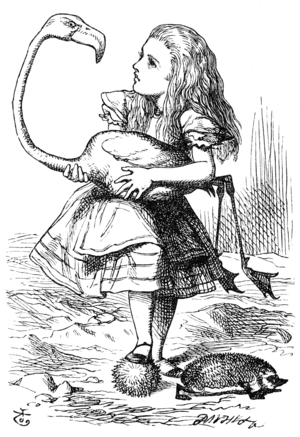
Fiction is a figment of the creative imagination of an author of fiction or a screenwriter of a feature film , embodying his worldview. Fiction is characterized by the absence of direct correspondences both in reality and in previous works of art [1] .
Content
The Role of Fiction in an Artwork
Fiction is a key element of art, along with the reproduction of observed facts, the use of prototypes and historical, mythological and literary sources, the main method of artistic generalization. According to Maxim Gorky , artistry without fiction is “impossible, does not exist” [1] . Fiction is even present in works based on real events, touching on individual thoughts, statements and actions of characters [2] . Artistic imagery necessarily combines two components - conventionality (accented non-identity or even a contrast between the depicted and reality) and lifelike (blurring the boundaries, creating the illusion of the identity of art and reality) [3] .
The scope of fiction is the circumstances and events that make up the plot , individual character traits and behavior of the characters, details of the domestic environment, nature, terrain, etc. However, fiction is not an arbitrary fantasy, it is almost always somehow connected with reality. As M. M. Bakhtin wrote, the author does not “invent”, but “betrays” his hero. Even in fairy tales and fiction, fiction is connected with the realities of the present or the past. Possible forms that fiction can take are the speculation of mythological and historical sources (typical examples are the ancient drama and the old Russian story ), as well as life prototypes (in biographical and autobiographical works); or conventionality, grotesque and fairy tale, providing opportunities for more free expression and active processing of material [4] . A characteristic difference between elements of an artistic narrative and reality is the absence of an element of chance: if a person’s death in real life can be accidental, then in a work of art it is always subordinate to the author’s intention. Realizing events that “could happen”, the author reflects his ideas about the laws of life, the possibilities of development of reality. Moreover, in the works of certain genres (especially heroic and satirical), such events may go beyond the scope of everyday credibility; according to the definition of M. E. Saltykov-Shchedrin , art is called to depict “not only those acts that a person freely performs, but also those that he would undoubtedly have committed if he could or dared” [2] .
Fiction in historical development
Archaic thinking is characterized by the absence of a clear boundary between historical and artistic truth. However, fiction is already recognized in folk tales - they never claim to be considered a reflection of reality [3] .
In ancient times, fiction manifested itself mainly in two conventional forms: idealizing hyperbole and belittling grotesque [3] . The first form was used in works speculating myths (in particular, in ancient tragedy ), historical legends and traditions ( heroic songs , sagas , epics ). Overcoming the framework of tradition and strengthening the position of individual artistic fiction is associated with such late-antique seriously laughable genres as the Menippean satire . Plato noted the presence of fiction in myth [5] ; Aristotle later formulated the principle according to which the poet writes “not about what really happened, but about what could happen, therefore, about what is possible in probability or necessity” [2] .
Christian doctrine negatively related to fiction. So, Thomas Aquinas called poetry "lower doctrine" ( lat. Infima doctrina ) and accused of "lack of truth" ( defectus veritatis ); Umberto Eco believes that the “lowest” for the father of the church in this case was “art as doing” in comparison with pure speculation . Medieval scholastics believed that if a poet writes about known truths, then he does not reveal to the reader anything new, merely giving the writing a pleasant form; in the worst case, poetry (for example, a metaphor ) is a lie, and poetry is a concussion ( Latin sonum tantummodo vocis ) [6] .
In the courteous and animal epic , fablio and other forms of short stories of the Western European Middle Ages, the fundamental role of fiction was clearly recognized. In fiction, fiction convexly manifests itself in Dante's “ Divine Comedy ”, in rethinking the traditional plots of Bocaccio and Shakespeare , reaches an epic scale in the work of Rabelais . On the contrary, in the main genres of ancient Russian literature (military novels, the lives of saints ), such awareness did not exist until the 17th century, since the authors of these works saw themselves in the role of guardians of tradition, rather than writers [7] .
A turning point in relation to fiction occurs in the era of pre-romanticism and romanticism . If before that (especially in the theory of classicism ) the point of view was dominant, which assigned the role of a reliable reflection of reality to art, in the ideology of romanticism, the emphasis is, according to Heinrich Kleist , on “writing by its own laws”, and fiction is recognized as the most important property of poetry. Romantic writers boldly transform and rethink folklore, mythology, and previous literary sources - a work of I. Goethe and especially his Faust can serve as a typical example. In the framework of claims to absolute spiritual independence (and sometimes elitism), an active search begins for a new artistic reality that has no previous analogues; such are the fantastic works of E. T. A. Hoffmann , Edgar Allan Pog , N. V. Gogol , and the poem of J. G. Byron [8] .
In realistic literature of the nineteenth and twentieth centuries, fiction gives way to a certain extent, as the emphasis shifts to portraying facts and personalities personally known to the author of the work, and the distance between objective and artistic reality is reduced. Leo Tolstoy in his last years of life, in particular, writes: “It is conscientious to write a lie that there was something that did not exist. If you want to say something, say it directly. ” Even for Thomas Mann’s fantastic work at its core, the author noted the “stimulating effect of facts.” "Scripture from nature" again becomes an independent value; in the 20th century, fiction is often criticized as a phenomenon that has exhausted itself and is replaced by "literature of fact." Nevertheless, in the genre of realism, methods of speculation and “rearrangement” of facts of the real world continue to be used, and a high-quality realistic work combines fictional and non-fictional elements [9] . In Soviet art criticism, which proclaimed the priority of a realistic reflection of reality, over time, a position was developed according to which "there is and must exist a convention realistic ... a progressive and popular convention," which "organically enters into a broad understanding of realism" [10] . Opponents of the ideology of naturalism, especially at the beginning of the 20th century, on the contrary, emphasized convention, completely rejecting the “routine” lifelike - such was the work of Vsevolod Meyerhold [3] .
Currently, the main areas where author's fiction remains clear and undisguised are detective , adventure literature and cinema , science fiction , and fantasy . But fiction, although to a lesser extent, is present in all other works of fiction and cinema. E. N. Kovtun writes that in the works of mass genres “the course of events characteristic of everyday reality” is deliberately thickened and sharpened; in adventurous, adventure, detective and romance melodramatic literature, the concentration of coincidences, coincidences, trials that fall out to the heroes, if not impossible, is at least incredible [11] .
Realism
Literary realism, as a rule, includes a story whose setting (time and place in the world) is real and whose events can actually occur in real conditions; Fiction includes a story whose setting , on the contrary, often occurs in a completely imaginary universe, an alternative history of the world, different from that currently understood as true, or in some other non-existent place or time period, sometimes even impossible technologies or violation of other understood laws of nature. Nevertheless, all types of fiction may invite their listeners to explore real ideas, problems or opportunities in a different imaginary environment or use what they understand in reality to mentally construct something similar to reality, although different from it.
The lines of the traditional separation of fiction and non-fiction are now commonly understood to be blurry, showing more coincidence than mutual exclusion. Even fiction usually has non-fiction elements. The difference between them can be better defined from the point of view of the audience, according to which a work is considered as non-fiction if its people, places and events are historically or actually real, while the work is considered as fiction if it deviates from reality in any of these areas. The distinction between fiction and non-fiction is further obscured by the understanding, on the one hand, that truth can be represented through imaginary channels and constructions, while, on the other hand, imagination can also lead to significant conclusions about truth and reality. .
Literary critic James Wood claims that “fiction is both fiction and credibility, which means it requires both creative invention and some acceptable degree of credibility, a concept often included in the term of poet Samuel Taylor Coleridge: the voluntary removal of unbelief. In addition, endless fictional possibilities themselves signal the impossibility of a complete knowledge of reality, provocatively demonstrating the absence of a criterion for measuring the structures of reality.
See also
- Credibility in Fiction
- Suspension of Unbelief
- Fantastic
- Fictional universe
Notes
- ↑ 1 2 Halizev, 2001 , p. 153.
- ↑ 1 2 3 KLE, 1962 , p. 1069.
- ↑ 1 2 3 4 Halizev, 2004 .
- ↑ Halizev, 2001 , p. 153-154.
- ↑ Halizev, 2001 , p. 154.
- ↑ Eco U. “Lower Doctrine” (“Infima doctrina”) // Art and Beauty in Medieval Aesthetics . - SPb. : Aletheia, 2003.
- ↑ Halizev, 2001 , p. 154-155.
- ↑ Halizev, 2001 , p. 155.
- ↑ Halizev, 2001 , p. 155-156.
- ↑ Kovtun, 2008 , p. 29.
- ↑ Kovtun, 2008 , p. eleven.
Literature
- Kovtun E. N. Fiction in twentieth-century literature . - M .: High School, 2008.
- Kozhinov V.V. Fiction fiction // Brief literary encyclopedia / Ch. ed. A.A. Surkov . - M .: Soviet Encyclopedia , 1962. - T. 1. Aarne - Gavrilov. - S. 1069-1070.
- Halizev V.E. Vymysel // Literary Encyclopedia of Terms and Concepts / Ch. ed. and compiled by Nikolyukin A. N. .. - M .: Intelvak, 2001. - S. 153-156. - ISBN 5-93264-026-X .
- Halizev V.E. Artistic fiction. Conventionality and lifelike // Theory of literature. - 4th ed., Rev. and add. - M. , 2004. - S. 103-107.
Links
- Stanislav Rassadin , Benedict Sarnov Reality and fiction in a work of art