The Medes [1] ( sometimes: the Medes ) are an ancient people, presumably of Iranian origin , who inhabited the region of Media , located in the north-west of modern Iran and southeast of Turkey . The language in which they spoke belongs to the group of
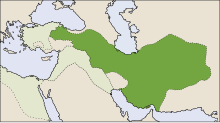
Their arrival in the region is associated with the first wave of migration of the Iranian Aryan tribes at the end of the 2nd millennium BC. er - the beginning of the 1st millennium BC. er . This period coincided with the decline of the main regional powers - Assyria , Elam and Babylonia . Between X and the end of VII century BC. er Medes and Persians were ruled by the Novo-Assyrian kingdom located in northern Mesopotamia . During the reign of the Assyrian king, Shin-shar-ishkun (633 BC. E. - 612 BC. E.) Began to weaken and the Medes stopped paying tribute. In alliance with the Persians and other peoples of the Medes in 612 BC. er captured Nineveh , which led to the destruction of the Novo-Assyrian kingdom in 605 BC. er As a result, the Median kingdom appeared with its capital in Ecbatana , which, along with Babylonia, Lydia and Egypt , became one of the main political centers of the ancient Near East .
In addition to Ecbatana, the largest cities of the Medes were Laodicea , Raga and . According to Herodot's History , the Medes were divided into 6 tribes — beads, Paretakens, strukhats, Arizants, Budias, and magicians [2] . In 553 BC. er Mussel was conquered by Cyrus the Great .
Content
History
The tribes of the Medes are known in history from the beginning of the 9th century BC. er when they moved from Central Asia (according to another version, from the North Caucasus around the Caspian Sea ) to Iran. In the following centuries, the Medes gradually assimilated the non-Aryan tribes of the Gutii , Hurrians , Lulubeis and Kassites , who from the most ancient times inhabited the territory of Iran. At the end of the ninth century. - the beginning of the VIII century. BC er Mussel was conquered by the Assyrians , but around 673 BC. er The Medes, who were led by the Kashtariti, rose and gained independence.
Soon after, the local dynasty, which was founded by Judge Dayucca, began to rule the Medes . His son, Fraort , was able to capture Persia , and with his grandson, Uvahshatra (Greek Kiaksar), the Medes together with the Babylonians conquered a great Assyrian state . At the same time the Mussels departed Northern Mesopotamia ; thereupon Uvahshtra conquers Urartu and attacks the small kingdoms of eastern Asia Minor ; after a long war, he successfully shares with Anatolia Lydia along the river Galis (Kyzyl-Yrmak). Thus, by the end of the reign of Uvakhshatra, the Medes would be at the peak of power, owning all of today's Iran, the Armenian Highlands , Northern Mesopotamia, and the east of Asia Minor.
The capital of Medes was the city of Ecbatana [3] (now Hamadan ). The king of the Medes wore the title of "King of Kings", which, however, did not reflect the universal claims (as they began to interpret later), but the fact that he was originally "the first among equals" vassal kings. The son of Uvahshatry, Ishtuweg (Greek Astyages), tried to strengthen the royal power, which caused the opposition of the nobles. About 550 BC. er The mussel was conquered by the Persian king Cyrus II , as legends say, with the active help of the nobles dissatisfied with Ishtuweg. Persians were related to the Medes; Kir himself belonged to his mother in the royal family (he was the grandson of Ishtuweg), and the rebel nobles viewed the victory of the Persians as a palace coup. However, their hopes were deceived: for one generation, the Medes were pushed aside from all significant posts and could only occupy minor positions in the world power of the Achaemenids , and Midia itself was turned into one of the ordinary satrapies and paid tribute to the Persians, along with other conquered peoples. However, Ecbatana continued to be considered one of the capitals of the Persian (and then Parthian ) kings, where they preferred to spend the sultry summer months.
After the death of Alexander the Great, the last satrap of the Medes, Aturpatak (Atropat), proclaimed himself king in the north of his former satrapia, in the region of Lake Urmia , thus founding the state of Malaya Midia, aka the Media Atropatena, or simply Atropatena . From the word "Atropatena" appeared later the toponym " Azerbaijan ".
Culture
Archaeological research and written sources do not give a lot of information about the history and culture of the state of the Medes. Due to the scarcity of sources in the Medean language, their language is also practically unknown.
The Medes were very close to the Persians in terms of language, religion , and customs. They wore long hair and beards; like the Persians and all the Iranians, they wore pants, short boots and at the waist - akinak (the middle between a long dagger and a short sword), which was the hallmark of a free man. Unlike the Persians, they donned not narrow jackets, but long loose robes with large sleeves (they were quickly adopted by the Persian nobility and despised by the Greeks, considering them to be "women"); they are also distinguished from the Persians by a special type of headgear. Strabo mentions that the Medes wore "sleeves with sleeves", pants, and wore felt hats [4] .
The foot soldiers of the Medes were armed with short spears and woven leather-covered shields. But unlike the Persians, who fought on foot, the Medes were famous for their cavalry. The king of the Medes fought in the center of the army, standing in an Assyrian chariot — a custom adopted by the Persians. Like all Iranian peoples, the Medes used lamellar armor that covered both horsemen and horses.
Religion
The religion that the Medes professed was one of the forms of the ancient Aryan religion that preceded Zoroastrianism . During the Achaemenid era, pure Zoroastrianism was developed among the Medes more than among the Persians, possibly the former state religion under Ishtuweg . The name of the Zoroastrian priests, mobad , is associated with the name of one of the tribes of the Medes, from which the ministers of this cult supposedly originated.
The cult of worshiping the fertility goddess Ardvisura Anahita was spread in Mussel. In the main city of Medes, Ecbatana, there was a temple of the goddess Anahita (among the Greek authors, Anahitis) [5] . Strabo , Roman historian of the 1st century BC e., referring to the ancient Greek historian V in. BC er Herodotus , mentions the rituals of ritual prostitution, and says that the Meadow Women, while serving in the temples of Ardvisur Anahita , “indulge in debauchery. At the same time, they treat their lovers so affectionately that they not only provide them with hospitality and exchange gifts, but often give more than they receive, as they come from rich families who supply them with the means. However, they accept as lovers not the first recipients from strangers, but mostly equal to themselves by social status ” [6] .
Descendants
The appearance of the Savromats was reported by Diodorus of Sicily ( I century BC ): the Scythian kings, as a result of the Near-Asian campaigns, many tribes were resettled, “ ... and the most important were two: one from Assyria ... the other from Media , founded by the Tanais River; these migrants were called Savromats ” [7] . This kind of information is also contained in Pliny the Elder ( 1st century BC ): “ Sarmatians live along the Tanais River, which flows into the sea by two estuaries, according to legend, the descendants of the Medes, also divided into many tribes. The first are the Sauroma women, who are called so because they are descended from marriages with Amazons ” [8] .
Other descendants of the Medes are the same Iranian-speaking Kurds [9] .
Median Language
The question of the Median language is controversial. Some scientists (for example, I. M. Dyakonov . The History of Mussels, M.-L., 1956 ) accept the existence of a single Median language; others (for example, O. L. Vilchevsky. Kurds, M., 1961 ) deny this, considering that the Medes spoke several dialects that, along with the Persian dialect, constituted a single ancient Iranian language. This is explained by the fact that the languages that can be considered descendants of the Median (North-Western Aryan languages : Kurdish , Talysh , Tat , tati and others), do not demonstrate the necessary degree of kinship. In any case, a priori, we can assume that the common language in the Medes was the dialect of the Ecbatana district (as a general rule, according to which the state language is, with few exceptions, the language of the capital and the courtyard). The Soviet Iranianist V.A. Livshits hypothesized that the Baluch language continued the development of one of the dialects of the Median language and Baluchis , thus descendants of one of the peoples of the ancient Mussel. Writing, of course, existed, but its monuments were not found. It is remarkable that the cuneiform writing in which Persian texts are written in Persians is an Urartian cuneiform adapted to the Persian language — hence, it could get to the Persians only through Medes. Median origin (according to the peculiarities of pronunciation) also reveals some words of the ancient Persian language related to the social and state sphere, for example, the word "satrap".
Notes
- ↑ Dyakonov I.M. The History of Mussels. M.-L., 1956.
- ↑ Herodotus. Book 1. Clio. 101.
- ↑ Strabo . Geography . 11: 13: 1
- ↑ Strabo . Geography . 11: 13: 9
- ↑ John Murray. It is intended to be part of the campaign for Alexander, and the Anabasis of Xenophon . - London, 1829. - pp. 68-69. - 325 s.
... Polybius, the most striking object at the Temple of Andes; and Isidore, in later age;
- ↑ Strabo. GEOGRAPHY in 17 books. Reprint reproduction of the text of the 1964 edition. M. / S. L. Utchenko. - “Ladomir”, 1994. - p. 501.
- ↑ Diodorus, II, 43
- ↑ Pliny, VI, 19
- Windfuhr, Gernot (1975), "Isoglosses: A Sketch on Persians and Parthians, Kurds and Medes", Monumentum HS Nyberg II (Acta Iranica-5), Leiden: 457-471
Literature
- Dyakonov I.M. The History of Mussels. M.-L., 1956.
- Young, T. Cuyler (1997), “Medes”, in Meyers, Eric M., The Oxford Encyclopedia of Archaeology in the Near East 3, Oxford University Press, pp. 448—450, ISBN 978-0-19-511217-7
- Young, T. Cuyler, Jr. (1988), "The Medes of the Persons and the Achaemenid empire of the Death of the Cambyses", in Boardman, John; Hammond, NGL; Lewis, DM; Ostwald, M., The Cambridge Ancient History 4, Cambridge University Press, pp. 1-52