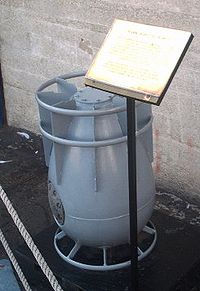
Depth bomb - one of the types of weapons of the Navy , designed to combat submerged submarines .
Depth bomb - a projectile with a strong explosive or atomic charge , enclosed in a metal case of cylindrical, spherocylindrical, drop-shaped or other forms. An explosion of a depth bomb destroys the hull of a submarine and leads to its destruction or damage. The explosion is caused by a fuse that can be triggered: when a bomb strikes a submarine hull; at a given depth; when passing a bomb at a distance from the submarine, not exceeding the range of the proximity fuze. The steady position of the depth bomb of spherocylindrical and drop-shaped form during movement on the trajectory is given by the tail feathers - stabilizer. Subdivided into aviation and ship; the latter are used by launching jet depth charges from launchers, firing from single-barrel or multi-barrel bombers and dropping from stern bombers .
The first depth bomb was created in 1914 and, after testing, entered service with the British Navy [1] . Depth bombs were widely used in the 1st world war and remained the most important type of anti-submarine weapons in the 2nd world war of 1939-1945. Nuclear depth charges were dropped from service in the 90s. Nowadays, depth charges are being intensively replaced by more precise weapons (for example, a torpedo missile ).
At present, the Russian Navy’s aviation consists of the PLAB-250-120 anti-submarine bomb. The weight of the bomb is 123 kg, of which the weight of the explosive is about 60 kg. The length of the bomb - 1500 mm, diameter - 240 mm.
Content
Principle of action
Based on practical incompressibility of water. A bomb blast destroys or damages a submarine hull at depth. In this case, the energy of the explosion, instantly increasing to a maximum in the center, is transferred to the target by the surrounding water masses, through them destructively affecting the attacked military object. Due to the high density of the medium, the blast wave does not significantly lose its initial power in its path, but with increasing distance to the target, the energy is distributed over a large area, and accordingly, the radius of damage is limited.
The fuse is triggered by hitting the boat hull, at a certain depth, or when passing near the hull.
Typically, depth charges roll down from the stern of the ship or shoot them from the bombing installation. Depth charges can also be dropped from aircraft ( airplanes , helicopters ), delivered to the location of a submarine, using missiles.
Depth bombs are notable for their low accuracy, therefore, for the destruction of one submarine, they require a significant number, sometimes around a hundred bombs.
See also
- Towed (at a given depth) mine
Notes
- ↑ Captain-Lieutenant N. Kolyada. About depth charges // Smena magazine, No. 1, January 1941. p.15
Literature
- Kvitnitsky A.A. Fighting submarines (according to foreign data), Moscow, 1963;
- N. A. Shmakov, “Basics of Naval Affairs,” M., 1947. p. 155-57.