Folk square dance ( village , peasant , or just square dance , kadral , urban household dance, urban household easy pair dance [1] , dance [2] ) - a type of folk dance of the Eastern Slavs and the Baltic states , which is characterized by a certain construction and a clear division into pairs and figures. The folk quadrille descended from the French salon dance of the same name and very quickly became popular among the townspeople, and then the peasants. The dance has undergone changes in style and movements, however, its characteristic compositional features remained.
| Folk quadrille | |
|---|---|
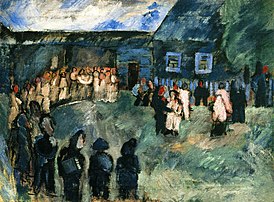 N. Prokoshev , Village Quadrille. 1931 | |
| Direction | pair folk dance of the eastern Slavs and the Baltic |
| Related | |
| Polka | |
| Derivatives | |
| Matanya , Tatyana , Oyra-oyra | |
| see also | |
| Festivities | |
The folk square dance included many figures and drawings from round dances and dances . Usually an even number of couples takes part in the dance, while their number is not limited. Often, quadrille is performed by ditties , which are sung by all performers at the same time, or in turn. In the square dance, each figure is separated from the next by musical pauses, tributaries, claps or bows.
There are national types of dance - Russian, Belarusian, Ukrainian, Lithuanian. And each national has a lot of species. For Russians, for example, it is a Moscow, Ural, Volga quadrille.
Over time, square dance ( quadrille ) became so popular among young people that the word "quadrate" began to mean "to get a partner towards oneself during the dance", "to get to know each other, to get closer, to incline towards reciprocity, to flirt" (first in the and then without it) [3] [4] .
Content
- 1 History
- 2 Russian
- 2.1 Square
- 2.2 Linear
- 2.3 Circular
- 2.4 Lansier
- 3 Ukrainian
- 4 Belarusian
- 5 See also
- 6 notes
- 7 Literature
- 8 References
Appearance History
In Russia, the dance appeared at the beginning of the XVIII century, in the era of the reforms of Peter I. November 26, 1718 a decree was issued on the introduction of assemblies . The main entertainment in the assemblies was dancing. Cavaliers could invite to the dance any of the ladies present. Refusing an invitation was not accepted.
Gradually “the serfs of the Russian noblemen transferred the quadrille form and some figures of this dance to their native villages and villages and, having altered it in their own way, adapted to their tastes” [5] . The quadrille in Russia was most widespread in large trading cities where there were visiting foreigners: Petersburg, Moscow, Yaroslavl, Samara, Nizhny Novgorod. Acquaintance with the new dance took place on the basis of the story of newcomers, serfs, servants of people who sometimes showed some figures of dance in their villages. The whole XIX century quadrille was very popular in Russian urban life. In the Russian peasant environment, the quadrille has spread since the mid-19th century, especially widely - from the late 1890s, and lasted until the 70s of the 20th century. In the villages, the quadrille danced, as did the round dances, accompanied by songs. From the 1920s and the 1930s, songs began to be supplanted by tunes on the accordion [6] .
Having entered the everyday life, the quadrille quickly assimilated, it changed and lost everything in the salon. The melody and manner of performance has acquired a national character. The quadrille acquired peculiar movements, drawings, and manner of execution. Popular names appeared: “kadrel”, “kadrelka”, “kandrel”, “kandryoshka”, etc. The kadril changed to such an extent that later the researchers of everyday dance even noted that the kadril, having got into the people, was distorted beyond recognition [7] .
Russian
Characteristic features of the Russian quadrille:
- the musical size is two quarters (sometimes it is replaced by 6/8);
- it is performed exclusively by an even number of dancing couples;
- there can be at least five figures and a maximum of 12 in a dance.
One of the quadrille varieties is folk dances of six, eight, four , common in the Urals and in the northern regions of Russia [8] .
Three groups of quadrille are distinguished from the huge variety of quadrille in the form of construction: square (angular, angular), linear (double-row) and circular. In some quadrilles, these forms of construction are not always maintained from the first figure to the last. Usually mixed linear and circular or angular and circular quadrille.
Square
A square (“four walls”, “corners”) quadrille is executed in four pairs, facing each other or on the sides of the square. The movement and transitions of pairs occurs diagonally or crosswise.
In square or corner quadrille, there are many different constructions and transitions of pairs:
- All pairs simultaneously converge to the center and then return to their places;
- Two opposing pairs go towards each other and switch places; the other two pairs either stand still or spin;
- Two opposite pairs go towards each other and form a circle; after turning in a circle for a certain number of measures, the dancing pairs diverge back into place or change places;
- Two opposite pairs converge in the center and the guy of one pair passes his girlfriend to the other, and, left alone, dances in front of them. Despite the similarity of the picture, the quadrille sharply differ in execution, since they always dance in the manner inherent in the area in which this quadrille exists.
Linear
Even two pairs can participate in a linear (two-row) quadrille, so it is convenient to dance with a limited number of participants and area. Each pair dances almost always with just the opposite pair. The main movements in a linear quadrille - pairs go at each other at the same time or one pair comes up to another.
Usually, at the beginning of linear quadrille, guys line up on one side and girls line up on the other. Then there is an invitation, and the pairs stand in line opposite each other. This can happen with or without music.
In linear quadrille, their various constructions and transitions of pairs are characteristic:
- The lines simultaneously converge with each other and again diverge into place, or one line stands still, and the other approaches it and then returns to its place; Pairs of one and the other line through one go simultaneously to the pairs of the other line remaining in place, going to the opposite pairs, the participants form circles of two pairs that move in a circle, then the incoming pair, passing under the “collars” of the other pair, returns to their a place; Girls form a circle between two lines of guys; or, conversely, the circle is formed by guys between the lines of girls
- Two lines go towards each other, one line runs under the “gate” of the other; having reached the opposite side, both lines turn around and go to their places, but now another line passes under the “collars”.
Circular
In a circular number of pairs should be less than four. Usually an even number of pairs is involved: 4, 6, less often 8 pairs. But sometimes an odd number can dance - 5 or 7 pairs.
Pairs are arranged in a circle, and move in a circle. The movement of pairs and single transitions occur mainly in a circle, as well as to the center of the circle and vice versa:
- Guys stand in their places, and the girls move in a circle to the next partner. In some cases, on the contrary, guys go around in circles.
- Boys and girls simultaneously circle in opposite directions until they reach their partners.
- Girls or boys converge to the center of the circle and form an “asterisk” or circle, then turn around and return to their place.
- Boys or girls form an inner circle, turning to face the outer circle, the performers make a round with their partners right or left shoulder forward.
Polkas are distinguished into a separate group, for which the movements “heel, nose, top, top, top” are characteristic. This is a polka, a little pole, a polka-butterfly, a polka-bird, a polka with a heel [9] .
Lansier
A special kind of quadrille is Lansier . Lansier appeared in Russia 50-60 years after the quadrille and also went from a salon dance to folk dance. Lansier can also be called “lance”, “lance”, “lince”, “lance”, “lance”. This dance is found in the north of Russia and in Siberia . Lansier performs an even number of pairs, the construction of a square, less often two lines. Pairs cross diagonally. The figures in Lansier are smaller than in the Russian quadrille. The obligatory figure is "shen" [10] [11] .
Ukrainian
Quadrille is widely used in Ukraine. It differs more in choreographic versions of musical material. Some folk quadrille from the choreographic side have one or another plot development, for example, “Shalantuh”. This brings the quadrille closer to such plot dances on everyday topics such as “Mikola”, “Garny Molodichka”, “Torlitsd” and others. Each quadrille figure has the corresponding music, which is based on the modal-intonational and rhythmic features of the Ukrainian melos.
Unlike other genres, domestic dances have long been the focus of attention of composers and choreographers. The square dance consists of many figures (up to 12). The square dance musical material in most cases consists of song melodies (“Oh, don’t go to Gritsu”, “Balamute”, etc.)
In instrumental performance, polka melodies are also used.
Examples of quadrille: “Okhromievsk quadrille”, “Derzhivan quadrille”, “Krasilivsk quadrille”, “Podshilsk quadrille”, “Poliska quadrille”, “Ivanov quadrille”, “Lance (Linets)”, “Ukrainian quadrille” (“Nine quadrille” ), quadrille "Shalantuh."
Belorussian
In Belarus, in the second half of the 19th century, quadrille was widely spread and existed in various local versions. On the basis of some of them, stage models were created in our time: “Lanskaya”, “Tureyskaya”, “Smargonskaya” and others. And sometimes under independent, separate names: “Lantsyay”, “Vrubel”, “Chizhyk”, “Goby ”,“ Shore ”,“ Najnitsa ”and others. Quadrille can be found in Belarusian villages and villages even today. A distinctive feature of the Belarusian quadrille is the inclusion of soloing, either separately or in pairs.
In the Belarusian quadrille them from 4 to 12 figures. Usually, the factory owner shouts out the name of the figure before starting. The most famous are:
- "Passage" - sedate, with playful narcissism.
- "Gates" - a small pattern in which carefully crafting each pa.
- "Little Ring" - running with rapidly changing circles.
- Lyavonikha is cheerful and cheerful.
For example, the eight-figured dance: “Lyanuyay”: 1. “passage” 2. “gate” 3. “meeting” 4. “column” 5. “cross” 6. “rope” 7. “run” 8. general polka.
The quadrille figures are often made up of familiar dances: at the beginning of the Lady , in the middle of the Cossack or Ruskach, and at the end of Lyavonikhu . Sometimes the square dance became like a dance suite, parts of which are connected only by a certain sequence of figures. For example: 1. gallop 2. oberek 3. march 4. mazurka 5. nettle 6. waltz 7. Russian 8. polka. Music obeys choreography and breaks off as soon as the performance of a particular figure ends. Quadrille is rarely performed with songs.
The most frequent quadrille composition is from two to 16 pairs. Typical drawings are circles, crosses, gates, columns, lines, stars. Movements - pas de basque , chassis , glide paths , tributaries , etc. Characteristic features of the Belarusian quadrille: dances “open” and “close” with the general circular movement of the participants.
A characteristic of the Belarusian quadrille is the repetition by each pair or participant in turn of a given figure or fragment of a figure. After dancing the knee with one partner, the girl must do the same with all the others.
There are quadrille, not executed in pairs, but two or more triples. As a rule, they are made up of a young man and two girls (for Russians this kind of quadrille is called "Shester").
According to the executive style, Belarusian square dance is divided into 2 types: slow power and fast.
See also
- Tank
- Russian dance
Notes
- ↑ Martynova N. E. Pair dances as a form of traditional Russian choreography // Traditions and Modern Culture and Mastastva: In 5 parts. Part 5: Problems of seizure and papuleryzatsy cultural culture of the fellow: mat. International Navukova Practical Conference: Minsk, 25–26 beauty of 2013 - Minsk: Rights and Economy, 2013. - 144 p. - ISBN 978-985-552-238-7 (part 5) - S. 84, 85
- ↑ Afanasyev A. B. “Dialogue of cultures” in musical and choreographic folklore: History and modernity, sociocultural and pedagogical aspects // Bulletin of the Russian Ballet Academy named after A. Ya. Vaganova. No. 1 (42) 2016 - S. 90
- ↑ Crop // Kuznetsov’s Explanatory Dictionary
- ↑ Otin E.S. Materials for the dictionary of profanity (continued) // East Ukrainian Linguistic Collection. Fifth Edition - Donetsk: Donetsk Region, 1999. - P. 183
- ↑ Goleizovsky K. Ya. Images of Russian folk choreography. - M .: Art, 1964 - p. 349
- ↑ Afanasyev A. B. “Dialogue of cultures” in musical and choreographic folklore: History and modernity, sociocultural and pedagogical aspects // Bulletin of the Russian Ballet Academy named after A. Ya. Vaganova. No. 1 (42) 2016 - S. 91
- ↑ Afanasyev A. B. “Dialogue of cultures” in musical and choreographic folklore: History and modernity, sociocultural and pedagogical aspects // Bulletin of the Russian Ballet Academy named after A. Ya. Vaganova. No. 1 (42) 2016 - S. 91
- ↑ Quadrille // Musical Encyclopedia
- ↑ Martynova N. E. Pair dances as a form of traditional Russian choreography // Traditions and Modern Culture and Mastastva: In 5 parts. Part 5: Problems of seizure and papuleryzatsy cultural culture of the fellow: mat. International Navukova Practical Conference: Minsk, 25–26 beauty of 2013 - Minsk: Rights and Economy, 2013. - 144 p. - ISBN 978-985-552-238-7 (part 5) - S. 85, 86
- ↑ Lance // Dance Dictionary
- ↑ Lance // Great Soviet Encyclopedia
Literature
- Bazhonkin A.V. Nizhny Novgorod quadrille and dance - Gorky, 1990
- Quadrille // Explanatory Dictionary of the Living Great Russian Language : in 4 volumes / auth. V.I. Dahl . - 2nd ed. - SPb. : Printing house of M.O. Wolf , 1880-1882. - T. 2.
- Timoshenko L. G. Russian quadrille // Russian folk dance: regional features . - Tomsk: Tomsk State Pedagogical University, 2013.
Links
- Spiridonova T. V. Regional features of folk dances of the Irkutsk region
- Quadrille folk dance: types and features
- Quadrille is a lively, fast dance. Varieties of quadrille
- Encyclopedia of Dance: Quadrille
- Quadrille - Russian folk dance
- From the depths of centuries to our time. Quadrille: ballroom dance or folk dance?
- Features of the Russian quadrille