“Guest in the House” , later appeared under the name “ Satan in Skirts ” ( English Satan in Skirts ) is a film noir directed by John Brahma , which was released in 1944 .
| Guest at home | |
|---|---|
| Guest in the House | |
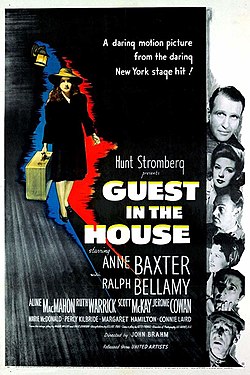 | |
| Genre | Film noir Psychological thriller |
| Producer | John Bram |
| Producer | Hunt stromberg |
| Author script | Ketty Frings Hagar Wilde, Dale Yunson (play) |
| In the main cast | Anne Baxter Ralph Bellamy Alin mcmagon |
| Operator | Lee Garms |
| Composer | Werner Janssen |
| Film company | Hunt stromberg productions United Artists (distribution) |
| Duration | 117 min (or 120 min) |
| A country |  USA USA |
| Tongue | English |
| Year | 1944 |
| IMDb | ID 0036886 |
The film tells about a mentally ill young woman ( Anne Baxter ), who comes as a bride to a strange house, gradually destroying the relationship between loved ones.
In April 1944, the film began to be directed by director Lewis Milestone , but a month after starting work right on the set, he lost consciousness from an attack of appendicitis , after which John Bram replaced him as a director. The production of the film at various stages was also attended by directors John Cromwell and Andre De Tot .
The film received mixed reviews from critics. It was noted that the plot of the picture is extremely far-fetched and not convincing, however, the acting was positively evaluated.
The film received an Academy Award nomination for Best Music (written by Werner Janssen).
Content
Story
Elderly lady Marta Proctor ( Aline McMagon ) recalls a “very strange story” that happened in her family’s house:
One summer, her nephew, Dr. Dan Proctor ( Scott Mackay ), and her fiancée Evelyn Keith ( Anne Baxter ), whom the doctors, due to poor health, recommended to spend some time in a quiet place in nature, came to their large country family home in New England . Entering the house, Evelyn can not refrain from admiring how everything is arranged, and then emotionally greets each of its inhabitants - Douglas, Dan's older brother, who works as an advertising artist ( Ralph Bellamy ), Douglas's wife named Anne ( Ruth Warrick ) and their daughter Lee ( Connie Laird ), a Douglas model named Miriam ( Marie MacDonald ), aunt Martha Proctor, a family friend of Edward Hackett ( Jerome Cowan ), and also servants - a middle-aged married couple Hilda ( Margaret Hamilton ) and John ( Percy Hilbright ). The family meets Evelyn very sympathetically and benevolently, knowing about her emotional and physical problems, which are associated with a difficult childhood under the oppression of an alcoholic father. Anne gives Evelyn a separate room, where she finds a gramophone and records, among which is a record with her favorite nocturne of Franz Liszt's “ Dreams of Love ”. That evening, when Douglas and Anne are happily spinning in a love dance, Evelyn suddenly shouts. As it turns out, Lee decided to show the guest her bird in a cage, but she is terribly afraid of the birds and horrified of them. To reassure Evelyn, Douglas quickly throws her portrait on the floor lamp shade. When everyone disagrees, Evelyn takes out his secret diary, in which he writes about his indifference and even aversion to Dan and about the passion that has arisen in relation to Douglas. On Sunday, when the whole family goes to church, Miriam and Douglas stay to work in his studio. Having decided to conquer Douglas, Evelyn intends to spoil their relationship, but she is disturbed by Dan, who unexpectedly came from the city to see his bride. Evelyn is clearly not happy to meet with him and accuses the groom of insane jealousy, after which he insists that he immediately return to work, where the sick need him. Dan meekly collects his things and drives back to the city. Soon, Evelyn secretly sets Lee against Miriam, as a result of which the little girl concludes that her father has an affair with the model. Upset Lee shares her sad thoughts with Hilda, who tells John about this, and in the end, rumors reach Martha. To avoid possible problems, Martha suggests that Douglas take a break from work, and send Miriam to the city, but he does not want to listen to her. One afternoon, Douglas and Miriam set off for the station together to pick up a paint thinner sent to him from the city. After they return home in the middle of the night in a fair amount of drinking, Hilda, outraged by their behavior, as well as by unjust claims to their work, claims to be quitting. Left alone with her husband, Anne directly asks about his relationship with Miriam, but not wanting to listen to his wife's suspicions, Douglas refuses to talk to her, after which she complains about the model's unjust attacks. When Miriam goes to Ann to explain everything to her, she defiantly slams the door in front of her. Offended by this attitude, Miriam picks up his things that evening and leaves for the city. Evelyn immediately suggests taking Miriam's place and working for Douglas as a model.
It takes several weeks. One day, Hackett arrives to visit, who received news of problems with Miriam. Anne complains to him that with the appearance in the house, Evelyn Douglas abandoned his work and instead began to paint for the local church a picture of Saint Cecilia , for which Evelyn poses for him. At the same time, Douglas was constantly dissatisfied with his work and began to drink hard. At this moment, with the music of “Dream of Love”, Lee descends the stairs, and Ann bitterly notes that the girl is starting to copy some features of Evelyn. Realizing that Evelyn sowed seeds of discord in the Proctor family, Hackett persuades Anne to drive the guest out of the house. However, when Ann asks Evelyn to move to Martha, she accuses her of unreasonable jealousy and refuses to leave. When Douglas returns home, Evelyn in a hysterical state accuses Ann of unjust attacks, after which she begins to sob. Believing that the wife is to blame for everything, because of which Miriam was forced to leave before this, Douglas pushes Ann away and runs out of the house. Evelyn gleefully watches as Ann collects her things and leaves, after which she destroys her farewell note to her husband. Douglas, who returned soon, is horrified when Evelyn tries to hug and kiss him, while fantasizing about their life together. He immediately leaves for the station, where he finds Anne, who never boarded the train. He asks his wife for forgiveness, and, having reconciled, they return to the house. Upon returning home, Douglas promises Evelyn to arrange her in a good sanatorium if she refuses to be engaged to Dan. Left alone, Evelyn calls the city of Dan, and the next morning he arrives. Meeting Dan, Evelyn in front of everyone invites him to get married immediately. At this point, Douglas finds on the table in the living room a forgotten Evelyn diary, from which he reads aloud several paragraphs about her negative attitude towards Dan and her love for Douglas. After that, Evelyn asks Douglas to read the entry on the last page, where she writes that she no longer loves Douglas. Loving Dan believes in the honesty and decency of Evelyn and insists that he marries her. While he leaves to pick up some of his belongings, Evelyn suddenly sees an empty bird cage, knowing that the bird has recently died. Remembering Evelyn’s psychic reaction to birds, Aunt Martha deceives her by saying that the bird just flew out of the cage and flies around the house. In a panic from a possible collision with a bird, Evelyn jumps out of the house, reaches a steep cliff and rushes into the sea.
Cast
- Ann Baxter - Evelyn Heath
- Ralph Bellamy - Douglas Proctor
- Aline McMagon - Aunt Martha
- Ruth Warrick - Anne Proctor
- Scott Mackay - Dr. Dan Proctor
- Marie MacDonald - Miriam
- Jerome Cowan - Mr. Edward Hackett
- Margaret Hamilton - Hilda, Servant
- Percy Kilbride - John Butler
- Connie Laird - Lee Proctor
Filmmakers and Leaders
German-born director John Bram arrived in Hollywood in 1937, where in the 1940s he became famous for staging such noir thrillers as “ The Resident ” (1944), “ Hanover Square ” (1945), “ Medallion ” (1946) and “ Bloody ” money ”(1947) [1] [2] .
Starring Anne Baxter at the time of the shooting of this film was already a recognized actress, known for her main roles in the dramas of Jean Renoir “ Swamp Water ” (1941) and Orson Welles “The Magnificent Ambersons ” (1942), as well as in the military dramas “ Five Tombs on the way to Cairo ”(1943) and“ Sullivans ”(1944) [3] . After this film, in 1947, the actress was awarded the Oscar for supporting actress in a drama based on Somerset Maugham’s novel The Razor's Edge (1946), and in 1951 she was nominated for an Oscar for starring in a drama about theatrical life " All About Eve " (1950) [4] . Among Baxter’s most significant films are the crime scene Yellow Sky (1948), Alfred Hitchcock’s thriller I Confess (1953), and Cecil De Mill 's biblical drama The Ten Commandments (1956) [5] .
In the 1930s, Ralph Bellamy was already a well-known actor who played significant roles in the melodrama "The Unlawful " (1932) and the crime melodrama " The Photo Hunter " (1933), and in 1938 he was nominated for an Oscar for best second plan in the romantic comedy "The Terrible Truth " (1937) [6] . After this picture, he played in such popular films as the comedy “ His Girlfriend Friday ” (1940), the horror film “ The Wolfman ” (1941), and even later in the psychological horror film “ Rosemary's Baby ” (1968), the comedy “ Change places "(1983) and the melodrama" Pretty Woman "(1990) [7] .
Movie Story
The film was based on the play of the same name in 1942, written by Hagar Wilde and Dale Yunson [8] [9] .
According to Hollywood Reporter , in December 1943, Joan Harrison , known for her work with Alfred Hitchcock , was invited as co-producer and screenwriter, whom she planned to write with Elliott Paul. However, due to disagreements with producer Hunt Stromberg in January 1944, she quit [1] , and in the end the script was written by Ketty Frings [9] .
In April 1944, the director of the film was assigned to the director Lewis Milestone , but in May, he lost consciousness right on the set. Initially, the director John Cromwell was offered to continue the work, but he still did not manage to get to work, so at that moment he was forced to shoot additional scenes for the film “ Since You Left ” (1944). Then John Bram was appointed as a director [1] . According to Linda Rasmussen, director Andre De Tot also took part in the production of the film [10] .
Anne Baxter was rented for filming in this film from Twentieth Century Fox . Initially, the producer of the film, Hunt Stromberg, planned to invite Joseph Cotten to the main male role, to the role of Dan - Cornel Wilde , and to the role of Lee - Joan Carroll , but for various reasons they had to abandon these plans [1] .
Panoramic shooting for the picture was carried out on the coast in Maine , additional street scenes were shot at the ranch of the Universal Studios film company in California [1] .
Criticism of a film
Overall rating of the film
Immediately after the release of the film on the screens, the New York Times columnist Bosley Krauser gave him a sharply negative assessment, noting that this was the “craziest and most incredible story” of those that had “disturbed the screen” lately. According to him, on the theatrical stage, the play on which the film was staged had “moderate success”, but as a film she faces “ridicule and quick failure”. The critic believes that “the blame for this lies both with the story itself, which is cheap, far-fetched and about as logical as the song of a pop singer,” and with all those who participated in the work on the film. The critic draws attention to the fact that the film "does not explain the reasons for the malicious intent of the lady, and the ease with which she achieves her goals looks unconvincing." Summing up, Krauser notes that “the recognized producer Stromberg ” when working on this picture “lost his grip” [11] . The contemporary film historian Dennis Schwartz also did not appreciate the painting, calling it "unsatisfactory, heavyweight and devoid of logic theater melodrama", which "is not exciting and not convincing." According to Schwartz, the film can only serve as a warning against people with hysterical behavior and shows "how to sow the seeds of discord if everything is not in order in the family" [9] .
Other modern film critics perceived the film, mostly more favorably, although they drew attention to its shortcomings. In particular, Tony D'Ambra described the picture as “one of the less significant films of noir”, while “interesting and strange” [12] . Spencer Selby also drew attention to the film, writing that it was “a grim psychological picture in which a mentally unhealthy young woman has a stunning effect on a happy family” [13] . TV Guide magazine came to the conclusion that this is “sometimes an unconvincing suspense film”, but “a good cast prevents it from falling face down into the mud” [14] . Leonard Moltin praised the painting, calling it "atmospheric, sometimes exciting melodrama about a neurotic young woman and her impact on the family of his fiancé" [15] . Linda Rasmussen also positively evaluated the tape, writing that “it is a fascinating, sensual psychological melodrama that is well-posed and played” [10] .
Evaluation of the work of the director and creative team
Krauser did not appreciate John Brahm’s production, writing that it “is so overloaded with conversations and paraphrases that as a result, everything moves slowly and heavily” [11] .
Linda Rasmussen drew attention to the "excellent film music composed by Werner Janssen " [10] . For the music for this picture, Janssen was awarded an Oscar nomination [1] [10] .
Actor rating
Krauser did not appreciate the acting, writing that " Anne Baxter plays the destroyer with such pretentious modesty that everyone except the blind sees that she is up to something." “No less ridiculous,” according to Krauser, and Ralph Bellamy in the role of “a middle-aged byronic handsome who tries to be boyishly alive and in love, and at the same time important and wise” [11] .
Most film experts, however, praised the acting. So, Rasmussen expressed the opinion that “Baxter gives out a good game in the role of a mentally unstable young woman who cannot cope with her obsessive passions” [10] . D'Ambra also believed that Baxter was able to make "the necessary eerie impression in the role of a madwoman with a pathological and ultimately fatal fear of birds." As for Bellamy in the role of a “happily married man with whom she falls in love”, he essentially plays “the same right guy” whom he played in the film “ His Girlfriend Friday ” (1940) [12] . According to Moltin, “Bellamy is extremely attractive in a rare romantic role, and Ann works hard for her role, which is spiritually close to her (future) role of Eva Harrington in the film“ All About Eve “(1950)” [15] . Like many other critics, Michael Keeney notes that “Baxter enjoys playing the role of a crazy guest from Hell with an insatiable need to put everything under control, and Bellamy is ideal in the role of a cheerful, loving husband, whose emotional openness and innocence bring him to great misfortune " [16] .
Notes
- ↑ 1 2 3 4 5 6 Guest in the House (1944). History . American Film Institute. Date of treatment April 1, 2019.
- ↑ Highest Rated Feature Film Titles With John Brahm . Internet Movie Database. Date of treatment April 1, 2019.
- ↑ Highest Rated Feature Film Titles Released No Later Than December 31, 1944 With Anne Baxter . Internet Movie Database. Date of treatment April 1, 2019.
- ↑ Anne Baxter. Awards Internet Movie Database. Date of treatment April 1, 2019.
- ↑ Highest Rated Feature Film Titles With Anne Baxter . Internet Movie Database. Date of treatment April 1, 2019.
- ↑ Ralph Bellamy. Awards Internet Movie Database. Date of treatment February 21, 2019.
- ↑ Highest Rated Feature Film Titles With Ralph Bellamy . Internet Movie Database. Date of treatment April 1, 2019.
- ↑ Guest in the House . Internet Broadway Database. Date of treatment April 1, 2019.
- ↑ 1 2 3 Dennis Schwartz. How things get resolved is for the birds . Ozus' World Movie Reviews (September 27, 2014). Date of treatment April 1, 2019.
- ↑ 1 2 3 4 5 Linda Rasmussen. Guest in the House (1944). Synopsis AllMovie. Date of treatment April 1, 2019.
- ↑ 1 2 3 Bosley Crowther. The Screen . The New York Times (February 16, 1945). Date of treatment April 1, 2019.
- ↑ 1 2 Tony D'Ambra. Guest In The House (1944): Sex in the strangest places . filmsnoir.net (16 August 2013). Date of treatment April 1, 2019.
- ↑ Selby, 1997 , p. 148.
- ↑ Guest in the House (1944 ) . TV Guide. Date of treatment April 1, 2019.
- ↑ 1 2 Leonard Maltin. Guest in the House (1944). Movie Review Turner Classic Movies. Date of treatment April 1, 2019.
- ↑ Keaney, 2003 , p. 172.
Literature
- Spencer Selby. Dark City: The Film Noir . - Jeffeson, NC: McFarland & Co Inc, 1997. - ISBN 978-0-7864-0478-0 ref = Selby.
- Michael F. Keaney. Film Noir Guide: 745 Films of the Classic Era, 1940–1959 . - Jefferson, North Carolina, and London: McFarland & Company, Inc., Publishers, 2003. - ISBN 978-0-7864-1547-2 .
Links
- Guest at home on IMDb website
- Guest at home on AllMovie website
- Guest at home on the website of the American Film Institute
- Guest at home on Turner Classic Movies