Prevalitana ( Latin Praevalitana , also spelling Prevalitana , Prevaliana , Praevaliana and Prevalis ) is a province of the late Roman Empire that existed between 284 and 600 years. The province covered parts of modern Montenegro , Albania (north) and Serbia (southwest). The capital is Skodra .
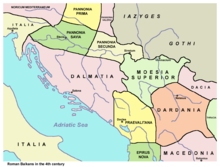
Background
The Roman Empire conquered the Adriatic and the Balkans after the Third Illyrian War in 168 BC. The Romans defeated the Illyrian king Gentius in 168 BC and captured him, bringing him to Rome three years later. Four puppet republics were formed, subordinate to Rome. Later, based on them, the province of Illyria was created, the capital of which was Skodra. In 10 AD, Illyria was divided into Pannonia and Dalmatia , the latter covering the Dinar Alps and almost the entire East Adriatic coast (including the territory of modern Montenegro).
Education
The province of Prevalitan was formed by decree of the emperor Diocletian on the basis of the southeastern part of the former Dalmatia and became part of the Moesian diocese, one of the 12 dioceses created by Diocletian in the tetrarchy system [1] . Later, the Moesian diocese was divided into Dacian and Macedonian dioceses (in the north and south, respectively). The prevalence was initially part of the Macedonian diocese, but later became part of the Dacian diocese, which also included the Mediterranean Dacia , Coastal Dacia , Dardania and Inner Moesia . In 395, after the split of the Roman Empire, it entered the Eastern Roman Empire, the Praetorian prefecture of Illyricum. In 413, part of the province of Macedonia Salyutaris departed for Prevalence (the other part went to Epirus Nova) [1] .
Disappearance
After the collapse of the Western Roman Empire, Prevalitanus remained under Byzantine rule. In the 530s, under Justinian, the Byzantines used the province as a base for preparing for a campaign of the Ostrogoths during the Gothic Wars . During the Great Migration of Peoples, the province was inhabited by Pannonian Avars and Slavic tribes [2] , and in the 6th – 7th centuries they were almost completely plundered and ruined, destroying large cities.
Cities
The first written records of settlements in South Dalmatia date from the Roman province of Prevalitan and the Roman city of Birsiminium, located near the Illyrian city of Doklei. Dokleya was a large city at that time (its population was from 8 to 10 thousand people), and received its name by the tribe of doklets living in that territory. Around 400 AD, Dokley's Archdiocese was formed, which existed until 927. The reports lived in the fertile valley of the Zeta River, which connected the coast and the continental part of modern Montenegro and ensured the economic growth of those lands. Another tribe, the Labet, lived between Lake Skadar and the place where Podgorica is now; their capital was Mefeon (now Medun), and they themselves had a well-developed social and military system.
From the 5th century AD, the Prevalans began to be settled by Slavic and Avar tribes who plundered the locals and ravaged the cities. Dokley was wiped off the face of the earth, and soon the Slavs built their city, which was named Ribnitsa (now Podgorica). Non-Romanized Albanian tribes went to the highlands. Until the X century, the Romanized city, not subjected to ruin, remained Akruvium (now Kotor), which became the commercial center of the region. Also known at that time were the cities of Anderva ( Niksic ) and Rizinium (Risan).
Notes
- ↑ 1 2 A Companion to Ancient Macedonia , pp. 547-549
- ↑ Bury, JB History of the Later Roman Empire from Arcadius to Irene . - Cosimo Classics, 2008 .-- ISBN 9781605204055 .
Literature
- John Van Antwerp Jr. Fine The Early Medieval Balkans: A Critical Survey from the Sixth to the Late Twelfth Century . - Ann Arbor, Michigan: University of Michigan Press, 1991.
- Gyula Moravcsik. Constantine Porphyrogenitus: De Administrando Imperio . - 2nd revised. - Washington DC: Dumbarton Oaks Center for Byzantine Studies, 1967.
- Le christianisme sur le sol de l'Illyricum oriental jusqu'à l'arrivée des Slaves . - Institute for Balkan Studies, 1996. - ISBN 978-960-7387-10-3 .