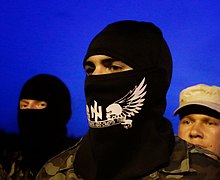
Neo-Nazism in Ukraine is a phenomenon of modern Ukrainian society, associated with the radicalization of public consciousness, in which the ideas of ultra-right extremism are becoming more widespread. International media [ what? ] indicate that striking manifestations of this trend can be considered pogroms of gypsies , anti-Semitic attitudes, attacks on supporters of feminism and activists of LGBT communities . The severity of this problem was reflected in publications of the World Jewish Congress , the Simon Wiesenthal Center , Human Rights Watch , Amnesty International and Freedom House [1] .
Content
Genesis of the phenomenon
As a rule, in the countries of Eastern Europe , representatives of the working class become sympathizers of ultra-right movements. The motivation for such a political choice is often hatred of the nouveau riche and the diverse minorities who are or are involved in crime. Minority groups ( Jews , Gypsies, and others) are part of all Eastern European states, and they are convenient “objects” for splashing out, in the words of , “ xenophobia and paranoid fear” [2] . Nevertheless, some post-Soviet peoples of Eastern Europe - Czechs , Poles , Slovaks , Hungarians - demonstrate a much more positive attitude towards a democratic arrangement of society than, for example, Russians , Ukrainians or Belarusians . More democratic traditions give a chance to keep in check the right-wing forces and prevent them from gaining power in their own hands [3] .
Due to a number of circumstances in its development, the ultra-right environment in Ukraine has evolved in two different directions: as official political parties and as a combination of network communities, radical groups and paramilitary groups consisting of volunteers with right-wing radical views [4] . It is noted that the spectrum of the right wing of Ukrainian nationalism has a very heterogeneous composition, but several key organizations stand out in it. First of all, it is the Ukrainian National Assembly - Ukrainian National Self-Defense , which is heading towards building a pro-Western unitarian nationalist state [5] . This organization took part in military conflicts on the side of Georgia against Abkhazia in 1993 and on the side of Chechen separatists against Russian troops. In the mid-1990s, the level of her chauvinism and extremism sharply increased, and in 1994, the intention was even declared to gain power by extra-parliamentary means [6] .
In addition to UNA-UNSO, the populist party “ Freedom ” [7] , as well as the organization “ Sovereign Independence of Ukraine ”, striving to create an ethnically homogeneous Ukraine and promised to set up internment camps for Russian speakers, attracted a lot of attention to themselves [5] . This party refused to allow anyone other than Ukrainians into its ranks, attacked communists and pro-democratic nationalists, opposed mixed marriages and immigrants of other nationalities to the country, and also called for the deportation from Ukraine of Jews, gypsies and Armenians who are not were its permanent residents. In the end, the party left the political arena, and then ceased to exist [8] .
In 2013, the Right Sector association appeared, which served as the police opposing Russia [5] and initially developed as a formation for a radical non-political struggle. It included militants from Trizub , Patriot of Ukraine , UNA-UNSO, White Hammer and several others. At the same time, each of them had nationalist views, had a paramilitary organization, and did not have the opportunity to be represented in Ukrainian political life [9] .
Representatives of right-wing radical parties also participated in Euromaidan . Despite their relatively small number, they showed a high level of activity and became a visible minority in the total number of protesters [9] . It was noted that the ability of right-wing extremists to quickly mobilize their network of supporters became a critical factor in the violent confrontation, but they were not able to use it in the electoral process - for example, in the May 2014 elections [10] .
During the change of power in 2014 and after it, the symbols of the Organization of Ukrainian Nationalists and its leader Stepan Bandera were widely used [5] . A number of symbols of Ukrainian radicals are an obvious legacy of Nazi emblems and slogans, such as, for example, Wolfsangel from the emblem of the German SS division Das Reich [11] . This sign is used by the Social-Nationalist Party of Ukraine, then the Freedom Association, as well as a number of Ukrainian and European neo-Nazi groups [12] .
The ideological foundation
According to the international organization Freedom House , in Ukraine there are many well-organized radical ultra-right groups [13] . In addition, almost all of the nationalist parties of Ukraine adopted the ideas of Ukrainian ethnic nationalism , social conservatism , anti-communism and anti-migrant rhetoric. In the positions of the UNA-UNSO, Freedom and New Power parties, white racism is clearly or openly manifested, which becomes most evident in the framework of their anti-migrant speeches [14] .
The attitude of neo-Nazis towards politically motivated violence is that it is permissible to use it, for example, to reorganize public life to such forms that cannot be achieved by exclusively non-violent methods. Moreover, extremist groups systematically use physical violence against their political opponents, promote aggressive hatred, and glorify historical examples of terror and ethnic cleansing. . When this criterion is taken into account, the definition of extremist organizations includes a number of large political organizations of a national scale: the all-Ukrainian association “Freedom”, the party “ National Corps ” and the association “ Right Sector ” [15] . In addition to them, there are a large number of smaller extremist groups, each of which numbers from several dozen to several hundred members, such as the Volunteer Movement of the OUN , the Brotherhood, C14 , the Carpathian Sich , and several others [16] .
The key ideas of the radical right-wing groups are based on traditional Ukrainian nationalism and are closely intertwined with it, but do not confuse these phenomena. Ukrainian nationalism acquired especially strong positions only in Western Ukraine . It was there that in the interwar years, in opposition to the harsh repressions of the Polish authorities, Ukrainiancentrism was firmly rooted as a reaction to failure after all attempts to gain independence of the period 1917-1920 [17] . The further historical legacy of such ultranationalist organizations as the OUN and UPA has passed the period of mythologization and romanticization of the post-Soviet period [18] . Many former members of these organizations settled in Western countries after the Second World War and, according to the Swedish historian Per Rudling , developed their own historical mythology for self-service, which glorified the OUN-UPA militants and ignored their war crimes [19] . It is worth noting that all the nationalist movements of Ukraine declared themselves the legitimate heirs of the ideology of the OUN-UPA and in every possible way emphasized their connection with them [18] .
Currently, on the basis of common views, Ukrainian radicals actively interact with the right-wing parties of other countries, for example, the Ukrainian National Assembly cooperates with the ultra-right National Democratic Party of Germany , and the Freedom party is a member of the Alliance of European National Movements [20] . According to the Russian philosopher A. Dugin , the nature of modern Ukrainian Nazism has instrumental properties, since it acts purely in the interests of the international oligarchy to solve its geopolitical tasks. It cannot be eradicated without affecting the Ukrainian oligarchs, large private capital and the pro-Western elites of society [21] . The American professor Stephen Cohen, in the pages of The Nation magazine, expressed his rejection that Ukrainian neo-Nazis receive full support from the Washington administration. According to Cohen, there is no doubt that the Ukrainian radicals were involved in the appearance of snipers on Independence Square, the bloody events in Odessa in May 2014, the creation of pro-Nazi formations like the Azov regiment, and the constant attacks by street " attack aircraft " against gays, Jews, and ethnic Russian [22] .
Current Situation
According to Freedom House , in its current form, Ukrainian right-wing radicals pose a serious threat to the democratic development of public institutions. If during the first 20 years of Ukrainian independence they were obvious marginals in the political field, then after Euromaidan their views began to gain considerable weight among broad sections of Ukrainian society. Opinion polls suggest that radical parties do not have high chances in parliamentary and presidential elections. However, many of these groups have rich combat experience, a paramilitary organization, and even access to weapons [23] . Their extremist views still remain unpopular among ordinary voters, but these groups were able to take root in society, demonstrated their ability to organize violence and firmly established their presence in many regions of the country. Over the years, their visibility in the political life of society is only growing, and this became especially evident after the change of power in 2014 [24] . In connection with the ensuing armed conflict, a number of paramilitary volunteer groups emerged, which included, among others, members of the Right Sector, Freedom, the Social-National Assembly and close organizations. Neo-Nazis continue to remain in his leadership of the “Azov” regiment, xenophobia, which is shown on paper as patriotism and social activity, has not disappeared in activity [25] .
The intensity of the patriotic mood in connection with the development of armed conflict in the east of the country coincided with an obvious increase in the level of hatred in public discourse and the level of violence directed at vulnerable parts of Ukrainian society (for example, the LGBT community ). The findings of these observations were supported by recent research results from the Council of Europe [13] .
A number of Ukrainian non-governmental organizations draw attention to the fact that such activity threatens the holding of authorized rallies and public meetings dedicated to many politically controversial issues, such as anti-war actions, the rights of members of the LGBT movement, etc.
In addition, violence in the symbolic form of vandalism also aims at public institutions and memorials related to national minorities: the Polish military cemetery in Volhynia, monuments to the victims of the Holocaust , monuments to the Hungarian national and cultural heritage in Transcarpathia and churches belonging to the Russian Orthodox Church of the Moscow Patriarchate [26] [27] . A series of inhumane attacks in several Ukrainian cities at once during the March 2018 demonstrations forced Amnesty International to make an unusually harsh statement that the Ukrainian government was rapidly losing its monopoly on violence [13] .
According to the conclusion of Freedom House , all this is accompanied by an imposition of an atmosphere of fear, which sharply intensified after the attack of nationalists from the C14 group on the Kiev antiwar leader Stanislav Sergienko. Moreover, in many cases, attackers rarely receive punishment for the commission of their crimes, and the Ukrainian police prefer not to take into custody of them, but peaceful demonstrators [13] [28] . Moreover, the radical group C14 concluded an agreement with the Kiev city administration, according to which the nationalists organized a “municipal guard” to control the streets of the capital. Three such units appeared at once in Kiev and at least 21 in other cities of Ukraine [13] . In addition, the Ukrainian government appoints dubious individuals to government posts. For example, Andrei Biletsky , known for his racist statements, received the rank of police lieutenant colonel [25] [29] . According to Ukrainian analyst Mikhail Pogrebinsky , the Ukrainian government deliberately legitimizes radical Russophobic organizations by integrating their activists into law enforcement [30] .
According to many analysts, the direct confrontation between Poroshenko and Avakov may not end in favor of the president, especially since he is often threatened by Ukrainian ultranationalists who even call for a revolution. It is possible that this is what makes the head of state put up with his interior minister, since only he is able to keep extremist groups in check [13] .
Notes
- ↑ Lev Golinkin. Neo-Nazis and the Far Right Are On the March in Ukraine (English) // The Nation . - New York, 2019 .-- ISSN 0027-8378 .
- ↑ Merkl, Weinberg, 2005 , Introduction, p. 15.Original text"... xenophobia and paranoid fear."
- ↑ Merkl, Weinberg, 2005 , Introduction, pp. 15-16.
- ↑ Rydgren, 2018 , The Radical Right in Post-Soviet Ukraine, p. 862-863.
- ↑ 1 2 3 4 Camus, Lebourg, 2017 , In Russian Vicinity, p. 232.
- ↑ Rydgren, 2018 , The Radical Right in Post-Soviet Ukraine, p. 865.
- ↑ Rydgren, 2018 , The Radical Right in Post-Soviet Ukraine, p. 867,868,869.
- ↑ Rydgren, 2018 , The Radical Right in Post-Soviet Ukraine, p. 866.
- ↑ 1 2 Rydgren, 2018 , The Radical Right during and after the Revolution of Dignity, p. 871.
- ↑ Rydgren, 2018 , The Radical Right during and after the Revolution of Dignity, p. 872.
- ↑ Camus, Lebourg, 2017 , From Nazism to Neo-Racism, p. 77.
- ↑ Rydgren, 2018 , The Radical Right in Post-Soviet Ukraine, p. 868.
- ↑ 1 2 3 4 5 6 J. Cohen Commentary: Ukraine's neo-Nazi problem Reuters, 2018
- ↑ Wodak, Khosravinik, Mral, 2013 , Main actors on the Ukrainian far-right scene, p. 250-251.
- ↑ Likhachev, 2018 , Definitions of radicalism in Ukraine, p. 2.
- ↑ Likhachev, 2018 , Definitions of radicalism in Ukraine, p. 3.
- ↑ Rydgren, 2018 , Nationalism (s) in a Structural-Historical Context, p. 873-874.
- ↑ 1 2 Minkenberg, 2015 , Historical legacies, p. 333.
- ↑ Rydgren, 2018 , Ultra-Nationalism v. Cultural Relativism, p. 876.
- ↑ Wodak, Khosravinik, Mral, 2013 , Main actors on the Ukrainian far-right scene, p. 252.
- ↑ Dugin , Liberalism as a crime.
- ↑ S. Cohen America's Collusion With Neo-Nazis The Nation, 2018
- ↑ Likhachev, 2018 , p. one.
- ↑ Rydgren, 2018 , The Radical Right in Post-Soviet Ukraine, p. 862.
- ↑ 1 2 Rydgren, 2018 , The Radical Right during and after the Revolution of Dignity, p. 873.
- ↑ Likhachev, 2018 , Political representation or street politics, p. 3-4.
- ↑ Byshok, Kochetkov, 2014 , Ukrainian Neo-Nazism against “Moscow” Orthodox Church, p. 97.
- ↑ Likhachev, 2018 , Political representation or street politics, p. four.
- ↑ Likhachev, 2018 , A threat to the democratic development of society, p. five.
- ↑ Pogrebinskiy, 2015 , p. 96.
Sources
- S. Byshok, A. Kochetkov. Neonazis & Euromaidan. From Democracy to Dictatorship. - 3d edition. - Createspace Independent Pub, 2014 .-- ISBN 978-5-8041-0709-4 .
- J.-Y. Camus, N. Lebourg. Far-Right Politics in Europe . - Cambridge, London: The Belknap Press of Harvard University Press, 2017 .-- ISBN 9780674971530 .
- V. Likhachev. Far-right Extremism as a Threat to Ukrainian Democracy (Eng.) // Nations in Transit. Freedom House. - 2018. - May.
- M. Pogrebinskiy. Russians in Ukraine: Before and After Euromaidan (English) // Ukraine and Russia: People, Politics, Propaganda and Perspectives. - Bristol: E-international Relations, 2015 .-- ISBN 978-1-910814-00-0 .
- Right-Wing Extremism in the Twenty-First Century / P. Merkl, L. Weinberg. - London: Taylor & Francis e-Library, 2005 .-- ISBN 0-7146-5182-6 .
- Right-Wing Populism in Europe: Politics and Discourse / R. Wodak, M. Khosravinik, B. Mral. - London: Bloomsbury, 2013 .-- ISBN 978-1-78093-343-6 .
- The Oxford Handbook of the Radical Right / J. Rydgren. - New York: Oxford University Press, 2018 .-- ISBN 9780190274566 .
- Transforming the Transformation? The East European radical right in the political process / M. Minkenberg. - New York: Routledge, 2015 .-- ISBN 978-1-315-73057-8 .
- A. Dugin . Ukraine: my war. Geopolitical diary. - M .: Centerpolygraph, 2015 .-- 512 p. - (The World History). - ISBN 978-5-227-05690-0 .
- Xenophobia, radicalism and hate crimes in Europe in 2015 . - M .: Edithus, 2016.
Links
- Adrian Karatnycky Ukraine, Anti-Semitism, Racism, and the Far Right Atlantic Council, 2018
- Marc Bennetts Ukraine's National Militia: 'We're not neo-Nazis, we just want to make our country better' The Guardian, 2018