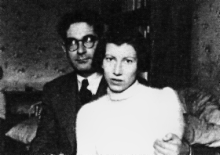
Leone Ginzburg ( Lev Fedorovich Ginzburg , Italian. Leone Ginzburg ; April 4, 1909 - February 5, 1944 ) is an Italian editor, writer, journalist and teacher, as well as a well - known anti-fascist political activist and hero of the Resistance movement . He was the husband of the famous writer Natalia Ginzburg and the father of the historian Carlo Ginzburg .
| Leone Ginsburg | |
|---|---|
 | |
| Date of Birth | |
| Place of Birth | |
| Date of death | |
| Place of death | |
Content
Early Life
Born in Odessa on April 4, 1909, into a Jewish family and moved with his parents, Fyodor Nikolaevich (Tanchum Notkovich) Ginzburg and Vera (Hava-Golda) Griliches, first to Berlin , and then to Turin while still at a young age [2] [3] . In Italy he studied at the Turin Lyceum Liceo Ginnasio Massimo d'Azeglio [4] . A group of intellectuals and political activists formed in this lyceum, who fought against the fascist regime of Benito Mussolini , and then took part in the formation of post-war democratic Italy . Among Leone Ginzburg's classmates there were such famous personalities as: Norberto Bobbio , Piero Gobetti, Cesare Pavese , Giulio Einaudi, Massimo Mila, Vittorio Foa, Giancarlo Payetta and Felice Balbo.
In the early 1930s, Leone Ginzburg taught Slavic languages and Russian literature at the University of Turin . It is believed that he influenced the development of the popularity of Russian writers in Italian society. In 1933, Leone Ginzburg, together with Giulio Einaudi, became the co-author of Arnoldo Mondadori Editore . In 1934, he was dismissed as a teacher, refusing to fascist regime [5] .
Harassment
In 1934, Leone Ginzburg and 14 other young Turin Jews, including Zion Segre Amar, were arrested for complicity in the so-called “ Ponte Tres case ” (they delivered anti-fascist literature to Italy across the border from Switzerland ), but Ginzburg was not sentenced to imprisonment. In 1935 he was again arrested for his activities as a leader (along with Carlo Levy ) of the Italian branch of the Justice and Freedom Party [6] , which Carlo Rosselli founded in Paris in 1929.
In 1938 he married Natalia Ginzburg (née Levy). In the same year, he was deprived of Italian citizenship when the fascist regime enforced anti-Semitic racial laws [5] . In 1940, a punishment was introduced against the Ginzburg family, known as “confino” (internal exile), they were forcibly taken to the remote impoverished village of Pizzoli in Abruzzi , where they remained from 1940 to 1943 [7] .
Leona Ginzburg managed to continue his work as head of the publishing house Arnoldo Mondadori Editore throughout the entire period of exile. In 1942, he became one of the founders of the underground Action Party [8] (Democratic Resistance Party), and was also the editor of the resistance newspaper L'Italia Libera [9] .
Detention and death
In 1943, after the Allied invasion of Sicily and the fall of the Benito Mussolini regime, Leone Ginzburg went to Rome , leaving his family in Pizzoli. In September 1943, the German Reich invaded Italy: Natalia Ginzburg and three children fled from Pizzoli, boarded a German truck and told the driver that they were military refugees who had lost their documents. They met with Leone Ginzburg in Rome, where they began to hide from persecution. On November 20, 1943, Leone Ginzburg, who used the fictitious name of Leonid Gianturco, was arrested by Italian police in an underground printing press of L'Italia Libera . He was taken to the German section of the Regina Coeli prison [5] [7] . On February 5, 1944, Leone Ginzburg died as a result of torture in prison at the age of 34 years [9] .
Notes
- ↑ 1 2 SNAC - 2010.
- ↑ Russian Italy: Ginzburg
- ↑ Seventy years ago, an anti-fascist Lev Ginzburg died in an Italian prison
- ↑ Ward, David. “Primo Levi's Turin.” In: Gordon, Robert SC (editor). The Cambridge Companion to Primo Levi (Cambridge Companions to Literature). Cambridge University Press, July 30, 2007. ISBN 1139827405 , 9781139827409. CITED: p. 11 .
- ↑ 1 2 3 (Italian) Short biography of Leone Ginzburg , Associazione Nazionale Partigiani d'Italia (ANPI) (accessed October 30, 2010)
- ↑ Giustizia e libertà Archived February 12, 2017 at Wayback Machine at www.pbmstoria.it
- ↑ 1 2 Biography of Natalia Ginzburg Archived on July 5, 2009. , Rai International (accessed October 30, 2010)
- ↑ Partito d'azione (1942-1947) Archived September 24, 2015 at Wayback Machine at www.pbmstoria.it
- ↑ 1 2 Opposition to Fascism Archived on September 7, 2006. , Memorial Library, University of Wisconsin-Madison
Links
- Natalia Ginzburg, All Our Yesterdays
- Natalia Ginzburg, The Things We Used To Say
- Susan Zuccotti, The Italians and the Holocaust: Persecution, Rescue, and Survival , University of Nebraska Press
- Books of the Times; Richard Bernstein, "Telling the Bigger Story With the Small Details" , The New York Times , August 4, 1999