Boeing C-135 Stratolifter (from English - “Stratospheric freight”, factory model designation - 717 ) - transport aircraft , created in the early 1950s by the corporation Boeing based on the experienced Boeing 367-80 (also served as the prototype of the passenger Boeing 707 ). It differs from the passenger B707 by a shorter and narrower fuselage, actually being the transport version of the Boeing KC-135 Stratotanker air tanker; in contrast to the latter, not widespread. C-135 and its modifications are mainly operated in the US and French Air Forces . Not to be confused with the Boeing C-137 Stratoliner (created on the basis of Boeing 707 ).
| C-135 Stratolifter | |
|---|---|
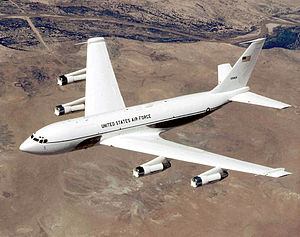 C-135C Speckled Trout | |
| Type of | Transport aircraft |
| Manufacturer | Boeing |
| First flight | August 31, 1956 (as KC-135) |
| Start of operation | |
| Status | operated by |
| Operators |  US Air Force US Air Force  French Air Force French Air Force |
| Years of production | 1961 , 1962 , 1964 |
| Units produced | 60 (with 2 prototypes and 1 C-135K ) |
| Cost of the development program | $ 39 600 000 |
| Basic model | Boeing 367-80 |
| Options | Boeing KC-135 Stratotanker Boeing EC-135 Boeing NC-135 Boeing RC-135 OC-135B Open Skies WC-135 Constant Phoenix |
History
Designing

In 1953, the B-47E Stratojet jet bombers , which allowed them to carry out refueling in the air , increased their range of action. However, the problem arose next - KC-97 Stratofreighter air tankers with piston engines, they turned out to be low-speed for these planes, which significantly complicated the completion of refueling; new tankers equipped with jet engines and developing higher speeds were required. Then the company Boeing proposed a project of such a tanker, made on the basis of the prototype of the Boeing 367-80 , but the commission from the Air Force first rejected this project. However, later the military still had to accept an offer from Boeing, since its prototype had already flown, whereas competitors had projects only on paper. Then on October 5, 1954, a contract was signed for 50 new aircraft. The new aircraft was created in two versions at once: the transport C-135 ( English Cargo aircraft - transport aircraft , model 135 ) and the KC-135 tanker ( English Kerosene tanker - tanker ).
The prototype fuselage had a fuselage with a diameter of 3353 mm, but for the model 707 it was increased to 3658 mm, which allowed to increase the number of seats in the row from 5 to 6. The fuselage of the same diameter was used on military aircraft, which should have been simplified in the future. However, later, at the request of the customer - American Airlines , the model 707 fuselage diameter was increased to 3759 mm - 1 inch more than the Douglas DC-8 (in the end, however, led to a delay in production). Since the military C-135 / KC-135 was now very different from the civilian, Boeing assigned it a new internal designation - 717 (not to be confused with the same model created in the 1990s).
Prototypes
On July 20, 1956, the plant in Renton ( Washington ) immediately launched the first serial KS-135A (model 717-100A, tail number - 55-3118, factory-made - 17234), which received the name The City of Renton (the Russian city of Renton ) and turned out to be 3454 mm longer than the prototype. Although the new aircraft was a tanker, the fuel was stored in the lower part of the fuselage, and there was a spacious deck above the tanks, which also made it possible to carry cargo or people, for which a large cargo door was provided on the side of the fuselage. On August 31, 1956, test pilot Alvin Johnston first lifted the KC-135 into the air. Subsequently, the Boeing plant built more than seven hundred KC-135, which for many decades became the basis of the air refueling fleet of the US Army.
In 1961, three transport aircraft were released, which received the designation C-135A (borts 60-0356, 60-0357 and 60-0362), but actually were KC-135A without a refueling rod, although they retained its mount and place of the operator . These aircraft were nicknamed C-135 False to avoid confusion with the original C-135. May 19, 1961 aboard 60-0356 made the first flight, and on June 8 he entered the military.
C-135A
On July 14, 1961, the plant in Renton produced the first original C-135 (model 717–157) - board 60-0369 (serial number - 18144, serial - C3001). Unlike the KC-135, its transport “brother” no longer carried equipment for refueling in the air, instead of having a refueling rod now having a tube for emergency discharge of fuel, but they still left the fairing of the operator’s cabin so as not to redesign the fuselage. Also, at C-135, the cargo compartment floor was strengthened and the cargo compartment volume was increased, and when transporting personnel, the passenger capacity could reach 176 seats, which necessitated the installation of an additional toilet. The plane had four Pratt & Whitney J57P-59W turbojet engines (thrust 6240 kg each), which were not equipped with a reverse . Apart from the difference in the fuselage diameters, the C-135A turned out to be close in size to the passenger B720 , the latter initially also had the model designation of the 717.
A total of 15 C-135A aircraft were built (airplanes 60-0369 - 60-0378, 61-0326 - 61-0330), which entered the US Air Force; subsequently, many of them were converted into various options: flying laboratories, reconnaissance aircraft, air command posts, and so on. Such a small number was explained by the fact that the military considered this aircraft as a temporary replacement for the larger C-141 Starlifter , which was supposed to enter the army in the coming years. In 1982-1983, three C-135A (borts 60-0372, 60-0375 and 60-0376) underwent modernization, during which they installed the tail unit of an increased area (as on the model 707-300), as well as more powerful engines Pratt & Whitney TF33-PW-102 (they were removed from the Boeing 707 that were out of use and bought by the military), and therefore the designation was changed to C-135E .
C-135B
February 15, 1962 board 61-0331 (factory number - 18238, serial - 3016), which became the first representative of the C-135B (model 717-158), climbed into the sky. The new model was different from the previous increased tail area and the use of Pratt & Whitney TF33-P-5 engines (traction force of 8160 kg each). A total of 30 aircraft of this model were built in 1962 (airplanes 61-0331, 61-0332, 61-2662 - 61-2674, 62-4125 - 62-4139), 10 of which were later converted into a version of the WC-135 Constant Phoenix to study atmospheric pollution during nuclear testing . Also, 5 aircraft were converted into salons VC-135B for transportation of VIP- person, while they were applied blue-and-white livery, similar to the presidential VC-137 ; during the presidency of Jimmy Carter , in order to save money, these planes were converted back to transport.
Three aircraft WC-135 were later converted into transport, while they were given the designation C-135C .
C-135F
In 1964, the Boeing plant built 12 aircraft (serial numbers 18679–18684 and 18695–18700, serial - C2001 — C2012, the initial side numbers - 63–8470–63–8475 and 63–12735–63-12740, respectively), which received the designation C-135F and were sold to the French Air Force . Strictly speaking, these aircraft were actually KC-135A (model 717-146), but the letter K in the designation was omitted, since the aircraft were considered tankers by default, and the F index means that the aircraft were intended for delivery to France ( eng. France ) . In the French army, these aircraft were used as intended for refueling fighters and front-line bombers, but some were later used as flying laboratories and reconnaissance aircraft. In 1985-1987, 11 C-135F aircraft (except for the crash of 38743 in 1972) were sent to Kansas , where they were upgraded to Wichita ( eng. Re-engined ), during which new CFM International F-88 engines were delivered. -100 , which were distinguished by greater traction and less noise. Upgraded aircraft received the designation C-135FR .
C-135K
This designation was assigned to the former EC-135K converted into a transport aircraft (air command post ), which in turn was created by reworking the KC-135A tanker.
Incidents
| date | Board number | Place of occurrence | The victims | Description |
|---|---|---|---|---|
| October 23, 1962 | 62-4136 | Guantanamo | 7/7 | During the Caribbean crisis, the aircraft was transporting ammunition to a base that was blocked by Cubans, but crashed while landing. |
| May 11, 1964 | 61-0332 | Clark | 1 + 79/84 | When landing in the SMU hooked radio beacon and fell to the ground, knocking down the car. |
| June 25, 1965 | 60-0373 | Santa Ana , near El Toro | 84/84 | After takeoff, the crew violated the exit scheme and, after 5 kilometers, crashed into the mountain ( more ... ). |
| June 1, 1972 | 38743 | Hao | 6/6 | During takeoff, fell into the sea after engine failure; the plane was engaged in collecting data during nuclear tests on Mururoa |
See also
- Boeing KC-135 Stratotanker
- Boeing 707
Literature
- Christopher JB Hoctor. Voices from an Old Warrior: Why KC-135 Safety Matters : [ eng ] . - 2. - GALLEON'S LAP, 2014. - 139 p.
- Dmitry Komissarov. How did a bassur airliner go to war // World Aviation.
Links
- C-135 Stratolifter . Corner of the sky The appeal date is March 10, 2019.