Fukuivenator (lat.) Is a genus of theropod dinosaurs from the treasure of maniroptors , whose fossil remains are found in lower Cretaceous sediments in Japan . In the genus include the only species of Fukuivenator paradoxus .
| † Fukuivenator |
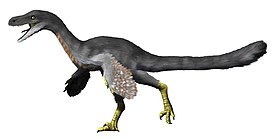
Reconstruction |
| Scientific classification |
|---|
| No rank : | Bilateral symmetric |
| Infraclass : | Archosauromorphs |
| No rank : | Archosauriformes |
|
| International Scientific Name |
|---|
Fukuivenator Azuma et al. 2016 |
| Single species |
|---|
† Fukuivenator paradoxus
Azuma et al. 2016 |
Geochronology127.0-111.0 Ma | million years | Period | Era | Eon |
|---|
| 2.588 | Even | | | Ka | F
but
n
e
R
about
s
about
th | | 23.03 | Neogene | | 66.0 | Paleogene | | 145.5 | a piece of chalk | M
e
s
about
s
about
th | | 199.6 | Yura | | 251 | Triassic | | 299 | Permian | P
but
l
e
about
s
about
th | | 359.2 | Carbon | | 416 | Devonian | | 443.7 | Silur | | 488.3 | Ordovician | | 542 | Cambrian | | 4570 | Precambrian |
◄ Nowadays◄ Cretaceous-Paleogene extinction◄ Triassic extinction◄ Perm mass extinction◄ Devonian extinction◄ Ordovician-Silurian extinction◄ Cambrian explosion |
|---|
|
Content
Fukuivenator was a medium-sized dinosaur with an estimated length of 245 centimeters and an estimated weight of 25 kilograms. Distinguishing features of the animal include spatulate teeth in the front part of the premaxilla , sharp, bent teeth without chipping in the upper jaws and a long neck with elongated cervical vertebrae [1] .
The anatomy of this dinosaur shows a unique combination of primitive and advanced cellosaurus features. The phylogenetic analysis performed by the authors of the description restored Fukuivenator as a primitive representative of the Maniraptoriformes group, which occupies a separate position in the cladogram and is equally associated with ornithomimosaurus , maniraptor and ornitolest . Several features similar to those of dromaeosaurids were explained by researchers by convergent evolution [1] .
Skeleton reconstruction and stratigraphic map
The type species Fukuivenator paradoxus in 2016 was named and described by a group of scientists led by Yoichi Azuma. The generic name combines a reference to Fukui prefecture in Japan with the Latin word lat. venator - the hunter. A species name indicates a specific combination of characters that the taxon demonstrates [1] .
The rocks, where the holotype FPDM-V8461 was found in August 2007, are referred to as the formation, which is dated Barrem - the Aptian longline of the Lower Cretaceous system (127-115 million years ago). The holotype consists of an incomplete skeleton with a skull . As of 2019, the Fukuivenator paradoxus specimen is the most complete skeleton of the non-avian dinosaur found in Japan. The remains, including 160 bone unbonded fragments, were found on an area of 50x50 centimeters [1] .
Because of the long neck and heterodont teeth without chipping, the authors of the description suggested that Fukuivenator was adapted to a herbivorous or omnivorous diet [1] .
- ↑ 1 2 3 4 5 Azuma Y., Xu X., Shibata M., Kawabe S., Miyata K., Imai T. A bizarre theropod mosaic among coelurosaurians (Eng.) // Scientific Reports. - 2016. - Vol. 6 , no. 20478 . - DOI : 10.1038 / srep20478 .
