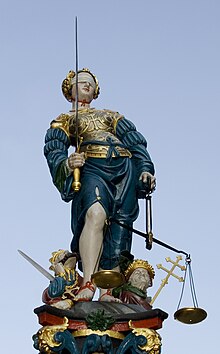
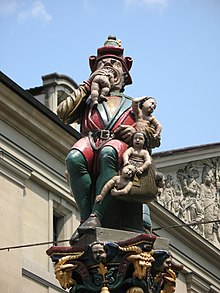
Hans Ging (the first mention is 1525 - died 1562) is a Swiss Renaissance sculptor. Most famous for his unique sculptures of public fountains in the Old Town of Bern and in Freiburg.
Content
Biography
It is known that Ging, who was probably of Swabian origin, became a citizen of Freiburg and a member of the guild of merchants in 1527. At the beginning of his creative career he worked as a sculptor in the workshop of Hans Geiler. However, in 1533, he surpassed his teacher and became more famous. For centuries, Gayler and Ging were confused, but modern studies show that they were actually two different people [2] .
As a sculptor, Ging mainly worked in Freiburg . He also worked in Bern in the 1540s, in Solothurn from 1554 to 1556 and in 1557 in St. Gallen .
Works
Ging's style is close to Swabian art: traditional, in the style of Gothic art in his religious creations, but strong and realistic in worldly works.
Freiburg
In Freiburg, his main works include the Renaissance Council table (1546) and figures of seven public fountains (1547–1560), which are considered the most significant ensemble of sculptural art of the period in Switzerland.
Bern
Ging created most of the public fountains of Bern, which were installed between 1542 and 1546. His presence in the city is rarely confirmed by surviving records: the entry in the Council’s 1543 diary reads: Meyster Hans, Bildhower, im grossen Spital z'Herbrig sin und an des spittelmeisters tisch ässen ("Master Hans, a sculptor, lives in a large hospital and eats at the table Spittelmeister ").
For this reason, his authorship of several fountain figures, which are not signed, has been a subject of controversy for a long time. The founding work of Paul Schenk, written in 1945, Berner Brunnen-Chronik (Chronicle of the Bernese Fountain) ascribes with confidence to Ging three fountains - Pfeiferbrunnen (Piper Fountain), Kindlifresserbrunnen (Fountain of the Children Eater) and Simsonbrnnnnnnnnnnnnnnnnnnnnnnnnnnnnnnnnnnnnnnnnnnnnnnn , Kindlifresserbrunnen (Fountain of the Children) and Simsonbrnnnnnnnnnnnnnnnnnnnnnnnnnnnnnnnnnnnnnnnnnnnn Fountain ( Piper Fountain) - and regards Ging as the “quite possible” creator of other fountains. More recent works, such as Kunstdenkmäler des Kantons Bern (from German "Artistic monuments of the canton of Bern") by Paul Hofer in 1952 or Historisch-topographisches Lexikon der Stadt Bern (from German in "Historical and topographical vocabulary of the city of Bern") in 1976 by Berchtold Weber confirm that the authorship of most of the Bernese fountains belongs to Gingu.
Other works
Other works attributed to Ging include monumental crucifixes , stonework in Tafers church, statues, tombstones, and heraldic motifs.
Links
- Ging, Hans - article from the Historical Dictionary of Switzerland (him.) (Fr.) (ital.)
- Hans Gieng, Bildhauer on g26.ch (German)
- Die Stadtbrunnen on g26.ch (German)
Notes
- ↑ Gerechtigkeitsbrunnen Archival copy dated September 2, 2006 on Wayback Machine on g26.ch Archived July 14, 2011. (him) . Not visible to the Sultan and a Schultheiss , respectively.
- ↑ Ging, Hans - article from the Historical Dictionary of Switzerland (German) (Fr.) (ital.)