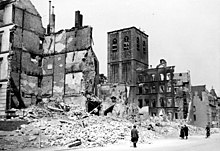

The bombing of Cologne - the bombing of the city, conducted by the Royal Air Force of Great Britain on May 30 - 31, 1942 . In the air attack was attended by over a thousand aircraft. In total, during the Second World War , 262 air attacks were committed on Cologne [1] .
Content
Preparation
The attack took place in the framework of Operation Millennium. More than 1000 bombers took part in it for the first time. It was expected that the consequences of the air raids, in which so many planes were involved, would be so devastating that it would force Germany to capitulate or at least greatly undermine the enemy's morale [2] . In addition, such raids were useful to the Royal Air Force bomber command and its head, Arthur Harris . After the failures of 1941, there were calls to send bombers to another theater of operations. At this stage of the war, the bomber command had 400 aircraft and gradually replaced the two-engine bomber of the pre-war years with modern aircraft.
For the first time, the tactic of the “ bomber stream ” ( bomber stream ) was used, and most tactical methods of this raid were used during the next two years of the war, some elements were used until the very end. It was assumed that such a number of aircraft overcoming the “ Kammhuber Line ” would suppress German fighters and keep the number of downed bombers within acceptable limits.
Air raid on May 30–31, 1942
868 bombers struck the main target and 15 minor ones. The total tonnage of dropped bombs was 1,455 tons, two thirds of which were incendiary. As a result, 2500 fires emerged, 1700 of them were classified by the German fire services as large. The actions of the fire brigades and the width of the streets prevented individual fires from merging into a single firestorm .
3300 non-residential buildings were destroyed, 2090 were seriously damaged and 6420 were slightly damaged - a total of 12840 buildings, of which 2560 were industrial or commercial. Among the completely destroyed buildings are 7 administrative buildings, 14 public buildings, 7 banks, 9 hospitals, 17 churches, 16 schools, 4 university buildings, 10 post and railway buildings, 10 historic buildings, 2 newspaper editors, 4 hotels, 2 cinemas, 6 department stores. Military losses included barracks of antiaircraft artillery. 13010 apartments were destroyed, 6360 were seriously damaged, 22270 were slightly damaged.
The number of victims ranged from 469 to 486 people, of which 411 were civilian and 58 military. 5027 people were injured. According to various estimates, after the raid, from 135 to 150 thousand inhabitants out of 700,000 people left the city.
The Royal Air Force lost 43 aircraft [3] .
| Aircraft type and number | The number of aircraft | |
|---|---|---|
| 1 group RAF | 156 Vickers Wellington Medium Bomber | 156 |
| 3 group RAF | 134 Vickers Wellington 88 Short Stirling Heavy Bomber | 222 |
| 4 group RAF | 131 Halifax heavy bombers 9 Vickers Wellington 7 Whitley medium bomber | 147 |
| 5 group RAF | 73 Lancaster heavy bombers 46 Manchester medium bomber 34 Hampden Medium Bombers | 153 |
| 91 (operational) | 236 Vickers Wellington 21 whitley | 257 |
| 92 (operational) | 63 Vickers Wellington 45 Hampden | 108 |
| Flying training team | 4 Vickers Wellington | four |
Notes
- ↑ koelnarchitektur.de - Stadtlandschaften versus Hochstadt . The appeal date is March 8, 2013.
- ↑ Bishop, Patrick. Wings: The RAF at War, 1912-2012. - Atlantic Books Ltd, 1 October 2012. - P. 24. - ISBN 978-1-84887-892-1 . Terry Copp, The Bomber Command Offensive: Army, Part 11 , < https://legionmagazine.com/en/1996/09/the-bomber-command-offensive/ > . Verified November 9, 2016.
- ↑ Winkelnkemper, Toni The Attack on Cologne . Der Großangriff auf Köln . calvin.edu. The appeal date is March 20, 2009.
- ↑ Facon, Patrick (May 2012), "Opération Millénium", Le fana de l'Aviation (no. 510): 43, ISSN 0757-4169
Literature
- Sebald, WG (2003), On the Natural History of Destruction
- Bishop, Chris (2005), The Military Atlas of World War II , Amber Books, p. 30, ISBN 1-904687-43-1
- Bomber Command Campaign Diary , RAF, 6 April 2005 , < http://www.raf.mod.uk/bombercommand/diary.html >