St. George's Church ( German: Georgskirche ) is a church of the Protestant parish in Aplerbeck , now part of the city of Dortmund ( North Rhine-Westphalia , Germany). It is a cruciform basilica built in the Romanesque style around the 12th century. Being the only one of its kind in Dortmund, the church was recognized as an architectural monument [1] .
| Sight | |
| Church of St. George | |
|---|---|
| A country | |
| Location | |
| Architectural style | |
| Site | |

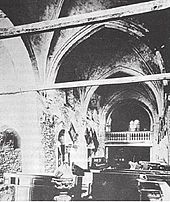
In the 19th century, due to the increase in the population of Aplerbek during the industrialization , the Big Church of Aplerbek was built, and the Church of St. George gradually fell into decay. Since 1926, it served as a community hall, and in 1963 was restored as a church. It again became a parish church, while the Great Church since 1999 has been mainly used for concerts.
Content
History
The church in Upperbek was first mentioned in the document of 899. The remains of the early church were discovered during the reconstruction of the current building in 1963, which in turn dates from 1150–1160 [2] .
The church became the Lutheran Augsburg Confession in 1612. During the period of industrialization in the 19th century, it could no longer accommodate all parishioners due to the growing population of Upperbek, as a result, in 1869, the Big Upperbek Church was opened. The Church of St. George began to decline. In 1872, she was struck by lightning and did not recover from the consequences of this event. In 1894, the plan for the demolition of its ruins was not supported by the Prussian government [2] . The street on which the church is located, in the end, due to the condition of the temple, was called Ruinen ( German: Ruinenstraße ) [3] .
The church was in this state until 1926. The plan to make it a community center with a restaurant or museum was rejected by conservative Johannes Kerner, who demanded that the Romanesque building be restored without changes. He could not prevent the construction of a war memorial with a sculpture of the archangel Michael next to the spire, which led to the emergence of the name "Michaelisbau" [4] .
The church was used as a meeting room for the Nazis, after the Second World War it continued to function as a place for public gatherings. In 1963, the church was restored to its original form and again became known as the Church of St. George [2] . Nowadays, it serves as the main parish church after a decrease in attendance at the Great Church of Aplerbek [5] .
Literature
- Siegfried Liesenberg (1992), Die Georgskirche in Aplerbeck , Dortmund-Aplerbeck: Gustav Kleff
Notes
- ↑ Denkmalliste der Stadt Dortmund (German) (neopr.) ? (inaccessible link) . Denkmalbehörde der Stadt Dortmund. Date of treatment February 19, 2019. Archived on September 15, 2014.
- ↑ 1 2 3 Aplerbeck damals (German) (neopr.) ? . aplerbeck-damals.de . Date of treatment February 19, 2019.
- ↑ Straßennamen (German) (neopr.) ? . Aplerbecker Geschichtsverein. Date of treatment February 19, 2019.
- ↑ 1100 Jahre Aplerbeck: [] / Hans Georg Kirchhoff. - Essen: Klartext Verlag, 1998 .-- P. 55. - ISBN 3-88474-735-5 .
- ↑ Bauerfeld, Jörg . "Geburtstag" / Große Kirche Aplerbeck ist 140 Jahre alt (German) (January 10, 2010). Date of treatment February 19, 2019.
Links
- georgsgemeinde.de - official site St. George's Church
- 850 Jahre Georgskirche / Festwoche vom 12.bis 18. September Georgsgemeinde 2011