 Play media file
Weightlessness is a state in which there is no force of interaction of the body with the support or suspension ( body weight ) arising in connection with the gravitational attraction or the action of other mass forces (in particular, the forces of inertia arising during accelerated motion of the body).
Sometimes the term microgravity is used as a synonym for the name of this phenomenon, which is incorrect (it seems that gravity is absent or negligible).
Content
Reasons to
The state of weightlessness occurs when external forces acting on the body are only mass (forces of force), or the field of these mass forces is locally homogeneous, that is, the field forces inform all particles of the body in each of its positions of the same magnitude and direction of acceleration (which, when moving in the field of the Earth practically takes place if the body size is small compared to the radius of the Earth), or the initial velocities of all the particles of the body are equal in module and direction (the body moves progressively).
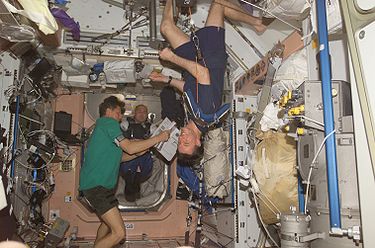
For example, a spacecraft and all bodies in it, having received a corresponding initial velocity, move under the action of forces of force along their orbits with practically the same acceleration, as free ones; neither the bodies themselves nor their particles exert mutual pressure on each other, that is, they are in a state of weightlessness. At the same time, in relation to the cockpit of the apparatus, the body in it can remain at rest anywhere (freely "hang" in space). Although the forces of weightlessness act on all the particles of the body, there are no external surface forces that could cause the mutual pressure of the particles on each other. [one]
Thus, any body, the dimensions of which are small compared to the earth's radius, making free translational motion in the field of the Earth, will, in the absence of other external forces, be in a state of weightlessness. The result will be similar for movement in the field of any other celestial bodies.
History
The change in the weight of the ball with its free fall in the liquid was also noted by Leibniz . In 1892-1893 several experiments demonstrating the occurrence of weightlessness in free fall were put by a professor at Moscow State University N. A. Lyubimov , for example, a pendulum deduced from an equilibrium position during a free fall did not swing [2] .
Features of human activity and operation of equipment
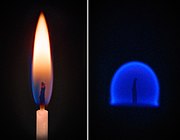
Under zero gravity aboard a spacecraft, many physical processes (convection, combustion, etc.) proceed differently than on Earth. The absence of gravity, in particular, requires a special design of such systems as shower, toilet, food heating systems, ventilation, etc. To avoid the formation of stagnant zones where carbon dioxide can accumulate, and to ensure uniform mixing of warm and cold air, MKS, for example, installed a large number of fans. Eating and drinking, personal hygiene, working with equipment and, in general, ordinary household activities also have their own characteristics and require the astronaut to develop habits and necessary skills.
The effect of weightlessness is inevitably taken into account in the design of a liquid - propellant rocket engine designed to start in weightlessness. Liquid fuel components in tanks behave in the same way as any liquid (they form liquid spheres). For this reason, the supply of liquid components from the tanks to the fuel lines may become impossible. To compensate for this effect, a special design of tanks is used (with separators for gas and liquid media), as well as a procedure for draining the fuel before starting the engine. Such a procedure consists in switching on the auxiliary engines of the ship for acceleration; the small acceleration created by them precipitates liquid fuel on the bottom of the tank, from where the supply system sends fuel to the main lines.
Impact on the human body
When moving from the conditions of the presence of body weight on the surface of the Earth to the conditions of weightlessness (first of all - when a spacecraft leaves into orbit), the majority of astronauts experience an organism reaction, called the syndrome of space adaptation .
When a person stays in space for a long time (more than a week), the lack of body weight begins to cause certain harmful changes in the body [3] .
The first and most obvious consequence of weightlessness is the rapid muscle atrophy: muscles are actually turned off from human activity, as a result all the physical characteristics of the body fall [3] . In addition, the result of a sharp decrease in muscle tissue activity is a reduction in oxygen consumption by the body, and the resulting activity of hemoglobin can lower the activity of the bone marrow that synthesizes it (hemoglobin) [3] .
There is also reason to believe that the restriction of mobility will disrupt phosphorus metabolism in the bones, which will lead to a decrease in their strength [3] .
Weight and Gravity
Quite often, the disappearance of weight is confused with the disappearance of gravitational attraction, but this is not at all the case. An example is the situation on the International Space Station (ISS). At an altitude of 350 kilometers (the height of the station), the acceleration of gravity is 8.8 m / s ², which is only 10% less than on the Earth’s surface. The state of weightlessness on the ISS arises not due to the “lack of gravity”, but due to movement in a circular orbit with the first cosmic velocity , that is, cosmonauts constantly “fall forward” at a speed of 7.9 km / s.
Weightlessness on Earth
On Earth, for experimental purposes, they create a short-term state of weightlessness (up to 40 s) when flying an aircraft along a ballistic trajectory, that is, such a trajectory along which the plane would fly under the influence of gravity alone. At low speeds, this trajectory turns into a parabola , which is why it is sometimes mistakenly called “parabolic”. In general, the trajectory is an ellipse or hyperbole.
Such methods are used to train astronauts in Russia and the United States. In the cockpit, a ball is suspended on a string, which usually pulls the string down (if the plane is at rest, or moves evenly and straightforwardly). The absence of the tension of the thread on which the ball hangs indicates weightlessness. Thus, the pilot must control the aircraft so that the ball hangs in the air without tension on the thread. To achieve this effect, the aircraft must have a constant acceleration equal to g and directed downwards. In other words, pilots create zero overload. Long such an overload (up to 40 seconds) can be created if you perform a special aerobatic flight “dip in the air”. Pilots abruptly begin to climb, leaving the "parabolic" trajectory, which ends in the same sharp drop in altitude. Inside the fuselage there is a camera in which future astronauts are trained, it is a fully upholstered passenger cabin without seats to avoid injuries both during moments of weightlessness and during moments of overload.
A person experiences a similar feeling of weightlessness (partial) during flights on civil aviation flights during landing. However, for safety reasons and due to the heavy load on the aircraft’s design, any scheduled aircraft drops its height, making several long spiral turns (from a height of 11 km to an approach height of about 1-2 km). That is, the descent is made in several arrivals, during which the passenger feels for a few seconds that he is a little up from the chair. The same feeling is experienced by motorists who are familiar with the tracks passing through steep hills when the car starts to slide down from the top.
Claims that the plane to create short-term weightlessness performs aerobatics of the " Nesterov loop " type is nothing more than a myth. Training is performed in lightly modified serial passenger or cargo aircraft, for which aerobatic maneuvers and similar flight modes are supercritical and can lead to the destruction of the vehicle in the air or rapid fatigue wear of the supporting structures.
The state of weightlessness can be felt at the initial moment of free fall of the body in the atmosphere , when the air resistance is still small.
There are several planes capable of conducting flights with the attainment of a state of weightlessness without flying into space. The technology is used both for training by space agencies and for commercial flights of individuals. Such flights are conducted by the American airline Zero Gravity , Roscosmos (on the IL-76 MDK since 1988, flights are also available for private individuals [4] ), NASA (on the Boeing KC-135), the European Space Agency (on the Airbus A-310) [ 5] A typical flight lasts about one and a half hours. During the flight, 10-15 sessions of weightlessness are held, to achieve which the plane makes a steep dive. The duration of each session of weightlessness is about 25 seconds [6] . More than 15,000 people made flights as of November 2017 [7] . Many famous people made flights in weightlessness on board the aircraft, among them: Baz Aldrin , John Carmack , Tony Hawk , Richard Branson , Artemy Lebedev. Stephen Hawking also made a short flight on April 26, 2007 [8] [9] [10] .
Notes
- ↑ Great Soviet Encyclopedia. Weightlessness
- ↑ Perelman Ya. I. Interplanetary travel. The initial bases of stargazing. - 6th ed. - L .: Surf . - p. 163. - 5000 copies.
- ↑ 1 2 3 4 Man lives in space (cosmic psychology)
- ↑ Weightlessness .
- ↑ ESA Human Spaceflight Research .
- ↑ Born to fly .
- Tourism Space tourism will surely be a blast .
- ↑ Learning to Fly, Strip, and Vomit on a 727 (March 5, 2007).
- ↑ Zero gravity for 3.5 G's (April 26, 2007).
- ↑ Stephen Hawking's Zero-G Flight Booked , CBS News , March 1, 2007
Links
- Sanko N. F. Astronomical Dictionary
- Parabola of weightlessness Video of Roskosmos television studio