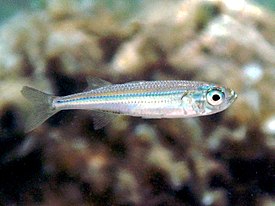
South European atherin [1] [2] ( lat. Atherina boyeri ) is a species of ray-finned fish of the atherin family (Atherinidae). Distributed in the eastern Atlantic Ocean , found in the Mediterranean , Black and Azov Seas. Pelagic marine flocking fish. The body is elongated, somewhat compressed laterally, up to 20 cm long.
| South european atherin |
 |
| Scientific classification |
|---|
| No rank : | Bilateral symmetrical |
| Infraseries : | Ateriomorphs |
| View: | South european atherin |
|
| International scientific name |
|---|
Atherina boyeri Risso , 1810 |
| Security status |
|---|
Least ConcernedIUCN 3.1 Least Concern : 2352 |
|
The body is elongated, somewhat compressed laterally, covered with cycloid scales . The scales are larger than those of other representatives of the genus; the transverse rows of scales are 39–53 (usually less than 50). The mouth is large, on both jaws small multi-row teeth. The length of the head fits 4 times in the total length of the body. The posterior edge of the upper jaw does not extend beyond the vertical passing through the front edge of the eye. On the first branchial arch 26-31 branchial stamens . In the first dorsal fin, 6–9 rigid, unbranched, flexible rays. In the second dorsal fin, there are 2 hard and 9-15 (usually 10-13) soft rays. In the anal fin there are 1 prickly and 12-18 (usually 13-15) soft rays. The pectoral fins reach the bases of the ventral fins. The caudal fin is bifurcated. The vertebrae are 40–47 [2] [3] .
The back is grayish-green or light brown, with small black dots. A silver stripe runs along the middle part of the body. The width of the strip does not exceed the width of one row of scales. The belly is silver-white [4] .
The maximum body length is 20 cm [5] .
Flocking pelagic fish. They live in the coast in the upper layers of water. Euryhaline, found both in seawater and in brackish. Withstand both fresh and hypersaline water (up to 77 ‰).
Nutrition
They feed on planktonic crustaceans, mainly mysids and copepods . In the lagoons , the diet also includes small benthic invertebrates ( amphipods , gammarus , polychaetes , mollusks ). Juveniles feed only on plankton [4] [2] [6] .
Reproduction and development
They mature for the first time at the age of 1 year with a body length of 4.4-7.5 cm. They can spawn in a wide range of salinity (from 2 to 42 ‰). Spawning is stretched from April to August, sometimes observed in March and September, begins at water temperatures above 10 ° C. Wash several servings of caviar. Fertility varies from 20 to 2000 eggs, depending on the size of the females. Spherical caviar with a diameter of 1.5-1.9 mm with filiform outgrowths. With the help of these outgrowths, eggs are fastened together and attached to aquatic vegetation. Embryonic development at 22-25 ° C lasts 10 days. After hatching the larvae, the yolk sac resolves in one day. Pelagic larvae. Life expectancy 3-4 years [2] [4] [6] .
Distributed in the eastern Atlantic Ocean from Spain to Morocco and Mauritania , including Madeira and the Canary Islands . Isolated populations were found off the coast of England and the Netherlands . They are found in the Mediterranean, Black, Caspian and Azov seas. In the Black Sea, one of the most popular fish after hamsa and sprat. Acclimatized in the Aral Sea . They go into fresh water (Lake Alexander at Batumi ; Southern Bug ). Residential populations are known in Lake Transzene in Italy and Lake Karun . Found in hypersaline reservoirs ( Dead Kultuk , Kaydak ) [4] [6] .
The fishing value is small. World catches in the 2000s ranged from 755 to 1513 tons. Most catches Italy . Fishing is carried out by offshore seines , bottom and deep trawls , and gillnets. It is sold fresh and salted. It is used as a bait for fishing by longlines and ugly fishing gears [2] .