The positivist church , or religion of mankind , is a secular religion , founded by Auguste Comte .

Content
Creed
A positive religion replaces theology with sociology , theolatry ( worship ) with a “sociolatry” or a cult of humanity, and finally, a theocracy with a “sociology” or organization of a society based on perfect and universal moral solidarity.
A positive cult has as its subject a Great Being in various fields and relationships. It is divided into personal, home and public. In the personal veneration of the Great Being, it should appear to be the closest to a person, and moreover, a female. In a mother, a person respects the moral or ideal meaning of his past, which has prepared in his person a minister to humanity; in his wife he personifies the meaning of his present, or his actual service to the Great Being; finally, in his daughter, he worships his future [1] .
History
After the death of Comte, the leader of the positivists in France was Pierre Lafitte , who accepted the title of high priest of mankind. Since 1878, he published the main organ of Orthodox positivism "Révue Occidentale" [1] .
Positive religion soon spread to the UK , where it was preached by Richard Congreve and Frederick Harrison [1] .
But the most favorable soil for the "religion of mankind" was South America ; Lagarrigue approved a new cult in Chile , and Miguel Lemos - in Brazil , where positivism has become almost a state religion. His followers, with General Deodoro da Fonseca and Benjamin Constant, are led, carried out a coup in 1889, replacing the empire with a republic [1] .
The flag of Brazil still depicts one of Comte's mottos ("Order and Progress"), and the teaching of sciences on the course of positivist philosophy was introduced in officer schools. There was even talk of the official introduction of the positivist calendar in Brazil, but this met obstacles. The institution founded by Lemos in Rio de Janeiro , under the name Apostolado positivista da Brazil, has published many books and brochures to spread the new religion [1] .
Even before the revolution of 1889, positivists contributed to the destruction of slavery in Brazil [1] .
In 1884, a split occurred in the religion of mankind. The Chilean-Brazilian group of Lagarrigue and Lemos, together with one of Comte's old French students, Audiffrent, as well as the Englishman Congreve, separated from Lafitte, whom these zealots found insufficiently penetrated by the religious principles of the teacher. The main point of disagreement was the idea of the Virgin Mother (Vierge Mère) as the highest personification of mankind. In the last year of his life, Comte in a letter to Odiffran invited him to present this idea as the final set of all positivism (à représenter le positivisme comme directement résumé par l'utopie de la Vierge-Mère). Comte's successor in the high priesthood, Lafitte, holding on to the letters of these words, saw in this idea only the ultimate concept of subjective synthesis; but Odiffran and the South Americans, who stood behind the spirit of Comte's last teaching, began to give the Virgin Mother a more real and primitive significance in the religion of mankind. However, Odiffran insisted on the need for an alliance with the Jesuits , according to Comte's latest intentions. In his opinion, there is only a minor difference between Catholics and positivists that the former believe in God, and the latter do not, the main thing is the organization of mankind, which both of them equally aspire to. On this basis, he invited all unbelievers in God to become positivists, and all believers - Catholics, so that later they could begin to fight together disciplined against undisciplined [1] .
In addition to the above countries, a positive religion had zealous followers in many others - Spain , the USA , Sweden , Hungary and even the Ottoman Empire [1] .
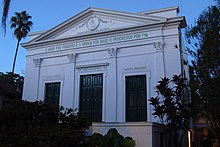
The positivist church of Brazil exists at the present time.
See also
- Positivism
Notes
- ↑ 1 2 3 4 5 6 7 8 Vl. Solovyov . Comte Auguste // Brockhaus and Efron Encyclopedic Dictionary : in 86 volumes (82 volumes and 4 additional). - SPb. , 1890-1907.