

Flattening is a measure of the compression of a circle or sphere in diameter with the formation of an ellipse or ellipsoid, respectively, by rotation of a spheroid . Other terms used are ellipticity or contraction. The usual notation for flattening is “f”, and its definition in terms of the semiaxes of the resulting ellipse or ellipsoid:
- {\ displaystyle \ mathrm {flattening} = f = {\ frac {ab} {a}}.}
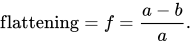
The compression ratio in each case is equal to . For an ellipse, this factor is also an aspect ratio of the ellipse.

There are two other flattening options., and when confusion is necessary, the above alignment is called the first alignment. The following definitions can be found in standard texts [1] [2] [3] , as well as in online texts [4] [5] .
Content
- 1 Definitions of flattening
- 2 Identities associated with flattening
- 3 Numerical values for planets
- 4 Opening flattening
- 5 notes
Flattening Definitions
In the following, “a” is the larger dimension (for example, the major axis), while “b” is the smaller (minor axis). All flattenings for a circle are zero ( a & nbsp; = & nbsp; b )
first flattening Fundamental. The geodetic reference ellipsoid is indicated by second flattening Rarely used. third flattening Used in geodetic calculations as a small expansion parameter. [6]
Flattened Identities
Smoothing is associated with other parameters of the ellipse. For example:
- {\ displaystyle {\ begin {aligned} b & = a (1-f) = a \ left ({\ frac {1-n} {1 + n}} \ right), \\ e ^ {2} & = 2f -f ^ {2} = {\ frac {4n} {(1 + n) ^ {2}}}. \\\ end {aligned}}}
Where is eccentricity .
Numerical Values for Planets
For the ellipsoid WGS84 for modeling the earth, the "determining" values are [7] :
- a (equatorial radius): 6 378 137.0 m
- 1 / f (reverse alignment): 298,257 223 563
- a (equatorial radius): 6 378 137.0 m
which implies
- b (polar radius): 6 356 752.3142 m,
so the difference between the major and minor axes is 21.385 km (13 miles). (This is only 0.335% of the main axis, so the representation of the Earth on a computer screen will be 300 by 299 pixels. Since it will be practically indistinguishable from a sphere displayed as 300 by 300 pixels, illustrations usually greatly exaggerate alignment when the image should represent the contraction of the earth.)
Other values in the solar system are Jupiter , f = 1/16; Saturn , f = 1/10, Moon f = 1/900. The oblateness of the Sun is about 9⋅10 -6 .
Opening flattening
In 1687, Isaac Newton published Principia , in which he included evidence that a rotating self-gravitating fluid body in equilibrium takes the form of a compressed revolution ellipsoid ( spheroid ). The amount of smoothing depends on the density, balance of gravity and centrifugal force.
Notes
- ↑ Maling, Derek Hylton. Coordinate Systems and Map Projections. - 2nd. - Oxford; New York: Pergamon Press , 1992. - ISBN 0-08-037233-3 .
- ↑ Snyder, John P. Map Projections: A Working Manual . - Washington, DC: United States Government Printing Office , 1987. - Vol. 1395.
- ↑ Torge, W. (2001). Geodesy (3rd edition). de Gruyter. ISBN 3-11-017072-8
- ↑ Osborne, P. (2008). The Mercator Projections Archived January 18, 2012. Chapter 5.
- ↑ Rapp, Richard H. (1991). Geometric Geodesy, Part I. Dept. of Geodetic Science and Surveying, Ohio State Univ., Columbus, Ohio. [one]
- ↑ FW Bessel, 1825, Uber die Berechnung der geographischen Langen und Breiten aus geodatischen Vermessungen , Astron.Nachr. 4 (86), 241–254, DOI : 10.1002 / asna.201011352 , translated into English by CFF Karney and RE Deakin as The calculation of longitude and latitude from geodesic measurements , Astron. Nachr. 331 (8), 852–861 (2010), E-print arXiv : 0908.1824 ,
- ↑ html The WGS84 parameters are listed in the publication of the National Geospatial Intelligence Agency TR8350.2 , p. 3-1.