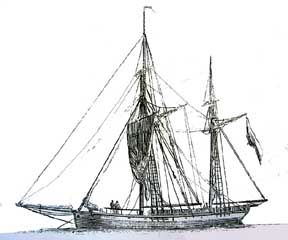
The list includes specially equipped sailing hydrographic vessels , the so-called pilot vessels or lots, which were in service with the Russian Navy .
Lots-ships or lots were ships specially designed for hydrographic work , including depth measurements at various sea sections and fairways , descriptions of coasts, installation and removal of milestones, cormorants and various signs, these ships were also used to deliver supplies to lighthouses [1 ] [2] .
In the era of the sailing fleet, ships of various classes, such as galliots , schooners , brigs , boats , bots , tenders and transports, were often involved in hydrographic work. Specialized hydrographic vessels for the needs of the Russian fleet were built in small quantities. So, for example, in the Baltic Fleet at different times from two to four such ships were simultaneously listed, and in the Black Sea Fleet they appeared only in the second half of the 19th century. A single project for the construction of Russian hydrographic ships did not exist, these ships at different times were galliots, bots, brig and schooners, which, meanwhile, were specially equipped for hydrographic work [3] .
Content
Legend
The list of vessels is divided into sections by fleet, inside the sections of the vessel are presented in the order of their inclusion in the fleet, within one year - in alphabetical order. Links to information sources for each row of the list tables and comments given to the corresponding rows are grouped and are located in the Notes column.
Table:
- Number of guns - the number of artillery guns mounted on the ship. If at different times the vessel was armed with a different number of guns, the values should be indicated through the “/” sign.
- Size - the length and width of the vessel in meters.
- Draft - draft of the vessel (immersion depth) in meters.
- Crew - the total number of crew members.
- Shipyard - shipbuilding shipyard.
- The ship master is the name of the master who built the ship.
- Service history - main places, dates and events.
- n / a - no data.
Sorting can be performed on any of the selected columns of the tables.
Baltic Fleet
The section lists all the pilot ships that were part of the Baltic Fleet.
| Name | Op. | The size | Draft | Ek. | Shipyard | Master | Vh. | Out | Service History | Note |
|---|---|---|---|---|---|---|---|---|---|---|
| Kurir [comm. one] | Information on the armament and design of the ships was not preserved. | ten | Olonets shipyard | I. Yu. Tatishchev | 1704 | n / a | Took part in the Northern War . Used for measurements on the island of Kotlin and in the Neva Bay . In May 1712, she participated in a voyage to Vyborg . After 1712 there are no references to the ship. | [2] [4] [5] [6] | ||
| Pilot [comm. 2] | Okhten Shipyard | V. Soloviev | 1726 | n / a | Used to deliver goods and people to lighthouses, to install and remove milestones and cormorants in the Gulf of Finland . In October 1731, she helped the stranded frigate Esperance . In May 1734 it was captured by the French courts, but released during the capture of Danzig . In 1735 it was renovated at the Galernaya shipyard . She took part in the Russian-Swedish war of 1741-1743 . From 1744 to 1746 it was a postal service between Kronstadt and Danzig. In 1753 and 1754, in addition to hydrographic work, it was used to find cans suitable for breeding oysters . | [2] [4] [7] [eight] | ||||
| Navigator [comm. 2] | 1727 | n / a | Used to deliver goods and people to lighthouses, to install and remove milestones and cormorants in the Gulf of Finland. In 1735, it was renovated in Kronstadt. She took part in the Russian-Swedish war of 1741-1743. In 1746, it was on a postal service between Kronstadt and Lubeck , and in 1749 and 1754 - between Kronstadt and Revel . | [9] [1] [10] [eleven] | ||||||
| Tonein [comm. 3] | Information on the armament, design and number of crews of the ships has not been preserved. | Galley Shipyard | Information about the ship masters who built the ships was not preserved. | 1740 | 1768 | In 1740, he made measurements and surveys of the Moonsund Strait. She took part in the Russian-Swedish war of 1741-1743. In 1745 and 1746, it was used to set milestones and monitor fairways. On October 30 ( November 10 ), 1745 , the lighthouse near Tolbukhin was ice-covered and the next day it was aground on Tolbukhin. In November and December it was taken aground and held in Kronstadt. In 1747 he went to Danzig. From 1748 to 1750, it established milestones and cormorants from Kronstadt to the Kolbodegrund can . She took part in the Seven Years' War of 1756-1763 as a hydrographic, cargo and messenger ship. In 1768 it was caught by a storm while parking at the island of Odenskholm , washed ashore and crashed. | [1] [12] [10] [13] | |||
| Pilot [comm. 3] | Olonets shipyard | 1755 | n / a | From 1755 to 1759, hydrographic work was performed on the ship in the Gulf of Finland. She took part in the Seven Years' War of 1756-1763, including the evacuation of troops from Kolberg . From 1761 to 1764 it was used to install milestones and cormorants in the Gulf of Finland. In 1765, he carried out fire service on the Kronstadt raid. | [1] [12] [14] | |||||
| Navigator [comm. 3] | n / a | From 1756 it was on a mail service between Kronstadt and Danzig. Took part in the Seven Years' War of 1756-1763 as a hydrographic, hull and cargo ship. | [1] [12] [15] | |||||||
| Lotz Galliot No. 1 | Galley Shipyard | 1772 | n / a | Used for hydrographic work in the Gulf of Finland and the provision of provisions for lighthouses. | [1] [12] | |||||
| Lotz bot number 3 | Olonets shipyard | 1773 | 1782 | From 1773 to 1782 it was used to perform hydrographic work in the Gulf of Finland. In November 1782, she left Revel to Nargen Island to help a British ship in distress. On November 11 (22), a flurry was thrown at the stones of Nargen and crashed. | [1] [12] [16] [17] | |||||
| Lotz bot number 1 | Information about the places of construction of ships and ship masters has not been preserved. | 1811 [comm. four] | n / a | From 1811 to 1814 it was used to perform hydrographic work in the Gulf of Finland. In addition, in October 1812, on a ship from Kronstadt to Sveaborg , provisions were delivered for students of the Marine Corps . From 1815 to 1817 he took part in experiments with a magnetic compass off the island of Ussari. | [1] [12] > [18] | |||||
| Lotz bot number 2 | n / a | From 1811 to 1817 it was used to carry out hydrographic work in the Gulf of Finland. In addition, in October 1812, on a ship from Kronstadt to Sveaborg, provisions were delivered for students of the Marine Corps. From 1818 to 1822 he performed a fire service on the island of Utta. | [1] [19] [20] [21] | |||||||
| Lotz bot number 3 | n / a | From 1811 to 1818 it was used to carry out hydrographic work in the Gulf of Finland. In 1818, he also carried out fire service on the island of Utta, from 1819 to 1822 - at Gangut , and in 1823 - in Sveaborg. | [1] [22] [23] [24] [25] | |||||||
| Yunge-Eduard | The place of confiscation of the vessel is unknown. | 1812 [comm. five] | n / a | Converted from a confiscated merchant ship. From 1813 to 1844 it was used to set milestones on the fairways and deliver goods to the lighthouses of the Gulf of Finland and Riga . After 1844, the sea did not go out. | [1] [26] [27] [28] | |||||
| Lotz bot number 8 | Information about the place of construction of the vessel and the master of the ship was not preserved. | 1815 [comm. four] | n / a | In 1815 it was used to perform hydrographic work in the Gulf of Finland. In the years 1816 and 1817 he carried out fire service with Rochensalm . | [1] [12] [29] [thirty] | |||||
| Philadelphia [comm. 6] | n / a | 26.4 x 7.3 | 3.4 | n / a | The seizure of ships is unknown. | 1818 [comm. 7] | 1826 | Converted from the Philadelphia Pext transport ship. From 1818 to 1824, it was annually used to set milestones on the fairways of the Gulf of Finland and deliver food from Kronstadt to Revel, Sveaborg and Rochensalm. At the end of the service it was dismantled. | [1] [31] | |
| Allert [comm. eight] | 6 | 22.3 x 6.8 | 3,5 | n / a | 1820 [comm. five] | 1834 | Converted from a confiscated merchant ship. From 1821 to 1833 it was used to carry out hydrographic work in the Gulf of Finland and deliver cargo to lighthouses. At the end of the service, it was converted into a store . | [1] [26] [32] | ||
| Vindava [comm. 9] | 6 | 25 x 6.7 [comm. ten] | 4,5 | n / a | Okhten Shipyard | V.F. Stokke | 1832 | 1843 | From 1833 to 1841, it was used annually for the installation of milestones in the Moonzund Strait, the Gulf of Finland and Riga, as well as for the delivery of goods to lighthouses. At the end of the service, it was dismantled in Kronstadt. | [1] [22] [33] |
| Triton [comm. eleven] | 14 | 30.5 x 9 [comm. ten] | 2.7 | n / a | Kronstadt shipyard | Semenov | 1835 | 1849 | In 1836 and 1837 it was used to set milestones in the Kronstadt area and deliver goods to lighthouses. Every year, each spring from 1838 to 1843 was also used to set milestones at Kronstadt, and each summer of the campaigns of these years sailed between the ports of the Baltic Sea with cadets of the navigating semi-crew. In 1844, milestones from Kronstadt to the Kolbodegrund can were installed on the ship. At the end of the service it was dismantled. | [1] [16] [22] [34] |
| Neptune [comm. eleven] | 6/14 | Okhten Shipyard | I.A. Amosov | 1845 | 1860 | From 1849 to 1858 they were used to carry out hydrographic work in the Gulf of Finland and to deliver materials to lighthouses. At the end of the service, both vessels were sold for scrap. | [1] [16] [22] | |||
| Siren [comm. eleven] | 14 | [1] [16] [22] | ||||||||
| Commerce [comm. 12] | 14 [comm. 13] | 27.8 x 10.1 | 3 | n / a | Brig was captured from the Swedes in the Sveaborg area. | 1851 [comm. 14] | n / a | Converted from the same brig. From 1853 to 1857 it was used to carry out hydrographic work at Revel. After 1857 he did not go to sea. | [35] [36] [37] | |
Black Sea Fleet
The section lists all the pilot ships that were part of the Black Sea Fleet.
| Name | Op. | The size | Draft | Shipyard | Master | Vh. | Out | Service History | Note |
|---|---|---|---|---|---|---|---|---|---|
| Alupka | 2 | 21.7 x 6.6 | 3.8 | Nikolaev admiralty | I. S. Dmitriev | 1842 | 1853 | From 1842 to 1853 it was used to carry out hydrographic work in the Black Sea . In 1851, it was timber timber in Nikolaev . In December 1853, during a storm, it was brought into the Bosphorus and captured by the Turks. | [22] [38] [39] |
| Astrolabe [comm. 15] | 6/10 [comm. sixteen] | 24.2 x 6.7 | 3.4 | G.V. Afanasyev | 1843 | 1855 | From 1844 to 1853 they were used to carry out hydrographic work in the Black Sea. She took part in the Crimean War , in 1854 and 1855 she was in Kerch . On May 12 ( 24 ), 1855 , it was flooded in the same place to avoid being captured by the Anglo-French squadron that approached Kerch. | [22] [38] [39] [40] | |
| Quadrant [comm. 15] | 1845 | 1859 | From 1846 to 1853 they were used to carry out hydrographic work in the Black Sea. During the Crimean War in 1854 and 1855 they were in Nikolaev. After the war From 1856 to 1858 they were again used to carry out hydrographic work in the Black Sea. At the end of the service, both vessels were sold for scrap. | [22] [39] [41] | |||||
| Plane table [comm. 15] | [22] [39] [41] | ||||||||
| Sextan [comm. 15] | 1855 | From 1846 to 1853 they were used to carry out hydrographic work in the Black Sea. She took part in the Crimean War, in 1854 and 1855 she was in Taganrog . May 22 ( June 3 ), 1855 there was destroyed by the fire of the Anglo-French squadron. | [22] [39] [41] | ||||||
| Bug [comm. 17] | n / a | 25 x 6.1 | 1.4 | M. M. Okunev | 1850 | n / a | From 1862 to 1879 it was used to carry out hydrographic work in the Black Sea and the Bug River. In 1880, the ship was discharged to the Nikolaev port. In 1902 it was listed as a “floating lighthouse number 1”. | [39] [42] [43] | |
| Berezan [comm. 17] | Alexandrov | 1853 | n / a | From 1862 to 1872 and from 1875 to 1879 it was used to carry out hydrographic work in the Black Sea and the Bug River. In 1873 and 1874 he carried out a military service in Ochakovo . In 1880, the ship was discharged to the Nikolaev port. In 1902 it was listed as a “floating beacon number 2”. | [39] [42] [44] [45] |
Notes
Comments
- ↑ Or “Courier.” Lotz Galliot.
- ↑ 1 2 Pilot-galliots “Pilot” and “Navigator” were built according to one project, and until June 23 ( July 4 ), 1730 , were named “First” and “Second”, respectively.
- ↑ 1 2 3 Lots Galliot.
- ↑ 1 2 The exact date of construction has not been established; the probable year of construction is indicated.
- ↑ 1 2 Year of confiscation of the vessel.
- ↑ Prior to conversion to the Philadelphia Pext Lots ship.
- ↑ The year of conversion into a pilot ship is indicated; transport was confiscated in 1812.
- ↑ A ship with a sailing brig, in some sources is also referred to as “Allart”.
- ↑ Pilot ship with brig sailing weapons.
- ↑ 1 2 Length between perpendiculars, and width without lining.
- ↑ 1 2 3 Lots-ships “Triton”, “Neptune” and “Siren” were built according to one project, type “Triton”.
- ↑ From Swedish. Cheerful, carefree .
- ↑ The armament of the brig is indicated; information on the artillery armament of the pilot ship was not preserved.
- ↑ The year of conversion into a pilot ship from brig is indicated.
- ↑ 1 2 3 4 Lots-schooners "Astrolabe", "Quadrant", "Menzula" and "Sextan" were built according to one project, type "Astrolabe".
- ↑ 3 lb. falconettes.
- ↑ 1 2 Pilot ships “Bug” and “Berezan” were built according to the same project, type “Bug”. In a number of documents, both vessels were listed as tenders because they had sailing equipment for the tender. Both ships had an iron hull.
References to sources
- ↑ 1 2 3 4 5 6 7 8 9 10 11 12 13 14 15 16 17 18 Shirokorad, 2007 , p. 242.
- ↑ 1 2 3 Chernyshev, 2002 , p. 417.
- ↑ Chernyshev, 2002 , p. 417-420.
- ↑ 1 2 Shirokorad, 2007 , p. 241.
- ↑ Veselago, 1872 , p. 268-269.
- ↑ Veselago I, 2013 , p. 441.
- ↑ Veselago I, 2013 , p. 228-229, 414.
- ↑ Veselago II, 2013 , p. 187, 203, 248, 341, 353, 387.
- ↑ Chernyshev, 2002 , p. 417-418.
- ↑ 1 2 Veselago I, 2013 , p. 229.
- ↑ Veselago II, 2013 , p. 247, 260, 341, 353, 377, 393.
- ↑ 1 2 3 4 5 6 7 Chernyshev, 2002 , p. 418.
- ↑ Veselago II, 2013 , p. 5, 6, 26, 65, 102, 159, 205, 242, 282, 393, 395, 435.
- ↑ Veselago II, 2013 , p. 65, 433.
- ↑ Veselago II, 2013 , p. 211, 240, 287, 352.
- ↑ 1 2 3 4 Veselago, 1872 , p. 252-253.
- ↑ Veselago III, 2013 , p. 117.
- ↑ Veselago VIII, 2013 , p. 343.
- ↑ Chernyshev, 2002 , p. 418-419.
- ↑ Veselago VII, 2013 , p. 518.
- ↑ Veselago VIII, 2013 , p. 299.
- ↑ 1 2 3 4 5 6 7 8 9 10 Chernyshev, 2002 , p. 419.
- ↑ Veselago VI, 2013 , p. 440, 557.
- ↑ Veselago VII, 2013 , p. 213.
- ↑ Veselago VIII, 2013 , p. 189, 202, 416.
- ↑ 1 2 Chernyshev, 2002 , p. 420.
- ↑ Veselago VII, 2013 , p. 101, 208, 215.
- ↑ Veselago VIII, 2013 , p. 422.
- ↑ Veselago VI, 2013 , p. 34.
- ↑ Veselago VIII, 2013 , p. 331.
- ↑ Chernyshev, 2002 , p. 404, 420.
- ↑ Veselago VI, 2013 , p. 359.
- ↑ Veselago VII, 2013 , p. 90.
- ↑ Veselago VIII, 2013 , p. 179-180.
- ↑ Veselago, 1872 , p. 757.
- ↑ Shirokorad, 2007 , p. 165, 242.
- ↑ Chernyshev, 2002 , p. 107-108, 419.
- ↑ 1 2 Shirokorad, 2007 , p. 375.
- ↑ 1 2 3 4 5 6 7 Veselago, 1872 , p. 560-561.
- ↑ Veselago XI, 2013 , p. 429.
- ↑ 1 2 3 Shirokorad, 2007 , p. 376.
- ↑ 1 2 Chernyshev, 2002 , p. 419-420.
- ↑ Shirokorad, 2007 , p. 393.
- ↑ Shirokorad, 2007 , p. 393–394.
- ↑ Veselago XII, 2013 , p. 385.
Literature
- Veselago F.F. List of Russian warships from 1668 to 1860. - SPb. : Printing Ministry of the Ministry of the Sea, 1872. - 798 p.
- Veselago F.F. The General Maritime List from the base of the fleet until 1917. - St. Petersburg. : “Atlant”, 2013. - T. 1. - 544 p. - (Military Historical Library). - ISBN 978-5-906200-02-0 .
- Veselago F.F. The General Maritime List from the base of the fleet until 1917. - St. Petersburg. : “Atlas”, 2013. - T. 2 / from the death of Peter the Great to the accession to the throne of Catherine II. - 464 p. - (Military Historical Library). - ISBN 978-5-906200-03-7 .
- Veselago F.F. The General Maritime List from the base of the fleet until 1917. - St. Petersburg. : “Atlas”, 2013. - T. 3 / The reign of Catherine II. A - I. - 464 p. - (Military Historical Library). - ISBN 978-5-906200-04-4 .
- Veselago F.F. The General Maritime List from the base of the fleet until 1917. - St. Petersburg. : “Atlas”, 2013. - T. 6 / The reign of Emperor Paul I / The reign of Emperor Alexander I. A - G. - 576 p. - (Military Historical Library). - ISBN 978-5-906200-09-9 .
- Veselago F.F. The General Maritime List from the base of the fleet until 1917. - St. Petersburg. : “Atlas”, 2013. - T. 7 / The reign of Emperor Alexander I. D - O. - 584 p. - (Military Historical Library). - ISBN 978-5-906200-11-2 .
- Veselago F.F. The General Maritime List from the base of the fleet until 1917. - St. Petersburg. : “Atlas”, 2013. - T. 8 / The reign of Emperor Alexander I. P - I. - 520 p. - (Military Historical Library). - ISBN 978-5-906200-12-9 .
- Veselago F.F. The General Maritime List from the base of the fleet until 1917. - St. Petersburg. : “Atlas”, 2013. - T. 11 / The reign of Emperor Nicholas I. H - S. - 608 p. - (Military Historical Library). - ISBN 978-5-906200-16-7 .
- Veselago F.F. The General Maritime List from the base of the fleet until 1917. - St. Petersburg. : “Atlas”, 2013. - T. 12 / The reign of Emperor Nicholas I. T - I. - 456 p. - (Military Historical Library). - ISBN 978-5-906200-18-1 .
- Chernyshev A. A. Russian sailing fleet. Directory. - M .: Military Publishing House, 2002 .-- T. 2 .-- 480 p. - (Ships and ships of the Russian fleet). - 5,000 copies. - ISBN 5-203-01789-1 .
- Shirokorad A. B. 200 years of the sailing fleet of Russia / Ed. A. B. Vasiliev. - 2nd ed. - M .: Veche, 2007. - 448 p. - ISBN 978-5-9533-1517-3 .