
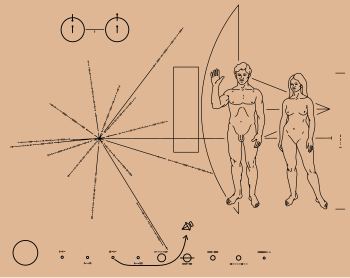
Pioneer plaques records are two identical anodized aluminum plates on board the Pioneer 10 (launched March 2, 1972 ) and the Pioneer 11 (launched April 5, 1973 ) with symbolic information about a person, the Earth and her location, author - Carl Sagan from Cornell University [1] , the author of the drawing of a man and woman is Linda Sagan , the second wife of Carl Sagan.
Content
Image Description
The plates depict a man , a woman, and the Pioneer ship on the same scale. To the left of them is the Sun , the rays show the location and distance to the 14 nearest pulsars and the center of the Galaxy . The numeral system accepts binary , a vertical bar is accepted as a unit symbol, a hyphen is adopted as a zero symbol. It was supposed that the hypothetical addressees of these messages would find it together with the Pioneers, who, being complex technical devices in themselves, would provide information on the achieved scientific and technical level of earthlings, therefore this kind of information was not posted on the “pioneer records”.
At the top of the plate are two basic states of the hydrogen atom [1] : the radiation wavelength of which (the neutral hydrogen radio line ), equal to 21 cm, is accepted as the basic unit of measurement of sizes and distances in this message, the line between the symbols of ortho and parahydrogen atoms symbolizing 21 cm marked with a vertical line (unit), images of the central part of the spacecraft, figures of a man and a woman, and this line is given in one scale. On the right side of the picture is indicated by the number 8 (8x21 = 168cm) the average height of the woman. The initial draft of the drawing contained an image of a man and a woman holding hands. Karl Sagan, however, quickly realized the fact that aliens would perceive this as a drawing of one living being, the drawing was corrected. Despite the fact that in the original version of the drawing, the genitals were depicted in both a man and a woman, the NASA leadership censored the drawing.
In the left part of the message there is an image of 15 lines leaving one point. 14 of these lines represent, in proportion to each other, the distances from the Solar System to 14 known pulsars and are accompanied by long binary numbers, indicating the frequency (more precisely - the wavelength of pulses) of the radiation of these pulsars in the accepted units of measurement on the message. Since the radiation frequency of the pulsars slowly changes with time, these data can be used to calculate when this message was made and launched. The perpendicular line closer to the end at each of these lines gives a segment with a dimension equal to the third coordinate (height) of the pulsar above the plane of our Galaxy.
If the plate is found, not all of these pulsars are likely to be observable from the location of the find, but indicating the position relative to 14 pulsars makes it possible to determine the coordinates of the solar system even in this case.
The data of one of the pulsars is somewhat erroneous, while the radiation period of the pulsar “1240” was known with an accuracy of only 3 decimal places, and the period on the plate was given with much greater accuracy. This pulsar is represented by a long line down and to the right.
The 15th line running horizontally to the right, behind the image of people, indicates the distance from the Sun to the center of the Galaxy.
The solar system with the trajectory of the flight "Pioneer-10" around Jupiter is schematically shown below. Despite the fact that the “Pioneer 11” then made a round of Saturn, both devices had the same records. Saturn is depicted with a ring, which would allow to identify the solar system. The rings of other planets, in particular, the rings of Jupiter, Uranus, Neptune, were not open by then. However, their more modest sizes partially compensate for this inaccuracy. Binary numbers above and below the planets indicate the relative distance to the sun. The unit of measurement is 1/10 of the distance from the orbit of Mercury to the Sun.
Physical parameters
- Material : gold anodized aluminum
- Width : 229 mm (9 inches )
- Height : 152 mm (6 inches)
- Thickness : 1.27 mm (0.05 in.)
- Engraving Depth : 0.381 mm (0.015 in.)
- Weight : approximately 120 grams
Criticism
The message was criticized as too complex to decrypt and too anthropocentric . The message was designed to accommodate as much information as possible in the minimum area, but almost none of the scientists not involved in this project, who showed this message, could not decipher it completely [2] .
Interestingly, one of the parts of the diagram, namely the arrow showing the trajectory of the ship, absolutely understandable to earthlings (the ship passed the orbit of Jupiter and left the solar system), may be the most difficult for those who find the plate outside the solar system. Arrow is an artifact of hunting and gathering societies. For societies with a different cultural heritage, this symbol may be meaningless.
Also, many negative reactions were caused by the fact that a man and a woman were depicted naked , NASA was accused of spending taxpayers' money on sending “obscenity” into space [3] .
See also
- Pioneer Program
- METI
- Voyager Gold Record
- Message "Peace", "Lenin", "USSR"
- Arecibo Message
Notes
- ↑ 1 2 Greetings from the Pioneers, 06/30/1996
- ↑ Strange Loops - How Do We Talk To Aliens?
- ↑ Carl Sagan : Murmurs of Earth , 1978, New York, ISBN 0-679-74444-4