The city cemetery in Tübingen ( German Stadtfriedhof Tübingen ) - a cemetery located in the university district of the Baden-Württemberg city Tübingen ; is one of the eleven municipal cemeteries of the city; was created in 1829 and covers an area of about three hectares . Since 2002, the graves (a total of 3,100, including 170 professors and 112 pastors ) have been re-opened to the public.
| City Cemetery | |
|---|---|
| him Stadtfriedhof tübingen | |
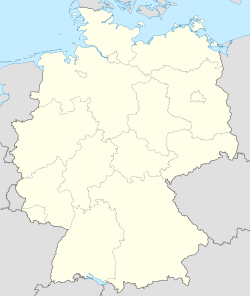
| A country | Germany |
| Coordinates | |

Content
History and Description
In 1829, in the city of Tübingen, on the site of the former Spitalekkern street, a new cemetery was created: it became necessary due to the fact that the old cemetery on the Ammer River was too small for the expanded city. From the old cemetery to the 21st century, only a part of its fence was preserved - on the territory of a modern botanical garden . In addition, the old tombstones near the local chapel were moved from there. On November 30, 1829, the first burial took place in the new cemetery - a blacksmith named Jacob Engelfried was buried. In connection with this, in the national language the cemetery received the designation "Engelfriedshof." The grave of Engelfrid is not preserved today, and the oldest surviving burial is the grave of merchant and pastry chef Jakob Conrad Schweichhardt from 1830.
The Tübingen cemetery has three entrances and one administrative building. According to the architect Uland, the new cemetery was to be located at a distance from the city and have regular grave fields, trees and shrubs. The originally planned chapel was opened only in 1894. In 1849, the territory of the cemetery was spread to the east - to the grave fields S, T, X and Z. The cemetery field X from then until 1963 was the burial site at the anatomical institute of the University of Tubingen [1] .
In 1872, the city cemetery was expanded to the north, to the grave fields L and Q. Finally, the grave fields U, V, W were created in 1920 - in the western direction. In 1968, the city cemetery was closed to new graves in connection with the exhaustion of squares. In May 2000, the municipal council of the city of Tübingen decided to re-open the cemetery - under the concept of the protection of monuments; since 2002, the burials (a total of 3,100; including 170 professors and 112 pastors ) are again available for visiting.
See also
- Collegiate Church in Tübingen
- Monastery Klosterbeuren
- Volkersberg Monastery
Notes
- ↑ Klaus D. Mörike. Geschichte der Tübinger Anatomie . - Franz Steiner Verlag, 1988. - p. 47. - 192 p. - ISBN 9783164453462 .
Literature
- Helmut Hornbogen: Der Tübinger Stadtfriedhof. Wege durch den Garten der Erinnerung. Verlag Schwäbisches Tagblatt, Tübingen 1995, ISBN 3-928011-16-2 .
- Barbara Happe: Die Entwicklung der deutschen Friedhöfe von der Reformation bis 1870. Tübingen, Univ., Diss., 1988).
- Benigna Schönhagen: Das Gräberfeld X. Eine Dokumentation über NS-Opfer auf dem Tübinger Stadtfriedhof. Kulturamt, Tübingen 1987 (Kleine Tübinger Schriften. Heft 11, ZDB-ID 1103345-9).
Links
- Sepp wais. Vor zehn Jahren wurde der Tübinger Stadtfriedhof neu eröffnet (German) . tagblatt.de . Schwäbisches Tagblatt (14. April 2012). The appeal date is February 12, 2019.