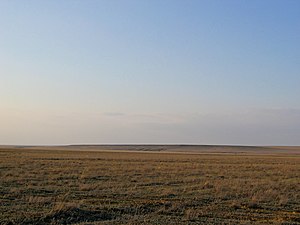

The steppe is a plain overgrown with grassy vegetation in the temperate and subtropical zones of the Northern and Southern hemispheres. A characteristic feature of the steppes is the absence or very small number of trees (not counting artificial plantations and forest belts along water bodies and communication lines).
Etymology
The word “steppe” has no generally accepted etymology [1] . If it came from the old Russian form, then the further origin is unclear; Fasmer considers unreliable comparison with lit. stiẽpti “extend”, Latvian. stiept “pull” [1] . If the ancient form was * rape (from the same Slavic root as "trample", "trample"), then in the Ukrainian language one should not expect a step , but * st_p ; on the other hand, it is possible that the word fell into the Ukrainian language from Russian, rather than Old Russian [1] . Origin from the form * тепptep (“cut down place”; cf. the old verb tepi - “chop”) is also possible [1] [2] .
From the Russian language, the word fell into Western European - German, French, English, and borrowing took place already in the XVI century. - English steppe is found in Shakespeare's lexicon [1] [3] .
Climate
Steppes are common on all continents except Antarctica . In Eurasia , the largest steppe areas are located in Russia , Kazakhstan , Ukraine and Mongolia . In the mountains it forms a high-altitude belt (mountain steppe); on the plains - a natural zone located between the forest-steppe zone in the north and the semi-desert zone in the south. Precipitation - from 250 to 450 mm per year, or from 100 to 1000 mm per year. The average temperatures of the winter months are from 0ºС to −20ºС, the summer months are from + 20ºС to + 40ºС, or the average annual temperatures are from 0ºС to + 20ºС. The climate of the steppe regions, as a rule, ranges from temperate continental to sharply continental and is always characterized by hot or very hot (up to +50 ° C) and very dry summers. Winter in the steppe regions is always snowy, with strong snow and snowstorms, from moderately mild to severe with crackling frosts, sometimes even frosts up to −40 ° C are possible .
Plant World
A characteristic feature of the steppe is predominantly treeless space covered with grassy vegetation. Grasses forming a closed or almost closed carpet: feather grass , fescue , thin-legged , bluegrass , sheep , etc. Plants adapt to adverse conditions. Many of them are drought tolerant or active in spring, when there is still moisture after winter.
Types of Steppes
Depending on the vegetation and moisture regime, the steppes are divided into five main subspecies:
- mountain (cryoxerophilic);
- meadow or herbaceous (mesoxerophilic) steppes;
- real ( xerophilic ) with a predominance of perennial turfgrains , mainly feather grass - the so-called feather grass steppes;
- Sazovye (haloxerophilic) - steppes consisting of plants in which the aboveground organs bear the features of adaptation to an arid climate, but grow in the presence of permanent or temporary soil moisture;
- desert (superxerophilic) steppes with the participation of desert grasses and shrubs of wormwood and thistle , as well as ephemera and ephemeroids .
Fragments of certain types of steppes are found in the forest-steppe and in the semi-desert .
On different continents, the steppe has different names: in North America - prairies ; in South America - pampas, or pampas , and in the tropics - Llanos . An analogue of South American Llanos in Africa and Australia is the savannah . In New Zealand, the steppe is called tussoki .
Fauna
Both in terms of species composition and some environmental features, the animal world of the steppe has much in common with the animal world of the desert. Like the desert, the steppe is characterized by high aridity. In winter, severe cold is often in the steppe, and the animals and plants living in it have to adapt, in addition to high, also to low temperatures. Animals are active in the summer mainly at night. Of the ungulates, typical species are distinguished by sharp vision and the ability to run fast and long, for example, antelopes ; of rodents - gophers , marmots , mole rats , mole rats, and jumping species building complex burrows: jerboas , kangaroo rats . Most of the birds fly away for the winter. Common: steppe eagle , bustard , steppe harrier , steppe kestrel , larks . Numerous reptiles and insects . Lizards (for example, monitor lizards ) can live without water for quite a while during a drought.
The steppe as a historical concept
In Russian history, the steppe is understood not only as a type of natural zone, but also as a habitat for nomads of various origin - “ steppes ”, united by the concept of “steppe”. From this time on the territory of Ukraine and southern Russia, small stone statues remained - “Scythian women ”, most likely having the meaning of religious symbols or monuments erected at the graves of prominent members of the then society, including warriors.
See also
- Forest steppe
- Prairie
- Savannah
- Steppes of Russia
Notes
- ↑ 1 2 3 4 5 Steppe // Etymological Dictionary of the Russian Language = Russisches etymologisches Wörterbuch : in 4 volumes / auth. M. Fasmer ; per. with him. and add. Corr. USSR Academy of Sciences O. N. Trubacheva , ed. and with the foreword. prof. B. A. Larina [vol. I]. - Ed. 2nd, erased - M .: Progress , 1986-1987.
- ↑ Aunts // Explanatory Dictionary of the Living Great Russian Language : in 4 volumes / auth. V.I. Dahl . - 2nd ed. - SPb. : Printing house of M.O. Wolf , 1880-1882.
- ↑ “ A Midsummer Night's Dream ” - “Why art thou here, // Come from the farthest Steppe of India?”
Literature
- Steppe / R.V. Kamelin // Social Partnership - Television. - M .: Great Russian Encyclopedia, 2016 .-- S. 233–234. - (The Big Russian Encyclopedia : [in 35 vols.] / Ch. Ed. Yu. S. Osipov ; 2004—2017, vol. 31). - ISBN 978-5-85270-368-2 .
- Steppes // Brockhaus and Efron Encyclopedic Dictionary : in 86 volumes (82 volumes and 4 additional). - SPb. , 1890-1907.
- Chibilev A. A. Face of the steppe: Ecological and geographical essays on the steppe zone of the USSR. - L .: Gidrometeoizdat , 1990 .-- 192 p. - ISBN 5-286-00104-1 .