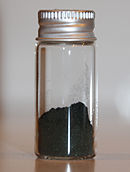
Safranin (3,6-diamino-2,7-dimethyl-10-phenylphenazine hydrochloride) is an organic compound , the main diazine dye belonging to the class of safranins , with the chemical formula C 20 H 19 N 4 Cl. Dark red powder, soluble in water and alcohol. It is used as a dye for wool, silk, paper and leather, despite the fact that it has poor light resistance. Also used for the preparation of varnishes, inks, as a desensitizer in photography.
| Safranin | |
|---|---|
  | |
| Are common | |
| Chem. formula | C₂₀H₁₉ClN₄ |
| Physical properties | |
| Molar mass | 350.85 g / mol |
| Chemical properties | |
| Solubility in water | 4.55 g / 100 g (15 ° C) |
| Solubility in alcohol | 3.57 g / 100 g (15 ° C) |
| Classification | |
| Reg. CAS number | |
| PubChem | |
| Reg. EINECS number | |
| Smiles | |
| Inchi | |
| ChemSpider | |
| Security | |
| NFPA 704 |  0 2 0 |
Synonyms: safranin O, safranin T, safranin T extra, tolusafranin, basic red 2, carthamine, cotton red, gossypimine [1] .
Content
Properties
It has the appearance of a dark red powder or yellow-red crystals in the form of needles. Molar mass 350.85 g / mol. Solubility in water is 4.55 g / 100 g (15 ° C), alcohol 3.57 g / 100 g (15 ° C). Insoluble in ether [2] .
Analytical Definition
Safranin forms a picrate, insoluble in water, but soluble in chloroform . The method is suitable for quantification [2] .
When hydrochloric acid is added to an aqueous safranin solution, the color changes from red to bluish-violet; after the addition of alkali, a brownish precipitate forms [1] .
Getting
From 2-toluidine [3] .
Application
It is used for dyeing, although it quickly fades when exposed to light. It dyes paper, leather, tanned cotton, silk, wool [2] .
In industry, it serves as a dye in the preparation of ink and alcohol varnishes [2] .
As a dye, it is widely used in biology for microscopic purposes in botanical, histological, bacteriological and other studies for staining cell nuclei; especially effective with drugs fixed compounds of chromium and osmium. In addition, it applies [1] :
- in histology, to detect various achromatin cell structures: linilin filaments, centrosomes , spindle filaments, polar radiance. The method of sequential staining with solutions of the following series of dyes is used: safranin - gentian violet - orange W;
- in bacteriology - for staining brucellosis bacteria.
In analytical chemistry, it is used as an adsorption or redox indicator, for example, in the processes of reduction of chromium (II) chloride with ferric iron and tetravalent uranium. It is also suitable for titration of sodium dithionite and as a reagent for nitrites [2] [1] .
It is used as a desensitizer in photography, but for this purpose it is preferable to use phenosafranin (safranin B) [2] [4] .
Security
Toxic, causes conjunctivitis and dermatitis [2] . NFPA rating 704 : health hazard: 2, flammability: 0, instability: 0 [5] .
Notes
- ↑ 1 2 3 4 Freistatt, 1980 , p. 350.
- ↑ 1 2 3 4 5 6 7 Chekalin, 1965 .
- ↑ Yeltsov, 1985 , p. 180-182.
- ↑ Venkataraman, 1957 , p. 877.
- ↑ LabChem .
Literature
- Venkataraman K. Chemistry of synthetic dyes. - L .: State Scientific and Technical Publishing House of Chemical Literature, 1957. - T. 2.
- Laboratory Workshop on the Synthesis of Intermediates and Dyes / Ed. Eltsova A.V. - L .: Leningrad- “Chemistry”, 1985.
- Freistat D.S. Reagents and preparations for microscopy. - M .: Chemistry, 1980 .-- 480 p.
- Chekalin M. A. Safranin: article // Brief Chemical Encyclopedia / Editorial: Knunyants I. L. (ed.) And others. - M .: Soviet Encyclopedia , 1965. - T. 4: Pyrometallurgy — S. - S. 747.
Links
- Safranin O Safety Data Sheet . LabChem. Date of treatment January 25, 2019.