
Self - timer - a camera device that allows you to make a time delay between pressing the shutter button and its actual operation. Self-timer is used to take self-portraits or to prevent camera vibrations due to pressing the button [1] .
Device
The first self-timer was mechanical and was a separate device made in the form of an attachment to the camera shutter [2] [3] . The delay was provided by an anchor or pneumatic mechanism that actuates the trigger pusher [4] . The self-timer was screwed into the socket of the shutter button, like a photocable , or attached to the “ cold shoe " of the camera [5] . Gradually, the self-timer began to be built into the camera body, placing it on the front wall for the convenience of shooting self-portraits. Back in the 1950s, the built-in self-timer was considered a sign of an expensive model, but over time it became a standard option. In cameras with a focal shutter, the self - timer is a rotary lever on the front wall, which the spring cocks. The launch is carried out by a separate button located under the crank lever. In cameras with central shutters, the self - timer was part of the mechanism and fired from the main trigger lever. The delay provided by the mechanical self-timer can be adjusted by the cocking angle of the lever and usually does not exceed 10-15 seconds.

Attached mechanical self-timer

Attached self-timer mounted on the camera

Nikon F2 Self-timer Camera with Delay Scale
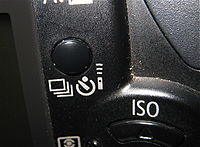
Electronic self-timer button


The proliferation of electromechanical shutters with electric release allowed to abandon the complex mechanical self-timer in favor of an electronic timer . In this case, the delay is fixed or can be selected through the camera menu. In modern cameras, including digital ones, the self-timer is controlled through the menu of modes of motorized driving ( Eng. Drive Mode ). Most often, the delay is controlled by choosing one of two values: 10 or 2 seconds. The electronic self-timer during operation gives a light signal by flashing the LED on the front wall, the frequency of which usually increases in the last second before the shutter is released. Sometimes a light signal is complemented by a sound.
In single-lens reflex cameras, the self-timer is often combined with a simplified mirror pre-lift mode. In this case, the mirror rises when the self-timer is turned on, and after the delay time the shutter is released, after which the mirror returns to the position of sight. In this way, camera shake due to mirror movement is reduced. This principle is used both in mechanical cameras ( Nikon FM , Start ), and in modern digital equipment ( Canon EOS 5D Mark IV , Nikon D800 ). In some mechanical cameras (for example, “ Nikon F2 ”), the self-timer allowed to expand the range of slow shutter speeds, opening the shutter at the beginning of the stroke when a special mode is activated [6] . In the Soviet Zenit-E camera, when setting the shutter speed to manual, the self-timer also worked out an exposure of about 10 seconds.
As an alternative to the self-timer, various methods of remote control of the shutter can be used, such as a release cable , a remote control, a selfie stick with Bluetooth support or others. During the polar expedition of the Japanese traveler Naomi Uemura , a specially designed camera “ Nikon F3 Uemura” was used, which included the ML-1 radio timer, which made it easier to photograph self-portraits with dogs in a single expedition [7] .
See also
- Trigger cable
- Selfies
Notes
- ↑ Photokinotechnics, 1981 , p. 20.
- ↑ Textbook of Photography, 1976 , p. 65.
- ↑ Pocket Guide to Photography, 1928 , p. 61.
- ↑ Quick reference to amateur photographer, 1985 , p. 54.
- ↑ Brief Photographic Reference, 1952 , p. 97.
- ↑ Debut of Nikon F2 . Camera Chronicle . Nikon Date of treatment March 8, 2013. Archived March 13, 2013.
- ↑ Ways to overcome low temperatures - lubricant and forward film winding . Nikon F2 and F3 Titanium Uemura Spesials . Nikon Date of treatment October 8, 2015. Archived January 8, 2015.
Literature
- Iofis E.A. Photokinotechnics / I. Yu. Shebalin. - M .: "Soviet Encyclopedia", 1981. - S. 20. - 447 p. - 100,000 copies.
- N. D. Panfilov, A. A. Fomin. I. The main parts of the camera // Quick reference amateur photographer. - M .: "Art", 1985. - 367 p. - 100,000 copies.
- V.V. Puskov. A brief photographic guide / I. Katsev. - M .: Goskinoizdat, 1952.- 423 p. - 50,000 copies.
- E. D. Tamitsky, V. A. Gorbatov. Chapter I. The technique of photographic shooting // Textbook on photography / Fomin A.V., Y. Fivensky .. - M .: “Light Industry”, 1976. - P. 7—128. - 320 p. - 130,000 copies.
- E. Vogel. Pocket Guide to Photography / J. K. Laubert. - 11th ed .. - M. - L .: State publishing house, 1928. - 325 p. - 6000 copies.