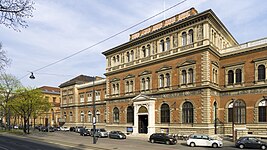
Museum of Applied Art ( German: Museum für angewandte Kunst , abbreviated as MAK ) is an art and cultural museum in Vienna . It was opened in 1864, originally at the Ballhaus (“Balhaus”) in Vienna's Hofburg, in the Inner City . In addition to the traditional sphere of interests for the collection of applied art, the museum also collects and constantly replenishes the collection of works of modern art and architecture.
| Museum of Applied Arts | |
|---|---|
 | |
| Established | 1864 |
| opening date | |
| Founder | |
| Address | Vienna-1, Ring Strasse / Stubenring |
| Site | www.mak.at |
Content
History
The museum was then called “The Imperial and Royal Austrian Museum of Art and Industry ” was founded on March 7, 1863 by Emperor Franz Joseph I. Its first director was Rudolf von Eitelberger, professor of the University of Vienna at the history of art. The opening of the museum took place on May 12, 1864, initially the exhibition temporarily occupied the building of the Ball House in Vienna's Hofburg, adapted by the architect Heinrich von Ferstel for exhibition halls. On November 15, 1871, the museum was opened in a new (current) building, designed by Heinrich von Ferstel in the Neo-Renaissance style. The decoration belongs to the painter Ferdinand Laufberger .
In the years 1865-1897, the museum publishes its journal under the name "Messages of the Imperial and Royal Museum of Applied Art", in 1898 to 1921 the journal "Art and Applied Art" was published. Between 1955 and 1986, he published the magazine "Old and Contemporary Art."
In 1907, the Museum of Applied Arts transferred a significant part of the collection of the Museum of Commerce. In 1897, Arthur von Skala became the director of the museum, who previously managed the Oriental Museum. Opponents of the Museum of Applied Art are such masters as Otto Wagner , Koloman Moser , Felicien von Mirbach, Josef Hoffman , Alfred Roller and others. After the founding of the Austrian Republic, in 1919 some of the funds from the property of the Austrian emperors were transferred to the museum, in particular the collection oriental carpets. As a result of an exchange with the Kunsthistorisches Museum in 1936 and in 1840, the museum donated some of the sculptures and the antique collection, receiving in return a collection of objects of applied art from the Figdor collection. After the Anschluss of Austria, in 1938 the museum was renamed the “State Museum of Applied Art in Vienna” ( Staatliches Kunstgewerbemuseum in Wien ). In the period from 1939 to 1945, his collection was replenished with numerous objects confiscated by the Nazis art. Some of them were returned to the owners and their heirs afterwards. In 1947, the museum was renamed the "Austrian Museum of Applied Art". In 1949, it was reopened for visits after the damage caused by hostilities was repaired.
In 1965, the museum, as its branch was attached to the building on Vöring Strasse, 18. Together with it, the museum passed into possession of a large collection of antique watches by Franz Sobek from 1750 to the 2nd half of the XIX century, as well as pieces of furniture 1800-1840 of the years. In 1994, the second external branch of the museum was founded, in the towers of Vienna Arenberg Park. However, after 2011, this branch was closed for visits. In 2000, the museum received the status of a research institution.
In 2015, at the initiative of the Museum, the first biennale in the field of art, design and architecture is held in Vienna. .
Since September 2011, the Vienna Museum of Applied Arts has been headed by Christoph Thun-Hohenstein. In 2016, he was approved as the general director and scientific director of the museum for the next five years.
Collection
The collection of cultural and art monuments of the museum is divided into several sections. It:
- VIENNA 1900. Design and applied art of 1890-1938 (WIEN 1900. Design / Kunstgewerbe 1890-1938)
- Carpets and rugs
- Asia. China - Japan - Korea
- Renaissance , Baroque , Rococo
- Baroque , Rococo , Classicism
- Empire , Biedermeier
- Historicism , Art Nouveau , Modern .
N: The most interesting objects of the exposition are works made in Vienna workshops, furniture by Trone and Jacob and Joseph Kon, Dunhauser, sketches by Gustav Klimt for mosaics of friezes to the Brussels-based Stokle palace, and a porcelain room from Dubski’s palace , a collection of Bohemian and Venetian crystal, Flemish and Italian dishes, silver, porcelain, fabrics and carpets, as well as products from Chinese porcelain, Japanese color graphics ( Ukiyo-e ) and wooden cliff templates for it (Katagami).
Rewards
- 1996: Euro Council Award
Nearby Historical and Cultural Monuments
- Vienna City Park
- Monument to Johann Strauss in the City Park
- Urania
- Austrian Post Bank
- Cafe Prukel
- Vienna Mitte Station
- Hotel Intercontinental
- Vienna Concert Hall
- St. Stephans (Stephansplatz).
Gallery
The interior of the gallery of the second floor of the museum
Allegory of painting
Bust of Giacomo Girolamo Casanova
Facade detail
Leopold Forstner . The figure of a woman (1900)
Openwork spring (Zierbrunnen).
Add-ons
- Wikimedia Commons has media related to Vienna Museum of Applied Arts
- Homepage des MAK - Museum für angewandte Kunst (Wien)