Gaganyan ( Eng. Gaganyaan , Hindi गगनयान ) - a project of a manned spacecraft in India . Developed by the Indian Space Research Organization (ISRO) to implement a national manned flight program . Previously, the conditional name of the ship under the project was ISRO Orbital Vehicle , in August 2018, the Prime Minister of India announced his own name.
| Gaganyan | |
|---|---|
| general information | |
| Developer |  ISRO ISRO |
| Manufacturer | ISRO |
| A country | India |
| Appointment | manned |
| Orbit | low reference orbit |
| The term of autonomous existence | 7 days [1] |
| Crew | 3 [1] |
| Production and operation | |
| Status | project |
| Total running | 0 (2019) |
| First start | unmanned dek.2020 [1] manned dec.2021 [1] |
| Launch vehicle | GSLV Mk.III |
| Launch pad | Satish Dhavan Space Center , Shriharikot |
| Typical configuration | |
| Dry weight | 3 735 kg [2] |
| Starting weight | 7 800 kg [2] |
| Dimensions | |
| Height | 2.7 m |
| Diameter | 3.4 m [1] |
| Useful volume | 11.5 m 3 |
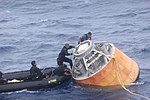
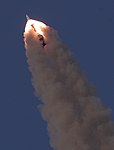
The project has been under development since 2006. In 2014, the first suborbital test took place with the landing (splashdown) of the Gaganyan ship model. In 2017, the first test of the emergency rescue system at startup was passed.
It is planned (as of December 2018) to carry out unmanned launches in December 2020 and July 2021, and the first manned launch in December 2021 , which should make India the fourth space superpower to independently conduct manned space flights . [one]
According to the project, the almost 8-ton (at launch) spacecraft is designed to put into orbit a crew of 3 Gaganaut astronauts ; the autonomous flight resource is 7 days.
|
Comparison with similar projects
| Comparison of the characteristics of the developed manned spacecraft ( Edit ) | |||||||
|---|---|---|---|---|---|---|---|
| Title | Federation | Orion | Dragon v2 | Starliner (CST-100) | Gaganyan | ||
| Developer | RSC Energia | Lockheed martin | Spacex | Boeing | Cast | ISRO | |
| Appearance | |||||||
| Multitasking |
|
|
|
|
| DOE | |
| The year of the first orbital unmanned launch | 2023 ( Irtysh (Soyuz-5) ) 2024 ( Angara-A5B ) [12] 2027 [4] or 2028 [12] ( Yenisei ) | 2014 (Delta IV Heavy) 2021 ( SLS ) [13] | March 2, 2019 (Falcon 9) | planned for 2019 [14] | planned for 2019 ( LM-5B or LM-7 ) [15] | Dec 2020 - 2021 [1] | |
| The year of the first manned flight | 2024 ( Irtysh (Soyuz-5) ) [16] [4] 202? ( Yenisei ) [4] | 2023 ( SLS ) [13] | planned 2019 | planned for the end of 2019 [14] | Dec 2021 - 2022 [1] | ||
| When flying to the DOE | |||||||
| Crew | 4 [4] [17] | - | under a contract with NASA - 4, + 1 tourist maximum - 7 | under a contract with NASA - 4, + 1 tourist maximum - 7 | up to 6 people [10] [11] | 3 [1] | |
| Starting weight, t | 14.4 [4] [17] | 12 | fourteen | fourteen | |||
| Payload mass in a manned flight, t | 0.5 [4] [17] | ||||||
| Payload weight of cargo version, t | 2 | 3.31 | |||||
| Flight duration as part of the station | Up to 365 days (DOE) [4] [17] | Up to 720 days | Up to 210 days | ||||
| Autonomous Flight Duration | Up to 30 days [4] [17] | Up to 1 week | Up to 60 hours | 7 [1] | |||
| Launch vehicle |
|
|
|
| LM-5B [15] or LM-7 | GSLV Mk.III | |
| When flying to the moon | |||||||
| Crew | 4 [4] [17] | four | - | 3-4 [10] [11] | - | ||
| Starting weight, t | 20.0 [4] [17] | 25.0 | twenty | ||||
| Payload mass in a manned flight, t | 0.1 [4] [17] | ||||||
| Flight duration as part of the station | Up to 180 days [4] [17] | ||||||
| Autonomous Flight Duration | Up to 30 days [4] [17] | Up to 21.1 days | |||||
| Launch vehicle |
|
|
| ||||
See also
- Tests of the model of the ship "Gaganyan" in 2014
Notes
- ↑ 1 2 3 4 5 6 7 8 9 10 Rs 10,000 crore plan to send 3 Indians to space by 2022 The Times of India (December 29, 2018).
- ↑ 1 2 ( Indian ) Indian Manned Spacecraft . Astronautix 2014.
- ↑ 1 2 Russia in the coming years will not abandon the use of Soyuz spacecraft . TASS (March 12, 2015).
- ↑ 1 2 3 4 5 6 7 8 9 10 11 12 13 14 15 16 Russian space: the history of the future. Eugene Mikrin , Roscosmos TV Studio (01/26/2018).
- ↑ In Roskosmos told about the future of the ship "Federation"
- ↑ First step to Mars . Lenta.ru (December 5, 2014). Date of treatment March 24, 2015. Archived December 6, 2014.
- ↑ US will test the latest Orion spacecraft in December
- ↑ 1 2 3 SpaceX to send privately crewed dragon spacecraft beyond the moon next year (Eng.) , SpaceX (02.27.2017). Archived on February 28, 2017.
- ↑ 1 2 3 Jeff, Foust SpaceX no longer planning crewed missions on Falcon Heavy . spacenews.com (02/05/2018).
- ↑ 1 2 3 4 我国 新一代 载人 飞船 将 实现 近 地 轨道 飞行 和 载人 登月 双重 任务 (Chinese) . Science and Technology Daily (March 8, 2016).
- ↑ 1 2 3 4 China's new spaceship to rival the best in the world . China daily (March 8, 2016).
- ↑ 1 2 3 4 ROSKOSMOS 2.0. TASKS DELIVERED BY THE MANAGEMENT COUNCIL WILL BE COMPLETED . Roscosmos (July 18, 2018). Archived July 19, 2018.
- ↑ 1 2 FY 2019 Budget estimates . NASA (February 2018).
- ↑ 1 2 April 3, 2019 - Commercial Crew Program . blogs.nasa.gov .
- ↑ 1 2 Jones, Andrew China's Long March 5 heavy-lift rocket to fly again around November in crucial test . spacenews.com (March 14, 2018).
- ↑ Dmitry Rogozin: not a single aggressor will venture to start a war against Russia . RIA Novosti (June 03, 2017). Archived July 3, 2017.
- ↑ 1 2 3 4 5 6 7 8 9 10 At RSC Energia, they talked about the differences between the lunar and near-Earth versions of the Federation ship . TASS (09/03/2019).
- ↑ The Federation ship can be created in two versions (06/21/2017).
- ↑ Vladimir Solntsev: RSC Energia opens the Virtual Design Center (02.22.2017).
- ↑ Eve of Launch: 2016 Goals Vital to Commercial Crew Success . NASA (January 20, 2016). Archived January 21, 2016.
- ↑ United Launch Alliance and the Boeing Company Unveil the Atlas V Configuration for the CST-100 Starliner Crew Capsule (English) , ULA (10.13.2016). Archived on October 13, 2016.
- ↑ ULA sees clean handover of Boeing crew launches to Vulcan rocket . spaceflightnow.com (April 18, 2015). Archived on April 18, 2015.
- ↑ SpaceX plans to send two people around the Moon (English) , theverge.com (02.27.2017).