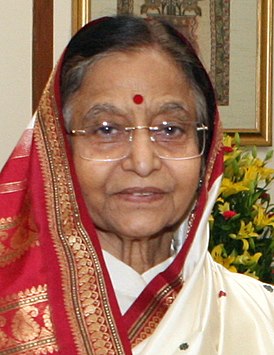
Pratibha Devisingh Patil ( Marathi : प्रतिभा पाटील, Pratibhā Pāṭīl IAST , Eng. Pratibha Devisingh Patil born December 19, 1934 ) is the twelfth president of India , the first woman in this post in the country's history. She was elected to this post on July 19, 2007 by an electoral college consisting of members of the federal parliament and state assemblies; took office on July 25, 2007 , succeeding Abdul Kalam . On July 25, 2012, Pranab Kumar Mukherjee took over as President of India .
| Pratibha Patil | |||||||
|---|---|---|---|---|---|---|---|
| Marath. प्रतिभा पाटील | |||||||
 | |||||||
| Predecessor | Abdul Kalam | ||||||
| Successor | Pranab Kumar Mukherjee | ||||||
| |||||||
| Predecessor | Madan Lal Khurana | ||||||
| Successor | Akhlaqur rahman kidwai | ||||||
| Birth | December 19, 1934 (84 years old) village Najaon , Maharashtra , British India | ||||||
| Father | Sri Narayan Rao | ||||||
| Spouse | Devisingh Ramsing Shekhawat | ||||||
| Children | son: Rajendra Singh daughter: Jyoti Rathore | ||||||
| The consignment | Indian National Congress | ||||||
| Education | Bombay University | ||||||
| Religion | Hinduism | ||||||
| Website | |||||||


Biography
P. Patil was born in Najaon (state of Maharashtra ); Received a law degree at Bombay University .
She took up politics in 1962 when she became a deputy of the Maharashtra assembly from the Indian National Congress .
In 1967 - 1978 held various posts in the state government;
After the split of the INC in 1978, following the defeat of Indira Gandhi in the 1977 general election, P. Patil, loyal to the Nehru-Gandhi clan, became the opposition leader in the state assembly. After I. Gandhi returned to power in the country in 1980 , many considered P. Patil the most likely candidate for the post of chief minister of Maharashtra, but preference was given to the protege of Sanjay Gandhi A.R. Antulu .
In 1985 - 1990 - Deputy of Rajya Sabha (upper house of the federal parliament) (in 1986-1988 - Vice-Chairman of Rajya Sabha);
in 1991 - 1996 - Deputy Lok Sabhi (lower house) from Amravati County.
In 1996 - 2004 practically did not participate in the political life of the country;
After the victory of the coalition led by the INC in the general election of 2004, she was appointed governor of Rajasthan (there was a unique situation when all the highest political posts in the state were occupied by women - the main minister was Vasundhara Raja , and the speaker of the assembly was Sumitra Singh ). The most high-profile event during P. Patil's tenure in this post was her rejection of the law preventing “forced conversion to another faith”, adopted by the ruling Hindu-nationalist Bharatiya Janata Parti (BJP), which was sharply criticized by a number of Christian organizations.
In June 2007, the INC suggested P. Patil for the post of 12th president of the country, after the left-wing parties supporting the coalition government led by the KPI (m) rejected the candidacy of Interior Minister Shivraj Patil (accused of "insufficient respect for the secular foundations of India" ) The nomination of P. Patil was justified as "contributing to the improvement of the status of Indian women in the year of the 60th anniversary of independence." Right-wing parties led by the BJP attacked P. Patil with sharp criticism, trying to collect and publicize as much dirt as possible on P. Patil (for this purpose, a special Know Pratibha Patil website was created). In particular, charges were brought of financial fraud and pressure on investigators investigating the murder allegedly committed by brother P. Patil. Nevertheless, since the INC with its allies had a strong majority in the electoral college, P. Patil won a landslide victory, receiving almost twice as many votes as the right-wing candidate, Vice President Bhairon Singh Shekhavat , and becoming the first woman president in the history of the country.