The League of Arab States ( Arabic. ةامعة الدول العربية Jha: mi'at ad-Duval al-Arabiyah; LAS ) is an international organization that unites Arab states and a number of friendly non-Arabic ones in which Arabic is one of the official. Consists of 22 member states [6] .
| Arab League | |
|---|---|
| امعة الدول العربية | |
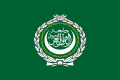 Flag of the League of Arab States | |
 | |
Member States of the League of Arab States | |
| Membership | 22 [1] states Members:  Algeria Algeria Bahrain Bahrain Djibouti Djibouti Egypt Egypt Jordan Jordan Iraq Iraq Yemen Yemen Qatar Qatar Comoros Comoros Kuwait Kuwait Lebanon Lebanon Libya Libya Mauritania Mauritania Morocco Morocco UAE UAE Oman Oman State of Palestine State of Palestine Saudi Arabia Saudi Arabia Syria (opposition) Syria (opposition) Somalia Somalia Sudan Sudan Tunisia TunisiaObservers:  Brazil (2003) [2] Brazil (2003) [2] Venezuela (2006) [3] Venezuela (2006) [3] India (2006) [4] India (2006) [4] Eritrea (2007) [5] Eritrea (2007) [5]Suspended:  Syria Syria |
| Headquarters | Cairo , Egypt |
| Type of organization | International organization |
| Official language | Arab |
| Executives | |
| General secretary | Ahmed Aboul Gate |
| Chairman of the Arab Parliament | Nabih Berry |
| Base | |
| Protocol of intent to create | October 7, 1944 |
| Official creation date | March 22, 1945 |
| lasportal.org | |
Established March 22, 1945 on the basis of the Alexandrian Protocol . The highest organ of the organization is the Council of the League, in which each member state has one vote. The headquarters of the League is in Cairo .
Content
Goals
The goals of the League are specified in the agreement signed in 1945, and provide for "strengthening ties between the states participating in it, developing a unified political line to cooperate between them, protect their independence and sovereignty, to consider the affairs and interests of Arab countries." Cooperation is not limited to political aspects and also includes economic, financial, communication, cultural, social and sanitary interactions. In addition, cooperation includes issues of citizenship, passports, visas, the issuance of criminals [7] .
Composition
The League of Arab States includes 18 Arab-speaking countries, the State of Palestine and 3 Muslim countries in East Africa (Comoros, Somalia and Djibouti), which are closely associated with the Arab world. [6] . In 19 of the 22 members of the Arab League, Arabic is native to most citizens.
League states occupy a total area of 5.25 million square miles, where more than 500 million people live [8] . Members of the League are both the richest ( Qatar , the UAE , Kuwait , Saudi Arabia , Oman , Bahrain ) and the poorest countries in the region ( Somalia , Comoros , Mauritania , Yemen , Sudan , Djibouti ). The League includes 8 monarchies, which are among the most politically stable countries in the world, and 14 republics, often torn by strong political contradictions.
Manual
The highest governing body of the organization is the Council of the League. Each member has one vote in the council, usually the country is represented by the foreign minister or the permanent representative on the council. The council meets twice a year, in March and September [9] . At the request of at least two countries, an extraordinary session of the Council may be convened. Decisions made by the League Council are binding on those countries that voted for them [10] [8] .
Between sessions of the Council, the leadership is exercised by the General Secretariat, headed by a Secretary General, elected for a term of 5 years. In addition, the Economic Council, the joint defense committee and other standing committees work in the League [9] [8] .
The headquarters is located in Cairo (in 1979-1991 - in Tunisia ) [9] . The official language is Arabic.
Arab Parliament
On December 27, 2005, the first session of the provisional Arab parliament , established by the decision of the Algerian Arab League summit in March 2005, was held in Cairo . Mohammed Jassem Al-Sakr, Chairman of the Foreign Affairs Committee of the Parliament of Kuwait, was elected Speaker of the Parliament. During the first five years, the Arab Parliament is formed by delegating 4 representatives from the parliament of each of the 22 LAS member countries (including the State of Palestine [11] ). In the future we plan to move to direct elections. The headquarters of the Arab Parliament is located in Damascus .
The work of the Arab Parliament is limited to issues in the social, economic and cultural spheres [12] .
Human rights
In 1968, the League Council created the Permanent Arab Human Rights Commission; however, in 2008 her powers remained very limited [13] . In 2004, the League countries adopted and in 2008 the Arab Charter on Human Rights entered into force.
Armed Forces
On March 29, 2015, at the 26th session of the League, the heads of member countries of the organization agreed on the creation of a unified regional armed forces to jointly counter security threats [14] .
On August 25, it was reported that the foreign ministers and ministers of defense of the member states of the League of Arab States (LAS) will sign on August 27 at a special meeting of the pan-Arab organization in Cairo a protocol on the formation of the Arab armed forces [15] .
History
League Creation
With the idea of uniting Arab independent states, England came out during the Second World War; Foreign Minister Eden repeatedly stated that England was ready to support any such project. In September 1943, the Arab states began negotiations on the creation of such a union. The protocol of intent was signed on October 7, 1944 in Alexandria by representatives of Syria , Trans-Jordan , Iraq , Lebanon and Egypt [16] . According to him, the Arab League was supposed to represent the foreign policy bloc of independent states. The agreement on the creation of the league was signed on March 22, 1945 in Cairo by the leaders of the aforementioned states, joined by the King of Saudi Arabia, Abdel Aziz ibn Saud [17] . On May 5 of the same year, North Yemen joined the agreement. Only independent Arab states were eligible to participate in the League < [7] .
Despite the declared independence, the League pursued a pro-British policy in the region. The result was the formation by 1949 of two hostile groups within the League: Iraq and Trans-Jordan remained on pro-British positions, while Egypt and Saudi Arabia were supported by the United States. As a result, the activity of the league was close to termination [7] . On April 13, 1950, an agreement was signed on cooperation in the field of defense and economy [10] .
In 1950, the League received observer status at the UN. At the same time, the struggle for independence unfolded in the Arab world. After the July 1952 revolution in Egypt, the League began to coordinate the actions of its members, aimed at obtaining the independence of individual Arab countries. Thus, the League served to unite the Arab countries of the Asian and African regions. After the number of UN members from Asia and Africa increased significantly, the influence of the League in the organization began to decline [9] .
League Disagreements
Another split in the League is associated with a defeat in the 1967 Arab-Israeli conflict: Egypt and Jordan, with the support of the United States, signed a cease-fire agreement and received sharp criticism from Algeria, Iraq, and the Palestine Liberation Organization. Syria’s intervention in the civil war in Jordan in 1970 and in Lebanon in 1975, Jordan’s proposal for the West Bank in 1972, the actual recognition of Israel by Egypt in 1977 was also ambiguous. After the signing of the Egyptian-Israeli peace treaty in 1979, Egypt’s membership in the League was suspended, sanctions were imposed against it, and the headquarters of the League was moved to Tunisia. Only in 1989, Egypt’s membership in the League was restored, its headquarters returned to Cairo in 1991 [9] .
New differences were associated with the war in the Persian Gulf (1990-1991). Saudi Arabia, Egypt, Syria, and Morocco represented an anti-Iraq coalition, while Jordan, Yemen, and Libya maintained neutrality [9] . The BBC News news agency calls the economic boycott of Israel, which the organization carried out from 1948 to 1993, the only decision in the history of the League that went beyond the declaration of intent [8] .
However, the League fruitfully dealt with economic issues. As part of the economic policy of the League of Arab States in 1959, the first Arab Petroleum Congress was held, and in 1964 the Arab League Educational, Cultural and Scientific Organization (ALECSO) was established. [10] . In addition, all-Arab institutions such as the Arab Telecommunications Association (Arab Telecommunications Union) in 1953, the Arab Postal Union (Arab Postal Union) in 1954, the Arab Development Bank, which later changed its name to the Arab Financial Organization (Arab Financial Organization) in 1959, (Arab Common Market) in 1965. The latter, open to all member states of the League, provides an opportunity for duty-free trade in natural resources and agricultural products, which contributes to the movement of capital and labor [12] .
Arab Spring
Another challenge to the organization was thrown by a wave of protests that swept across the countries of the Arab world in 2010–2011 and received the name of the Arab Spring [10] .
Libya
In February 2011, the Arab League suspended Libya’s participation in the organization’s activities [18] due to the mass popular demonstrations in the country and the authorities ’suppression. On March 13, 2011, the League of Arab States considered the proposal to close the airspace of Libya, almost all the member countries of the Arab League supported the proposal.
Syria
In November 2011, the League of Arab States suspended Syria’s participation in the organization’s activities [19] , finding it unacceptable to use violence by the government against demonstrators. In July 2013, the Arab League together with the Organization of Islamic Cooperation appealed to the parties to the conflict in Syria to establish a truce for the holiday of Eid al-Fitr ( Uraza Bayram ) [20] . In March 2014, the League condemned the "massacres of civilians" and called on all parties to the conflict to make efforts to end the civil war. “We condemn the killing of innocent people by the regime of Bashar al-Assad,” the statement says [21] .
Member States
Below are the states that are members of the League, in the order of their entry into the organization [22] :
- Egypt - March 22, 1945 . Entered as the Kingdom of Egypt . In 1953 proclaimed Republic. From 1958 to 1961 together with Syria formed United Arab Republic . Egypt was excluded from the League from March 26, 1979 to May 23, 1989.
- Iraq - March 22, 1945 . Entered as the Kingdom of Iraq . In 1958, proclaimed Republic. From 1963 to 2003 in power Baath Party.
- Lebanon - March 22, 1945 .
- Saudi Arabia - March 22, 1945 .
- Syria - March 22, 1945 . Syria from February 22, 1958 to September 28, 1961 was part of United Arab Republic, together with Egypt, Syria returned to the League October 28, 1961. Membership suspended November 16, 2011. At present, Syria in the Arab League is represented by the opposition to the B. Assad regime [23] .
- Jordan - March 22, 1945 (until 1949 - Transjordan).
- North Yemen - May 5, 1945 . In 1990, the state merged with the Ndr Yemen to Yemen
- Libya - March 28, 1953 . Entered as a kingdom . Since 1969 - Libyan Arab Republic , since 1977 - Great Socialist People’s Libyan Arab Jamahiriya ), since 2011 - Libyan Republic ). Libya announced twice her withdrawal from the League, but withdrew her decision: from October 24, 2002 to January 16, 2003, and from April 3 to May 25, 2003. Membership was suspended from February 22 to August 25, 2011.
- Sudan - January 19, 1956 .
- Tunisia - January 1, 1958 .
- Morocco - October 1, 1958 .
- Kuwait - July 20, 1961 .
- Algeria - August 16, 1962 .
- People's Democratic Republic of Yemen - December 12, 1967 . In 1990, the state merged with North Yemen in Yemen
- Bahrain - September 11, 1971 .
- Qatar - September 11, 1971 .
- Oman - September 29, 1971 .
- United Arab Emirates - December 6, 1971 .
- Mauritania - November 26, 1973 .
- Somalia - February 14, 1974 .
- Palestine Liberation Organization - September 9, 1976 . Since 1988, the State of Palestine has represented the League [11] .
- Djibouti - September 4, 1977 .
- Comoros - November 20, 1993 .
General Secretaries of the Arab League
The following are the secretaries general of the League of Arab States [22] :
- Abdul Rahman Hassan Azzam (1893–1976) from March 22, 1945 to September 1952
- Abdul Halek Hasuna (1898–1992) from September 1952 to June 1, 1972
- Mahmud Riad (1917-1992) from June 1, 1972 to March 1979
- Chadley Cliby (born 1925) from March 1979 to September 1990
- Assad al-Assad (born 1920) and. about. from September 1990 to May 15, 1991
- Ahmed Ismat Abdel Magid (1923–2013) from May 15, 1991 to May 15, 2001
- Amr Musa (born 1936) from May 15, 2001 to July 1, 2011
- Nabil al-Arabi (born 1935) from July 1, 2011 [24] to June 30, 2016.
- Ahmed Aboul Gate (born 1942) since July 1, 2016 .
LAS Summits
| # | A country | date |
|---|---|---|
| one | Cairo | January 13-17, 1964. |
| 2 | Alexandria | September 5-11, 1964. |
| 3 | Casablanca | September 13-17, 1965. |
| four | Khartoum | August 29, 1967. |
| five | Rabat | December 21-23, 1969 |
| 6 | Algeria | November 26-28, 1973. |
| 7 | Rabat | October 29, 1974. |
| eight | Cairo | October 25-26, 1976 |
| 9 | Baghdad | 2-5 November 1978. |
| ten | Tunisia | November 20-22, 1979. |
| eleven | Amman | November 21-22, 1980. |
| 12 | Fez | November 25, 1981, September 6-9, 1982. |
| 13 | Casablanca | 1985 |
| 14 | Amman | November 8, 1987. |
| 15 | Algeria | June 1988. |
| sixteen | Casablanca | 1989 |
| 17 | Baghdad | 1990 year. |
| 18 | Cairo | 1996 |
| nineteen | Amman | March 27-28, 2001. |
| 20 | Beirut | March 27-28, 2002. |
| 21 | Sharm el sheikh | March 1, 2003. |
| 22 | Tunisia | May 22-23, 2004 |
| 23 | Algeria | March 22-23, 2005 |
| 24 | Khartoum | March 28-30, 2006 |
| 25 | Riyadh | March 27-28, 2007. |
| 26 | Damascus | March 29-30, 2008 |
| 27 | Doha | March 28-30, 2009. |
| 28 | Sirte | March 27-28, 2010. |
| 29 | Baghdad | March 27-29, 2012. |
| thirty | Doha | March 21-27, 2013. |
| 31 | Kuwait | March 25-26, 2014 |
| 32 | Sharm el sheikh | March 28-29, 2015. |
| 33 | Nouakchott | July 20, 2016. |
| 34 | Amman | March 23-29, 2017. |
| 35 | Dhahran | April 15, 2018. |
| 36 | Tunisia | April 2019. |
Extraordinary League summits
At the moment, 11 extraordinary summits were held.
| # | Country city | date |
|---|---|---|
| one | Cairo | September 21-27, 1970. |
| 2 | Riyadh | October 17-28, 1976 |
| 3 | Casablanca | September 7-9, 1985. |
| four | Amman | November 8-12, 1987. |
| five | Algeria | June 7-9, 1988. |
| 6 | Casablanca | June 23-26, 1989. |
| 7 | Baghdad | March 28-30, 1990. |
| eight | Cairo | August 9-10, 1990. |
| 9 | Cairo | June 22-23, 1996. |
| ten | Cairo | October 21-22, 2000 |
| eleven | Riyadh | January 7, 2016. |
Two summits are not included in this system.
| # | A country | date |
|---|---|---|
| one | Anshas | May 28-29, 1946. |
| 2 | Beirut | November 13-15, 1958. |
Notes
- ↑ League of Arab States. Official cite
- ↑ Revista Eletrônica Estratégia Brasileira de Defesa - A Política e as Forças Armadas em Debate: Árabes apóiam reconstrução do Haiti (not available from 15-05-2013 [2269 days])
- ↑ People's Daily Online - Arab League accepts Venezuela as observer
- Invited India invited as summit for Arab League summit - Express India
- ↑ Eritrea Joins Arab League As Observer
- ↑ 1 2 Including the State of Palestine , recognized by a majority of nations of the world, but not recognized by a number of permanent members of the Security Council and members of the UN.
- ↑ 1 2 3 Diplomatic Dictionary, 1948 .
- ↑ 1 2 3 4 BBC News .
- ↑ 1 2 3 4 5 6 Round the world .
- ↑ 1 2 3 4 Britannica .
- ↑ 1 2 The state of Palestine is recognized by 137 UN member states , including all Arab countries and all members of the League of Arab States.
- ↑ 1 2 Arab League The Columbia Electronic Encyclopedia
- Ham Human ham ham ham League League League ham ham ham
- ↑ Arab countries have agreed to create a single armed forces.
- ↑ Mass media: August 27 the countries of the Arab League will sign a protocol on the creation of the Arab armed forces
- ↑ Lillian Goldman Law Library: The Alexandria Protocol; October 7, 1944 (eng.)
- IllLillian Goldman Law Library: Pact of the League of Arab States, March 22, 1945 (eng.)
- ↑ The League of Arab States suspended Libya’s participation in the organization’s activities . Gazeta.Ru (February 22, 2011). The date of circulation is February 11, 2011. Archived on August 22, 2011.
- ↑ Syria was temporarily expelled from the League of Arab States . Details.ua (November 12, 2011). The date of circulation is November 12, 2011. Archived on February 3, 2012.
- ↑ The League of Arab States and the Organization of Islamic Cooperation called for a truce in Syria , REGNUM news agency (July 31, 2013). Appeal date August 6, 2013. (unavailable link)
- ↑ LAS condemned the Assad regime for mass slaughter . The appeal date is March 26, 2014.
- ↑ 1 2 Arab League , www.worldstatesmen.org. The appeal date is February 15, 2013.
- ↑ Syrian opposition takes Arab League seat | World news | The guardian
- ↑ Egyptian Foreign Minister elected new Secretary General of the League of Arab States , Polit.ru (May 15, 2011). The appeal date is May 15, 2011.
Links
- Profile: Arab League . BBC News. The appeal date was August 6, 2013. Archived August 13, 2013.
- League of Arab States . Encyclopedia Krugosvet (2008). The appeal date is August 6, 2013.
- A. Ya. Vyshinsky, S. A. Lozovsky. League of Arab States // Diplomatic Dictionary. - M .: State Publishing House of Political Literature, 1948.
- Arab League . Encyclopedia Britannica. The appeal date was August 6, 2013. Archived August 13, 2013.