Diastella fraterna (lat.) - A species of plants of the genus Diastella of the Protein family . Evergreen small shrub up to 0.7 m high.
| Diastella fraterna |
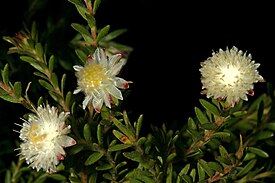
Diastella fraterna |
| Scientific classification |
|---|
| Order : | Proteanae Takht. , 1967 |
|
| International scientific name |
|---|
Diastella fraterna Rourke , 1976 |
|
Content
D. fraterna in the mountains of Claymond.
Diastella fraterna is an evergreen single-stemmed shrub up to 70 cm tall and about 1 m in diameter. Leaves - oval 8-14 mm wide, young leaves folded. Flower heads - from white to cream color, separate, with a diameter of 10-15 mm. Later they become brown and paper-like. It blooms throughout the year, but mainly in the summer [2] .
The range is bounded by gentle slopes in the Palmyet River Valley from Kogelberg to Kleinmond . It is also found at a higher altitude in the Bettis Bay Mountains. It grows both on stony well-drained slopes and humid areas, and along streams.
Pollinated by insects. Seeds contain a fleshy eliosome that attracts certain species of finbosh ants. Ants collect seeds and transfer them to their underground nest, where they eat a juicy part of the seeds. In the nest, the seeds remain protected from fire, birds and rodents. Seeds germinate after fires.
The view was described in 1976 by John Patrick Rourke [3] .
The name of the genus Diastella comes from the Greek. diastellein , which means “divide,” and is associated with divided perianth lobes. The specific name is from lat. fraterna , which means "the brotherhood of these species", since the species is close to Diastella divaricata subspecies montana . Diastella divaricata subspecies montana differs from D. fraterna only in that the bush is taller and the flowers are pink rather than white as in D. fraterna .
- ↑ For the conventionality of specifying the class of dicotyledons as a superior taxon for the plant group described in this article, see the APG Systems section of the Dicotyledonous article .
- ↑ Diastella fraterna (neopr.) . PlantSAfrika. Date of treatment January 7, 2019.
- ↑ JP Rourke, 1976 In: JS Afr. Bot., 42 (3): 197
