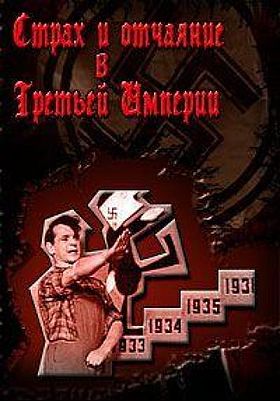
“Fear and Despair in the Third Empire” - a television play staged in 1965 by D. Karasik and A. Pavlov on Leningrad television based on the review play by Bertolt Brecht . The television show in the USSR was the debut of Brecht's works on the screen, and was warmly received by the viewers [1] .
| Fear and Despair in the Third Empire | |
|---|---|
 | |
| Genre | television show |
| Producer | A. Pavlov David Karasik |
| In the main cast | Emmanuel Vitorgan Oleg Basilashvili |
| Studio | Leningrad television |
| A country | |
| release date | 1965 |
Content
- 1 plot
- 2 Criticism of a television play
- 3 Cast
- 4 Camera crew
- 5 notes
- 6 Literature
Story
The television show consists of fifteen scenes about the life and customs of Nazi Germany in the late 1930s. The political and psychological drama is intended to show how Nazism penetrates into all spheres of life of German society of this period.
TV Criticism
The television performance, according to television critics of those years, “literally blew up” the almost canonized framework of a television theater [2] . According to the theater expert M. Lyubomudrov , the director of the play D. Karasik and director A. Pavlov “subtly comprehended the Brecht methodology. The grotesque and metaphor, generously introduced into the production, increased its journalistic power ” [3] . Critics noted the exact method found: the characters appeared on the screen like shadows, and like shadows, disappeared from it. The work of artist Sergey Skinteyev was also noted, who created a contrasting, sharp, halftone-free design that conveys the style of B. Brecht [2] [3] .
Cast
- Oleg Basilashvili
- Emmanuel Vitorgan
- Galina Demidova
- Mikhail Volkov
- Sergey Karnovich-Valois
- Joseph Konopatsky
- Efim Kopelyan
- Maria Prizvan-Sokolova
- Vladislav Strzhelchik
- Zinaida Sharko
- Leo Lemke
- Nikolai Korn - Attorney Spitz
- Lydia Shtykan
- Oleg Okulevich
- In the episodes of the artists of Leningrad theaters.
Camera crew
- Directors: David Karasik , A. Pavlov
- Operator: V. Gellerman
The television play is black and white, was shot on a 35 mm film from the picture tube screen and consisted of 15 parts [2] .
Notes
- ↑ Essays on the history of Leningrad: Leningrad during the period of the completion of socialism and the gradual transition to communism, 1946-1965, Publishing House of the USSR Academy of Sciences, 1970 - p. 459
- ↑ 1 2 3 A.A. Novikova. Television and theater: the intersection of patterns, 2010 , p. thirty.
- ↑ 1 2 M. Lyubomudrov . Lessons from Brecht's performances // Leningrad State Institute of Theater, Music and Cinematography Directing on the way: Collection of articles. - L .; M .: Art, 1966. - S. 121-160 .
Literature
- Novikova A.A. Television and theater: intersections of patterns / foreword by A. A. Sherel. - 2nd ed. - M .: URSS editorial, 2010 .-- 176 p. - ISBN 978-5-354-01257-2 .