Ligdamid I ( dr. Greek Λύγδαμις ) is the Persian ruler of Halicarnassus , who ruled in the VI-V century BC. e.
| Ligdamide I | ||||
|---|---|---|---|---|
| ||||
| Birth | ||||
| Children | ||||
Biography
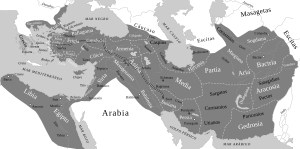
Although Herodotus does not mention his hometown when describing the events of the conquest by the military commander Cyrus Harpagus of Ionia , Lycia and Caria , it is believed that Halicarnassus was also included in the Persian empire around 545 BC. Herodotus also points out that, unlike many other peoples, “the Karians submitted to Harpagus without covering themselves with glory: neither the Karians nor the Hellenes living in their country accomplished any feats.”
After Darius I carried out an administrative reform, Halicarnassus became part of the first satrapy. The Persian authorities helped tyrants to come to power in many Greek territories subordinate to them. Igor Surikov suggested that it was during the indicated period that this also happened in Halikaras.
Ligdamid is considered the founder of the Ligdamid dynasty. This name for some reason was quite popular among the nobility of the Aegean civilization . Perhaps due to the invasion of Asia Minor in the VII century BC. e. Cimmerians , whose leader was called Ligdamid ( Tugdamme ). Askold Ivanchik justifiably notes that in Russian this name sounds like “Ligdamis.” However, domestic science has its own established tradition of transmitting this anthroponym .
If we proceed from the information set forth by Herodotus, in addition to Halicarnassus, Ligdamidou could also be subject to Kos , who was also a member of the Doric "Shestigradie" , and Nisyros with Kalinda , although they had their rulers. Governed by Ligdamid Halikarnassus, apparently, did not take part in the appearance of the Asia Minor Greeks against the Persian authorities at the beginning of the 5th century BC. e. - at least, ancient historians do not mention this.
Ligdamide was married to a Cretan woman whose name the sources did not name. Ligdamida was succeeded, after the death of her husband, by his daughter Artemisia I , who participated in the campaign of Xerxes to Hellas . Ligdamid also had a son Pigret , who became famous as a poet.
Literature
- Primary sources
- Herodotus . History (I.174, VII.99.)
- Pausanias . Description of Hellas (III.11.3.)
- Polyan . Stratighemes (VIII.53.2.)
- Plutarch . On the malice of Herodotus. (Xliii)
- Photius . Library (190)
- Research
- Smith W. Lygdamis // Dictionary of Greek and Roman Biography and Mythology . - Boston, 1870.
- Surikov I.E. Essays on historiography in classical Greece. Moscow, 2011.
- Ivanchik. A.I. Cimmerians: Ancient Eastern civilizations and steppe nomads in the VIII-VII centuries. BC e. Moscow, 1996.
- Helmut Berve . The tyrants of Greece. Rostov-on-Don, 1997.
- In fiction
- Mentioned in the novel by Sergei Shapovalov "The roads of the Ilarchs."