Espadarana (lat.) - a genus of tailless amphibians from the family of glass frogs that live in the New World . The generic name is given in honor of Marcos Jimenez de la Espada, a Spanish zoologist who described the first glass frog ( Centrolene geckoideum ) in 1872 and lat. rana is the frog. In addition, the Spanish word “espada” means “sword”, which may be due to the shoulder spurs that adult males of this genus have.
| Espadarana |
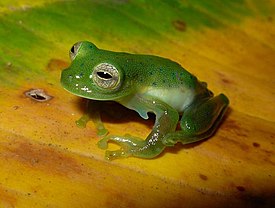
Dotted glass frog |
| Scientific classification |
|---|
| No rank : | Bilateral symmetrical |
| Squad: | Tailless Amphibians |
|
| International scientific name |
|---|
Espadarana Guayasamin, Castroviejo-Fisher, Trueb, Ayarzagüena, Rada & Vilà, 2009 |
|
Content
Characterized by the presence of shoulder spurs in adult males and lobed liver , covered with a transparent peritoneum , green bones and a translucent digestive tract . Between the third and fourth fingers there is a moderate membrane.
These are oviparous amphibians. Females lay eggs on leaves above streams.
The range covers Central America ( Honduras , Nicaragua , Costa Rica , Panama ) and the north of South America ( Venezuela , Colombia and Ecuador ).
As of November 2018, 5 species are included in the genus [1] :
- Espadarana andina (Rivero, 1968) - Andean Glass Frog
- Espadarana audax (Lynch and Duellman, 1973) - Waterfall Glass Frog
- Espadarana callistomma (Guayasamin and Trueb, 2007)
- Espadarana durrellorum (Cisneros-Heredia, 2007)
- Espadarana prosoblepon (Boettger, 1892) - Dotted Glass Frog
- ↑ Frost DR Espadarana . Amphibian Species of the World, an Online Reference. American Museum of Natural History, New York, USA
