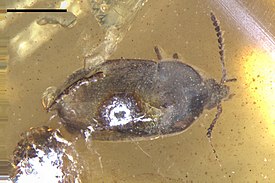
Allostrophus cretaceus (lat.) Is a species of extinct coleoptera from the family of tetratomids , the only one in the genus Allostrophus . They lived on the territory of modern Myanmar during the Upper Cretaceous era ( 99.6–93.5 million years ago) [1] .
| † Allostrophus cretaceus |
|---|
 |
|
| {{{{{{{{{{{{{{{{{{{{{{{{{{{{{{{{{{{{{{{{{{{| 1}} | 1}} | 1}} | 1}} | 1}} | 1}} | 1}} | 1}} | 1}} | 1}} | 1}} | 1}} | 1}} | 1}} | 1 }} | 1}} | 1}} | 1}} | 1}} | 1}} | 4}} : | Eukaryotes |
| No rank : | Bilateral symmetrical |
| Subtype : | Tracheo-breathing |
| Infraclass : | Winged insects |
| Treasure : | Fully Transformed Insects |
| Superfamily : | Tenebrionoid |
| Gender: | † Allostrophus Hsiao et al. 2018 |
| View: | † Allostrophus cretaceus |
|
|
Allostrophus cretaceus
Hsiao et al. 2018 |
|
|
The generic name Allostrophus is derived from other Greek. αλλος , which means "different", "strange." The species name translates as “chalky”.
The holotype CNU-COL-MA20160201 was discovered in Burmese amber dating from the Cenomanian century . According to it, in 2018, Yun Xiao, Adam Slipinsky , Yali Yu, Kongshuang Deng and Hong Pang described a new species and genus [2] .
Small oblong oval body, narrowed by antennae ; intimate tendrils; semicircular pronotum, with two weakly developed subbasal impressions; scutellum without light pubescence, each elytra with traces of eight stripes [2] .
He was a mycophage , parasitized on tinder funnels [2] .
The authors of the description taxon assigned to the tribe Eustrophini subfamily Eustrophinae family tetratomids [2] .
