Osamu Takizawa ( Japanese 瀧澤 修 , November 13, 1906 , Tokyo - June 22, 2000 , Tokyo ) is a Japanese theater, film and television actor. One of the most famous [4] shingeki theater actors (literally - a new drama, a direction that arose in Japanese theater at the beginning of the 20th century , theaters that tried to look like modern Western theater). Takizawa in Japan of the XX century was called the Shingeki God [3] . The actor starred in films a lot, but despite the extensive filmography, he considered work in the cinema a matter of secondary importance [5] . Takizawa has many theater awards [1] . For his services in the field of theatrical art in 1977, the actor was awarded the Medal of Honor with a purple ribbon . In 1986, Osamu Takizawa was awarded the Order of the Holy Treasure .
| Osamu Takizawa | |||
|---|---|---|---|
| jap. 瀧澤 修 | |||
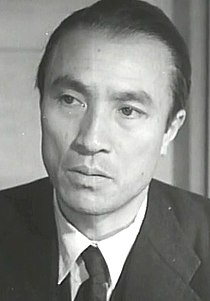 in the movie Street of Violence (1950) | |||
| Date of Birth | November 13, 1906 | ||
| Place of Birth | Tokyo Japan | ||
| Date of death | June 22, 2000 (93 years old) | ||
| A place of death | Tokyo Japan | ||
| Citizenship |  Japan Japan | ||
| Profession | actor | ||
| Career | 1933-1998 | ||
| Awards |
| ||
| IMDb | ID 0847698 | ||


Content
- 1 Biography
- 1.1 The early years. The beginning of a theatrical career
- 1.2 Theater career
- 1.3 Movie career
- 2 Recognition
- 3 Filmography
- 4 Comments
- 5 notes
- 6 References
- 7 Literature
Biography
Early years. The beginning of a theatrical career
Osamu Takizawa was born the third son in the family of a banker in the Usigome area (now Shinjuku , Tokyo). His older brothers: Keiichi is a writer, and Kenzo is an artist who takes Otati's surname as a pseudonym [1] .
After graduating from high school in 1924, he enrolled in a drama course at the Maly Theater ("Tsukiji Shogekijo"). The following year, he first appeared on the stage of this theater in the production of " Julius Caesar " [1] [2] . In 1927, he simultaneously participated in the performances of the Imperial Theater . Performing on the stage of the Tsukiji Shogekijo Theater under the direction of the outstanding directors of this troupe and Kaoru Osanai , Takizawa earned a reputation as one of the best young actors by participating in productions of foreign authors Georg Kaiser , John Maysfield and others. After the death of the artistic director the troupe of Kaoru Osanai (in 1928 ), Takizawa joined the proletarian theater (literally translated as Tokyo Left Theater). Since 1931 , in connection with the beginning of Japanese aggression in Manchuria , the repression of the authorities against the proletarian theater movement intensified (plays were forbidden, leaders of the movement were arrested, etc.), the activities of the Tokyo Sayoku Gekikyo troupe were difficult, and in 1934 the theater closed [6] .
Theater Career
One of the founders of Tokyo Sayoku Heikijo was the playwright and director , a member of the CPJ . After the dissolution of the troupe, he campaigned for the dismissed actors to enter the [7] , the leftmost theater of the direction, organized by him in the same year. Osamu Takizawa was one of the participants in the formation of the troupe and one of the stars of the new scene. Here he played leading roles and earned praise from critics for the realistic performance of Hanzo Aoyama, the protagonist of Toson Shimazaki ’s play “Before Dawn” (after almost two decades, in 1953, the actor again played this role on the movie screen in the eponymous film by Kozaburo Yoshimura ). Takizawa also showed an impressive acting in the production of “Volcanic Plateau” (based on the play by ), where he played the role of Satoshi [1] .
On August 19, 1940, Takizawa, together with Tomoyoshi Murayama, Eitaro Ozawa , Dzyukichi Uno and others, was arrested by the military police on suspicion of violating the Law on the maintenance of peace. By order of the authorities, the troupe was dissolved [1] . Takizawa spent one year and four months in prison [1] . After leaving prison, Takizawa was unemployed for some time, then in 1943, with the support of the management of the Toho film company and in the company of actor Masao Shimizu and actress Tanie Kitabayashi , a small traveling troupe Geijutsu was organized, with which they made a living until the end of the war.
After the end of World War II, on December 14, 1945, Takizawa, along with playwright Sakae Kubo and actor Kenji Susukida, were the founders of the Tokyo Art Theater (Tokyo Geijutsu Heikijo), which did not last long. In 1947, the troupe split and Takizawa, together with Jukichi Uno and Masao Shimizu, founded the new People’s Theater (Minshu Geijutsu Heikijo) [8] . In May 1949 , after intra-theatrical strife, the team disintegrated and was re-created in 1950 . The new Mingei troupe of the 1950 model was formed by Junichi Uno, Tanie Kitabayashi and Osamu Takizawa [8] . Since then, the name of the actor has been associated with this stage. On this scene, Takizawa became famous in the role of Van Gogh in the play “The Man of Fire” [3] based on the play by Jiro Miyoshi. This was the role of his life and the performance continued to remain in the repertoire of the theater until the actor was 83 years old. For this work, the actor was awarded the 1951 Festival of Arts Award and the Mainity Theater Award for Best Actor of the Year at the 4th Award Ceremony (1951).
Among the successful roles on the theatrical stage [1] : Willy Loman in “The Death of a Salesman ” by Arthur Miller (theater awards “Mainity”, “Asahi” and “Golden Arrow”); Trigorin in The Seagull (according to A.P. Chekhov ); Otto in "The Japanese named Otto" (The Mainity Theater Award). In the 1970s, for his role in the production of Sister, he was awarded the Kinokuniya Theater Award ( 1978 ), and for the performance of Anne Frank's Diary, the Geijutsu Senseo Prize. Since the late 1980s , after the death of Dzyukichi, Uno was involved in the management of the theater troupe, as well as theatrical direction and production.
Movie career
Takizawa began acting in films back in 1933 , making his debut in one of the first Japanese sound films “Indifferent Youth” (directed by Sotoji Kimura ) [9] . In the 1930s, he worked at the Toho film company, in the post-war years until the mid -1950s . He worked at various studio venues: in the film companies " Shёtiku ", " Day ", " Toei " and in independent projects . Since the mid-1950s, although he continued to collaborate with various film companies, he still starred most in the film company Nikkatsu . And although cinema, according to his own statement, was a secondary affair for a theater star, he nevertheless starred in nearly two hundred films over 60 years of his career.
Of his films of the 1930s, the most interesting were the role of Kosugi in Mikio Naruse 's film “ Three Sisters Clean in Their Thoughts ” ( 1935 ) and the roles played by director Kajiro Yamamoto , a playwright of the feudal era Mondzaemon Chikamatsu in the film “Love Tojuro” and a school teacher in the “Lesson of composition” (both films - 1938 ).
After the war, attracted the attention of critics, playing the role of the humiliated and despised by the Tokyo beau monde, the aristocrat Tadahiko Andjo in the film “ The Ball at Andjo House ” ( 1947 , dir. Kodzaburo Yoshimura ). The most notable and interesting works of the actor in cinema include roles in the films [1] : “ Street of violence ” (prosecutor Tonami, 1950 , dir. Satsuo Yamamoto ); “ The Story of Beloved Wife ” (the role of film director Sakaguchi, 1951 ) and “ Children of Hiroshima ” (the role of Iwakichi, 1952 , dir. Both films by Kaneto Shindo ); “ Echo School ” (father Mutyaku, 1952, dir. Tadashi Imai ); “ Before Dawn ” (Hanzo Aoyama, 1953 , dir. Kodzaburo Yoshimura); The Black Current (Mr. Yamana, 1954 , dir. So Yamamura ); “ Field Lights ” (Yasuda, 1959 , dir. Kon Ichikawa ); “ The Flag in the Fog ” (Kinzo Otsuka, 1965 , dir. Yoji Yamada ); the epic from the three films “War and People” (Yusuke Godai, 1970–73, dir. Satsuo Yamamoto).
June 22, 2000 at 11 o’clock. 51 minutes Tokyo time Takizawa died in pneumonia in a hospital in Mitaka , Tokyo [2] [1] . He was 93 years old.
The eldest son, Soichi Takizawa, is a professor at Toyama International University, the author of a book about his father [2] .
Recognition
- 1977 - awarded the Medal of Honor with a purple ribbon for his merits in the field of theatrical art.
- 1986 - awarded the Order of the Holy Treasure .
Filmography
| Selected filmography of the acting work of Osamu Takizawa [9] [10] [11] | ||||||
|---|---|---|---|---|---|---|
| Year | Russian name | original name | Romaji name | English name at international box office | Producer | Role |
| 1930s | ||||||
| 1933 | " Indifferent youth " | 河 向 ふ の 青春 | Kawamukô no seishun | Sotoji Kimura | ||
| 1935 | Dirty Silk Shoes | 絹 の 泥 靴 | Kinu no dorogutsu | Shigeo Jagura | ||
| “ Three sisters, pure in their thoughts ” | 乙 女 ご こ ろ 三人 姉妹 | Otome-gokoro - Sannin-shimai | Three Sisters with Maiden Hearts | Mikio Naruse | Kosugi | |
| " Notes of the Tramp " | 放浪 記 | Hōrō-ki | Drifting | Sotoji Kimura | ||
| “A strange incident in the city at 7:03 ” | 都会 の 怪異 七 時 三分 | Tokai no kaii shichi-ji san-pun | Strange Incident in the City at 7:03 | Sotoji Kimura | loan shark | |
| 1936 | Queen of Magic | 魔術 の 女王 | Majutsu no joô | The queen of magic | Sotoji Kimura | |
| “ Because I'm a mother ” | 母 な れ ば こ そ | Haha nareba koso | Because I Am a Mother | Sotoji Kimura | ||
| 1937 | " Mother's Song " (two-part film) | 母 の 曲 前 篇 / 母 の 曲 後 篇 | Haha no kyoku (Zenpen; Kohen) | Mother's Song (Parts l and 2) | Satsuo Yamamoto | Junji's father |
| " Courageous man " | 男 は 度 胸 | Otoko wa dokyō | Kunio Watanabe | |||
| 1938 | " Underground Heat " | 地 熱 | Chinetsu | Subterranean heat | Eiske Takizawa | Shimizu |
| The Giant | 巨人 伝 | Kyojin-den | The giant | Mansaku Itami | old seike | |
| “ Chorus of the century. Patriotic March | 世紀 の 合唱 愛国 行進 曲 | Seiki no gassho: Aikoku koshin-kyoku | Chorus Of the Century - Patriotic March | Osamu Fushimizu | ||
| " Love Tojuro " | 藤 十郎 の 恋 | Tôjûrô no koi | Tojuro's love | Kajiro Yamamoto | Chikamatsu Mondzaemon | |
| " Devil from the Crossroads " | 逢 魔 の 辻 江 戸 の 巻 | Ôma no tsuji - Edo no maki | Devil of the crossroad | Eiske Takizawa | Hannojo Misawa | |
| “ Lesson of composition ” | 綴 方 教室 | Tsuzurikata kyoshitsu | Composition class | Kajiro Yamamoto | school teacher | |
| " The Tale of the Pasture " | 牧場 物語 | Makiba monogatari | The ranch story | Sotoji Kimura | Sekiguchi | |
| 1939 | " Chusingura " (two-part film) | 忠臣 蔵 前 篇 / 忠臣 蔵 後 篇 | Chūshingura (Zenpen; Kōhen) | 47 Ronin (Part 1; Part 2) | Eiske Takizawa | Yanagisawa |
| " First love " | 初恋 | Hatsukoi | First love | Tomoyoshi Murayama | Genshin okamatsu | |
| 1940s | ||||||
| 1940 | " Village of Tajzinko " | 多 甚 古村 | Tajinko-mura | Tajinko Village | Tadashi Imai | Oso |
| Yoko Okumura | 奥 村 五百 子 | Okumura ioko | Ioko okumura | Shiro Toyoda | ||
| “The princess is a snake. Continuation | 続 蛇 姫 様 | Zoku hebihimesama | Snake princess 2 | Theinosuke Kinugasa | Hyogo Kambayashi | |
| " Women's Brick Factory " (rental - 1946) | 煉 瓦 女工 | Renga jokô | Women's Brick Factory | Yasuki Chiba | Tsui's father | |
| 1947 | “ Ball at the Anjo House ” | 安 城 家 の 舞 踏 会 | Anjô-ke no butôkai | A ball at the anjo house | Kodzaburo Yoshimura | Tadahiko anjo |
| 1948 | "The brilliant days of our lives " | わ が 生涯 の 輝 け る 日 | Waga shogai no kagayakeru hi | The bright day of my life | Kodzaburo Yoshimura | Kosuke Sagawa |
| The King | 王 将 | Ôshô | The king | Daiske Ito | Sekine | |
| Broken Covenant | 破戒 | Hakai | Apostasy | Kaisuke Kinoshita | Rentaro Inoko | |
| 1949 | " Prosecutor and Overseer " | 検 事 と 女 看守 | Kenji to onna kanshu | Ren Yoshimura | main judge | |
| " Boss " | ボ ス | Bosu | Boss | Masahiro Makino , Isamu Kosugi | ||
| " The last laughing man " | 最後 に 笑 う 男 | Saigo no warau otoko | The last man to laugh | Kimiyoshi yasuda | Minekiti Ooba | |
| “ Today I'm in love ” (two-part film) | 今日 わ れ 恋愛 す | Kyô ware ren'ai suru | Today i love | Koji Shima | ringleader | |
| “ Who turned me into that kind of girl? " | こ ん な 女 が 誰 に し た | Konna onna ni dare ga shita | Who Turned Me into This Kind of Woman? | Satsuo Yamamoto | detective | |
| " The Ghost of Yotsui " (two-part film) | 新 釈 四 谷 怪 談 | Yotsuya kaidan (Zenpen; Kohen) | The Yotsuda Phantom (Part I; Part II) | Kaisuke Kinoshita | Naosuke | |
| “ Mother is calling a bird ” | 母 呼 ぶ 鳥 | Haha yobu tori | Koichi Takagi | Sakae matsuda | ||
| Midday Waltz | 真 昼 の 円 舞曲 | Mahiru no embukyoku | Waltz at noon | Kodzaburo Yoshimura | Harumia | |
| Leaky Drum | 破 れ 太 鼓 | Yabure-daiko | A broken drum | Kaisuke Kinoshita | Naoki, Shigeki's father | |
| 1950s | ||||||
| 1950 | " Street of violence " | 暴力 の 街 | Bôryoku no machi | Street of violence | Satsuo Yamamoto | Tonami, the prosecutor |
| “ When will we meet again ” | ま た 逢 う 日 ま で | Mata au hi made | Until we meet again | Tadashi Imai | Eisaku Tajima | |
| “ I seek to escape persecution ” | 私 は 狙 わ れ て い る | Watashi wa nerawa rete iru | Kazuo Mori | Kanazawa | ||
| Vulture (Condor) | 禿鷹 (コ ン ド ル) | Hagetaka (kondoru) | Kimiyoshi yasuda | |||
| Resurrection | 復活 | Fukkatsu | Resurrection | Akira Nobuti | Hiroshi Usio | |
| " The end of the war " | 戦 火 の 果 て | Senka no hate | The Height of Battle / The End of Battle Fire | Kodzaburo Yoshimura | ||
| The Nagasaki Bells | 長崎 の 鐘 | Nagasaki no kane | The bells of nagasaki | Hideo Ooba | Professor Asakura | |
| 1951 | “ Reeds in the Wind ” (two-part film) | 風 に そ よ ぐ 葦 | Kaze ni soyogu ashi | Reeds in the wind | Masahisa Sunohara | Setsu Kiyohara |
| " Unlimited Passion " | 限 り な き 情 熱 | Kagirinaki jonetsu | Passion Without Bounds | Masahisa Sunohara | Doi | |
| " The Story of Beloved Wife " | 愛妻 物語 | Aisai monogatari | Story of a beloved wife | Kaneto Shindo | Sakaguchi, filmmaker | |
| " The Tale of Genji " | 源氏物語 | Genji monogatari | The tale of genji | Kodzaburo Yoshimura | ||
| Goemon Ishikawa: A True Story | 真 説 石川 五 右衛門 | Shinsetsu: Ishikawa Goemon | Goemon ishikawa: the true story | Hideko Sekigawa | mysterious old man | |
| 1952 | " One Night 's Events " | あ る 夜 の 出来 事 | Aru yoru no dekigoto | Incidents on a Certain Night | Koji Shima | Motegi |
| " I Will Never Forget Nagasaki's Song " | 長崎 の 歌 は 忘 れ じ | Nagasaki No Uta Wa Wasureji | I'll Not Forget the Song of Nagasaki | Tomotaka tazaka | Uncle Momoko and Ayako | |
| " School of Echo " | 山 び こ 学校 | Yamabiko gakkô | School of echoes | Tadashi Imai | father Mutyaku | |
| " Escape from the city of death " | 死 の 街 を 脱 れ て | Shino machi o nogarete | Eiichi Koishi | captain | ||
| " Children of Hiroshima " ("Children of the atomic bomb") | 原 爆 の 子 | Genbaku no ko | Children of hiroshima | Kaneto Shindo | Iwakichi | |
| Chuji Travel Diary: First Encounter on the Road | 忠 治 旅 日記 逢 初 道 中 | Chūji tabi nikki aizome dōchū | Chuji's Travel Diary: FirstMeeting on the Road | Yasushi Sasaki | Yasuzaemon Kabe | |
| “ Children without a mother and mother without children ” | 母 の な い 子 と 子 の な い 母 と | Haha no nai ko to ko no nai haha to | Motherless child and childless mother | Mitsuo Wakasugi | narrator (voice-over) | |
| 1953 | " Dunes of love " | 愛 の 砂丘 | Ai no sakyū | Nobuo Aoyagi | Aizawa | |
| " Thumbnail " | 縮 図 | Shukuzu | Epitome | Kaneto Shindo | Ino | |
| " Snakes and pigeons " | 蛇 と 鳩 | Hebi to hato | Snakes and doves | Masahisa Sunohara | Tsune Kokune | |
| " Before the dawn " | 夜 明 け 前 | Yoake mae | Before dawn | Kodzaburo Yoshimura | Hanzo Aoyama | |
| 1954 | " Rebellion " | 叛乱 | Hanran | Insurrection | Shin Saburi | head of the military council |
| " Hill of Broken Hearts " | 心 臓 破 り の 丘 | Shinzō-yaburi no oka | Keigo Kimura | Yoshio | ||
| “ Flower and Dragon ” (two-part film) | 花 と 竜 (第一 部 / 第二部) | Hana to ryū (Daiichibu / Dainibu) | Flower and Dragon (Part I; Part II) | Kiyoshi Saeki | Isokichi Yoshida | |
| "The beauty of man " | 美 し い 人 | Utsukushī hito | Beauty | Mitsuo Wakasugi | Yoshiyuki Osumi | |
| Asakusa Nights | 浅 草 の 夜 | Asakusa no yoru | Asakusa nights | Koji Shima | tozuki's father | |
| “ Street without the sun ” [comm. 1] [12] | 太陽 の な い 街 | Taiyo no nai machi | The street without sun | Satsuo Yamamoto | Okawa Director | |
| " Black current " | 黒 い 潮 | Kuroi ushio | Black tide | Se Yamamura | Mr. Yamana | |
| " Dirty young man " | 泥 だ ら け の 青春 | Dorodarake no seishun | Youth Covered With Mud | Itiro Sugai | Morikawa | |
| " Chusingura: a book of flowers, a book of snows " | 忠臣 蔵 花 の 巻 、 雪 の 巻 | Chūshingura hana no maki, yuki no maki | Chushingura: Story of Flower, Story of Snow | Tatsuo Osone | Kenosuke Kirakodzu | |
| 1955 | " Under the sky of Tokyo " | 東京 の 空 の 下 に は | Tōkyō no sora no shita niwa | Iseo Hirukawa | Tsuyoshi | |
| Haunted Youth Story | 青春 怪 談 | Seishun kaidan | Ghost story of youth | Kon Ichikawa | Akuzawa | |
| The Six Killers | 六 人 の 暗殺者 | Rokunin no ansatsusha | Six assassins | Eiske Takizawa | Ryoma Sakamoto | |
| "The Void I Created " | 自 分 の 穴 の 中 で | Jibun no ana no nakade | A Hole of My Own Making | Tom Utida | uncle aoyama | |
| " Bronze Christ " | 青銅 の 基督 | Seido no kirisuto | Christ in bronze | Minoru Shibuya | Pastor Ferreira | |
| " Doctor " | 沙羅 の 花 の 峠 | Sara no hana no tōge | The doctor | Se Yamamura | lawyer | |
| " The worm will change in Edo " | 江 戸 一寸 の 虫 | Edo issun no mushi | A worm will turn in edo | Eiske Takizawa | Ogasawara | |
| 1956 | “The Crime of Shiro Kamisaki ” | 神 阪 四郎 の 犯罪 | Kamisaka Shirô no hanzai | The crime of shiro kamisaka | Seiji Hisamatsu | Tetsuo Imamura |
| " People from Tokyo " | 東京 の 人 前後 篇 | Tokyo no hito zengōhen | A Person of Tokyo. Part 1 | Katsumi Nishikawa | Sunzo Shimaki | |
| The Black Belt of Mercy: Flower and Storm | 黒 帯 有情 花 と 嵐 | Kuroobi yôjô: Hana to arashi | The Merciful Blackbelt: The Flower and the Storm | Eiske Takizawa | Goro Anori | |
| " We, the children of the sea " | わ れ は 海 の 子 | Ware wa uminoko | We're children of the lake | Jukichi uno | Asakichi Maejima | |
| 1957 | “ We ask for good luck ” | 倖 せ は 俺 等 の ね が い | Shiawase wa oira no negai | Happiness Is Our Wish | Jukichi uno | Itoji Shigeta |
| “ The Sorceress of the White Night ” (“The Temptress and the Monk”) | 白夜 の 妖女 | Byakuya no yôjo | The temptress and the monk | Eiske Takizawa | Shyuto Ryo | |
| The Secret of Naruto | 鳴 門 秘 帖 | Naruto hichô | Secret of naruto | Theinosuke Kinugasa | Tokushima Elder | |
| “ Nine death row inmates ” | 九 人 の 死刑 囚 | Kunin no shikeishû | Comdemned | Takumi Furukawa | lawyer Tadkoro | |
| “Earth” (in Soviet box office - “ On this earth ”) [comm. 2] [12] | 地上 | Chijo | Mesopotamia | Kodzaburo Yoshimura | Akadori | |
| 1958 | " Spring Flowers Festival " | 春 高樓 の 花 の 宴 | Haru kôrô no hana no en | A spring bouquet | Theinosuke Kinugasa | Hakuyo Tsukushi |
| 47 Faithful Ronin | 忠臣 蔵 | Chūshingura | The loyal 47 ronin | Kunio Watanabe | Kozukenosuke Kira | |
| " Stolen Passion " | 盗 ま れ た 欲 情 | Nusumareta yokujô | Stolen desire | Shohei Imamura | Taminoske Yamamura | |
| " Face in the dark " | 真 夜 中 の 顔 | Mayonaka no kao | Face in the dark | Jukichi uno | Mori | |
| "The Drums of Death " | 落花 剣 光 録 | Rakka kenko-roku | The handdrum of death | Ryo Hagiwara | Mamoru | |
| Crimson Wings | 紅 の 翼 | Kurenai no tsubasa | Crimson Wings | Ko nakahira | Junpei Naganuma | |
| 1959 | “ Kiku and Isamu ” | キ ク と イ サ ム | Kiku to isamu | Kiku and isamu | Tadashi Imai | photographer |
| " Man explodes " | 男 が 爆 発 す る | Otoko ga bakuhatsu suru | Explosion Came | Toshio Masuda | Muroto | |
| " Jiroto Fuji " | 次郎 長 富士 | Jirôchô fuji | Jirocho fuji | Kazuo Mori | Katsuzo Kurukoma | |
| " Dream young man, dream " | 男 な ら 夢 を み ろ | Otoko nara yume o miro | Dream youngman dream | Yoichi Ushihara | Koichi Onodera | |
| Etajima: Naval Academy | 海軍 兵 学校 物語 あ ゝ 江 田島 | Kaigunheigakkô monogatari: Aa! Etajima | Etajima, the Naval Academy | Mitsuo Murayama | Kawamura | |
| " Image of a hot day " | か げ ろ う 絵 図 | Kagero ezu | Stop the Old Fox | Theinosuke Kinugasa | Nakano | |
| " Aristocratic steps " | 貴族 の 階段 | Kizoku no kaidan | Aristocrat's stairs | Kodzaburo Yoshimura | ||
| " Field Lights " | 野火 | Nobi | Fires on the plain | Kon Ichikawa | Yasuda | |
| " Through the darkness " | 闇 を 横切 れ | Yami o yokogire | Across darkness | Yasuzo Masumura | Hirose | |
| 1960s | ||||||
| 1960 | " Princess Sen 's Palace " | 千 姫 御 殿 | Sen-hime goten | Palace of Princess Sen | Kenji Misumi | Tajimanokami Yagyu |
| The Tree of Youth | 青年 の 樹 | Seinen no ki | Tree of youth | Toshio Masuda | boss | |
| “ There are no cities on the map ” | 地 図 の な い 町 | Chizu no nai | A town not on the map | Ko nakahira | Yonekiti | |
| “ I conquered the world ” | 天下 を 取 る | Tenka o toru | I take the world | Yoichi Ushihara | Godzaemon Onihai | |
| 1961 | “ The End of the Sweet Night ” | 甘 い 夜 の 果 て | Amai yoru no hate | Bitter end of a sweet night | Yoshishige Yoshida | Hondo |
| The Night Before the Execution | 処刑 前夜 | Shokei zen'ya | The night before execution | Eiske Takizawa | Issaku Yamagiva | |
| “ I refuse to die ” | 俺 は 死 な な い ぜ | Ore wa shinanaize | I refuse to die | Eiske Takizawa | Hoshimaru | |
| " Mouth " | 河口 | Kakō | The estuary | Noboru Nakamura | Daizo miyahara | |
| " He and I " | あ い つ と 私 | Aitsu to watashi | He and i | Ko nakahira | Masao Agave | |
| Buddha | 釈 迦 | Shaka | Buddha | Kenji Misumi | Asiyud hermit | |
| 1962 | Heady Heaven | 酔 っ ぱ ら い 天国 | Yopparai tengoku | Drunken heaven | Minoru Shibuya | managing director |
| " Inheritance " | か ら み 合 い | Karami-ai | The inheritance | Masaki Kobayashi | Itiro | |
| "The place of youth " | 青年 の 椅子 | Seinen no isu | The seat of youth | Katsumi Nishikawa | Hisiyama | |
| Face to the clouds | 雲 に 向 か っ て 起 つ | Kumo ni mukatte tacu | Facing to the clouds | Eiske Takizawa | Prime Minister Kawamoto | |
| "The man in the human stream " | 激流 に 生 き る 男 | Gekiryū ni ikiru otoko | Takashi Nomura | Marukin | ||
| O-Gin-sama | お 吟 さ ま | Ogin-sama | Love under the crucifix | Kinyu Tanaka | Hideyoshi Toyotomi | |
| “ On the shoulders of love and death ” | 愛 と 死 の か た み | Ai to shi no katami | Buiti Saito | Iijima | ||
| 1963 | “A pure heart stained with mud ” | 泥 だ ら け の 純情 | Dorodarake no junjô | The mud-spattered pure heart | Ko nakahira | Shimizu |
| “ Is there nothing interesting there?” " | 何 か 面 白 い こ と な い か | Nanika omoroi koto nai ka | Isn 't There Anything Interesting? | Koreyoshi Kurahara | Seijiro Matsushita | |
| “ Lies ” (film almanac, short story 3: “Three Women”) | 嘘 (第三 話 三 女 体) | Uso (San jyokyo) | When Women Lie (episode 3: Three women) | Theinosuke Kinugasa | main judge | |
| " Love in Rome " | ロ ー マ に 咲 い た 恋 | Rōma ni saita koi | Love in rome | Yoshiro Kawazu | Junichiro Akizuki | |
| " Blues on a foggy night " | 夜霧 の ブ ル ー ス | Yogiri no burûsu | Foggy night blues | Takashi Nomura | Kicking | |
| “ Legend or true story?” "(" The Legend of the Duel with Death ") | 死 闘 の 伝 説 | Shitô no densetsu | A Legend or Was It? | Kaisuke Kinoshita | narrator (voice-over) | |
| 1964 | " Flower and waves " | 花 と 怒濤 | Hana to dotô | The flowers and the angry waves | Seijun Suzuki | Ojojo Shigeyama |
| " Theater of Life " | 人生 劇場 | Jinsei gekijô | The theater of life | Toshio Masuda | ||
| " Sally " | 出 撃 | Shutsugeki | Sortie | Eiske Takizawa | Air Force Commander | |
| “ Looking for love and death ” | 愛 と 死 を み つ め て | Ai to shi wo mitsumete | Amazing at love and death | Buiti Saito | Senjuro Nakayama | |
| " Kaidan " (short story "In a cup of tea") | 怪 談 (茶碗 の 中) | Kaidan (episo ー do "Chawan no naka") | Kwaidan / Ghost Stories (segment "In a Cup of Tea") | Masaki Kobayashi | writer / storyteller | |
| 1965 | " Bandit " | 拳 銃 野 郎 | Kenjû yarô | Gunman | Motomu Ida | Matsugoro Kitamura |
| "The capture of the castle " | 城 取 り | Shirotori | Taking the castle | Toshio Masuda | Kanetsuzu | |
| “ Flag in the Fog ” | 霧 の 旗 | Kiri no hata | Flag in the mist | Youji yamada | Kinzo Otsuka | |
| 1966 | "The boss of youth " | 青春 大 統領 | Seishun daitōryō | Youth Vice President | Mio Ezaki | Kuroda |
| Chronicle of Love and Death [comm. 3] [13] | 愛 と 死 の 記録 | Ai to shi no kiroku | A Record of Love and Death / The Heart of Hiroshima | Koreyoshi Kurahara | head doctor of the hospital | |
| " The last song " | 絶唱 | Zesshō | The last song | Katsumi Nishikawa | Sonoda | |
| The Great White Tower [comm. 4] [12] | 白 い 巨塔 | Shiroi Kyotô | The great white tower | Satsuo Yamamoto | professor funao | |
| 1967 | " Live from the sword " | 秩 父 水滸 伝 影 を 斬 る 剣 | Chichibu suikoden: kage o kiru ken | Living by the sword | Motomu Ida | Yoshida |
| 1968 | "The Sun over Kurobe " | 黒 部 の 太陽 | Kurobe no taiyo | The Sands of Kurobe / Tunnel to the Sun | Kay Kumai | Otagaki |
| " Life of the period of Showa " ("Man of the turbulent era") | 昭和 の い の ち | Shōwa no inochi | Showa Era Life / Man of a Stormy Era | Toshio Masuda | Dr. Sasajima | |
| 1970s | ||||||
| 1970 | "Zatoichi and the bodyguard" (in Russia - " Battle of the Samurai ") | 座頭市 と 用心 棒 | Zatôichi to yôjinbô | Zatoichi meets yojimbo | Kihati okamoto | Yaske Ebosia |
| “ War and people. Part 1: Overtures of Fate | 戦 争 と 人間 第一 部 運 命 の 序曲 | Senso to ningen: Unmei no jokyoku | Men and war | Satsuo Yamamoto | Yusuke Godai | |
| 1971 | “ In the Ring of the Inland Sea ” | 内海 の 輪 | Naikai no wa | Shadow of deception | Koichi Saito | |
| " Revived Earth " | 甦 え る 大地 | Yomigaeru daichi | The earth is born again | Noboru Nakamura | chairman of the corporation | |
| “ War and people. Part 2: Love and sorrow of mountains and rivers " | 戦 争 と 人間 第二部 愛 と 悲 し み の 山河 | Senso to ningen II: Ai to kanashimino sanga | Men and War, Part Two | Satsuo Yamamoto | Yusuke Godai | |
| " It was raining " | 雨 は 知 っ て い た | Ame wa shitteita | The rain was falling | Michio Yamamoto | director | |
| 1973 | “ War and people. Part 3: The End | 戦 争 と 人間 第三部 完結篇 | Senso to ningen III: Kanketsuhen | Man and War, Part III | Satsuo Yamamoto | Yusuke Godai |
| 1974 | " Great family " | 華麗 な る 一族 | Karei-naru ichizoku | The family | Satsuo Yamamoto | Miyamoto |
| 1976 | " History of Suiko from the Tempo era " | 天保 水滸 伝 大 原 幽 学 | Tenpo suiko-den: ohara yugaku | Satsuo Yamamoto | Ihei Hayashi | |
| 1978 | August without the Emperor [comm. 5] [13] | 皇帝 の い な い 八月 | Kôtei no inai hachigatsu | August without Emperor | Satsuo Yamamoto | Sabayashi |
| 1980s | ||||||
| 1988 | "The death of the troupe" Sakura " " (doc.) | さ く ら 隊 散 る | Sakura-tai chiru | Sakura Theater Group Has Gone | Kaneto Shindo | eyewitness |
| 1990s | ||||||
| 1998 | "---" | ろ く で な し BLUES'98 | Rokudenashi burūsu '98 | Rokudenashi blues ii | Atsushi Muroda | Hiroto Both |
Comments
- ↑ The film was shown at the Soviet box office on March 6, 1956, r / u Goskino USSR No. 907/56 - published: “Annotated catalog of films of the current fund: Feature films”, M .: “Art” -1963, p. 346.
- ↑ The film was shown at the Soviet box office on August 1, 1959, r / u Goskino USSR No. 1025/59 (until February 1, 1964) - published: “Annotated catalog of films of the current fund: Feature Films”, M .: “Art” -1963 S. 200-201.
- ↑ The film was shown at the Soviet box office on March 20, 1972, r / y Goskino USSR No. 2006/71 (until January 15, 1978), dubbed at the station. them. Gorky (1970) - published: "Annotated catalog of films released in 1972", Inf.-advert. bureau kinofikatsii and film distribution of the Committee of the USSR Council of Ministers for Cinematography, M.-1973, p. 95.
- ↑ The film was shown at the Soviet box office from September 1968 (in Moscow from October 6), r / u Goskino USSR No. 2161/68 (until June 1, 1975) - published: “Catalog of films of the current fund. Issue II: Foreign Feature Films ”, Inf.-advert. bureau kinofikatsii and film distribution committee on cinematography under the Council of Ministers of the USSR, M.-1972, p. 10.
- ↑ The film was shown at the Soviet box office on March 23, 1981, r / u Goskino USSR No. 2215/80 (until June 20, 1987) - published: “An annotated catalog of films released in 1981. V / O "Soyuzinformkino", Goskino USSR, M.-1982, p. 112.
Notes
- ↑ 1 2 3 4 5 6 7 8 9 10 瀧澤 修 on the Kotobank website (Japanese)
- ↑ 1 2 3 4 瀧澤 修 on the Hatena Keyword website (Japanese)
- ↑ 1 2 3 滝 沢 修 on the Showa website (Japanese)
- ↑ Japanese theater on the site "History of the theater" (Russian)
- ↑ on the DoramaTV website (Russian)
- ↑ Sayoku Gekikyo on the Theater History website (Russian)
- ↑ Murayama Tomoyoshi on the site “History of the Theater” (Russian)
- ↑ 1 2 Minshu Geijutsu Heikijo ' on the Theater History website (Russian)
- ↑ 1 2 瀧澤 修 on the Japanese Movie Database (JMDb) website (Japanese)
- ↑ 瀧澤 修 on the website of the Kinema Jumpo magazine (Japanese)
- ↑ Osamu Takizawa (1906–2000) on the IMDb website
- ↑ 1 2 3 List of foreign films at the box office of the USSR from 1933 to 1970. at the forum of the cinema club "Phoenix" (Russian)
- ↑ 1 2 List of foreign films at the box office of the USSR from 1971 to 1985. at the forum of the cinema club "Phoenix" (Russian)
Links
- Osamu Takizawa on the Internet Movie Database
Literature
- Ozaki K. , “The New Japanese Theater”, trans. with Japanese., M., 1960.