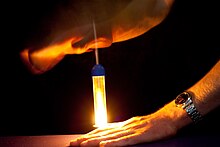
A fire piston , sometimes referred to as a shock flint or a lighter piston, is a device that has been used to ignite fire since ancient times. It is based on the principle of heating gas (in this case air) due to rapid adiabatic compression in order to ignite a piece of tinder , which is then used to ignite the kindling material.
Content
Application
The pump-action flint consists of a hollow cylinder hermetically sealed on one side and open on the other. Size range:
- tube length from 3 to 14 inches (7.5-35 cm).
- hole diameter from 0.25 to 0.5 inches (6-14 mm).
A piston is installed in the cylinder with an airtight annular sealing gasket installed inside the cylinder. To create a tight, but at the same time sliding seal, rubber gaskets or grease are used. At the end of the piston there is a small cavity where the tinder is placed, which is not crushed during subsequent operations. In order to lay or remove the tinder, the piston can be completely removed from the cylinder [1] .
The piston (or cylinder) has a handle at the end so that a rigid clamp can be attached to it, or a sufficiently large surface area over which it can be sharply and painlessly struck, while the cylinder (or piston) must abruptly hit a hard surface. Compression of air during the rapid flow of the piston into the cylinder causes the temperature inside the cylinder to increase sharply to 400 ° F (260 ° C), the self-ignition temperature of the tinder. This is a hot enough temperature so that the tinder on the surface or inside the piston ignites and you can see a flash (ignition) if the cylinder is made of a translucent or transparent material. Then the piston is quickly diverted before the existing oxygen inside the cylinder is consumed by the combustion of the tinder. Next, the smoldering tinder is removed from the end face of the piston and transferred to a large pile of material for ignition. The smoldering material inflates intensely until the flame ignites, at different stages of the ignition they throw up the ignition material until the fire ignites in full force [2] [3] .
Ancient and modern models of percussion flint can be made of wood , animal horns , bamboo or lead . Currently, the flint is most often made of wood, metal or plastic. Homemade pump flint can be made using a wooden dowel, PVC or copper tube and a rubber ring gasket , while the cost of the product will be less than two US dollars.
Principle of Operation
With rapid compression of the gas, its pressure and temperature simultaneously increase. If this compression is too slow, the heat dissipates into the environment, as the gas returns to its equilibrium position with the surrounding air. If the compression is fast enough, then the thermal equilibrium state does not occur. The thermodynamic temperature of the gas can suddenly become several times higher than the ambient temperature, increasing from the initial room temperature of the gas to a temperature sufficient to ignite the tinder. The air in the cylinder acts as a heat source and as an oxidizing agent for smoldering combustible material.
The same principle is used to ignite a combustible mixture in a cylinder of a diesel engine , in which it is not necessary to use a spark plug , as in a gasoline engine . The principle of operation is similar to the principle of the oil engine , an earlier predecessor of a diesel engine in which fuel (tinder) is compressed by gas, while in a diesel engine fuel is injected with compressed gas and at high temperature.
The compression ratio for the pump flint is 25 to 1. This is comparable to a 20: 1 ratio for a modern diesel engine and a ratio in the range of 7: 1 to 11.5: 1 for a gasoline engine. Impact flint is specially made narrow enough, a person without outside help can develop sufficient force to compress the air in the cylinder as much as possible. In order to achieve a high compression ratio, the final compressed volume of tinder and air must be small in relation to the length of the piston tube. These two factors mean that only a small amount of tinder can be ignited in the impact flint, but it can be enough to ignite other kindling material and, in turn, to ignite a stronger fire.
A tinder that ignites at very low temperatures is best suited. Flammable materials such as carbonized fabric or tinder fungus are just as good as tinder and can support smoldering . Conversely, cotton fiber ignites at 455 ° F (235 ° C) and burns brightly, but does not support decay. A bright fire is suitable for demonstration purposes, but is not suitable for kindling a constant fire.
The design of a hand-held bicycle pump is very similar, except that the pump has valves and a hose for compressed air . In the case of a pump, heating the compressed air will be an undesirable side effect, and the design and lubricants should be selected so as to prevent the occurrence of the highest temperatures.
History
The fire piston has been used for many centuries to ignite fire in Southeast Asia and the Pacific Islands . Cultures were discovered there that use a wind tube as a weapon, and it has been suggested that it could serve as a prototype of the design of the flint. There is evidence of the use of pump-action flint in Myanmar , on the Malacca Peninsula, in Indochina , on Borneo (Kalimantan) , Sumatra , Java , Sulawesi , the Philippines , Madagascar and South India [4] .
In the West, the first impact flint was made in 1745 by Abbot Agostino Ruffo of Verona , who made a pair of pneumatic guns for the King of Portugal, Juan V. When Ruffo tested the air pump of the gun for tightness , sealing the outlet with adhesive wood, he noticed that after pressure was applied to pump burned wood. Subsequently, he discovered that a tinder ignited in the pump. Ruffo made an apparatus for further study of this phenomenon. An article in a New York Times article in 1876 claimed that modern impact flint was independently invented in the west by experimenting with an air rifle, rather than being copied by analogy with the Asian design.
It is registered that the first pump-action flint was demonstrated to scientists in 1802 and patented simultaneously in England and France in 1807 . The fiery piston or, as they then called it, the “piston-lighter” was a popular household tool throughout Europe at the beginning of the 19th century , until matches were invented in 1844 .
Perhaps it was the pump-action flint that inspired Rudolf Diesel to create his diesel engine in 1892 .
In the United States, descriptions of pump-action flints have been published repeatedly for many years.
See also
- Diesel engine
- Flint
- Ignition of fire
Notes
- ↑ How to make a device for making fire with your own hands? "Against UEC . protivkart.org. Date of treatment December 18, 2018.
- ↑ Fiery piston . Do Samodelkin - DIY do it yourself. Date of treatment December 18, 2018.
- ↑ FIRE PISTON (manufacturing) . rubezh.ua. Date of treatment December 18, 2018.
- ↑ Paul Kekai Manansala. Metallurgy, Southeast Asian (Glossary ) . Quests of the Dragon and Bird Clan (March 24, 2006). Date of treatment December 18, 2018.