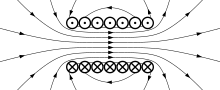
Winding - in electrical engineering, a set of turns of a wire forming an electrical circuit in which electromotive forces induced in the turns are added up [1] .
The simplest winding is a coil - a group of series-connected turns wound one next to the other. Complex windings consist of many sections located either in separate groove compartments separated by groove insulation , or in multilayer coils within one groove, in the form of separate layers separated by insulation.
Windings are used in:
- inductors , which usually have only one winding;

- transformers [1] , where they are divided into primary ( primary , to which electricity is supplied, and secondary , from which it is taken away) and auxiliary, the received or transmitted power of which is insignificant (for example, used to compensate for the third harmonic);
- electric motors and generators , where many of their types are used:
- three-phase for alternating current machines (used in rotors of synchronous motors, as well as stators of synchronous and asynchronous machines);
- single-phase for squirrel-cage induction motor stators;
- for anchors of collector machines;
- short-circuited for rotors of asynchronous electric motors;
- field windings;
- electromagnets .
Winding diagram
In the case of electric machines, the windings have a complex device (in addition to simple field windings and short-circuited windings for rotors of induction motors) and are located on the surfaces of rotation. Therefore, for their schematic notation, specialized diagrams are used [2] :
- The “end” circuit, in which the winding is projected onto a plane perpendicular to the axis of rotation (usually from the collector side), the conductors are depicted in circles with a coil number, and the connections located on the far side and therefore invisible are conventionally carried outside the winding or marked broken lines;
- "Deployed", in which the cylinder of the surface of rotation is deployed in a plane along with the turns and bends.
Notes
- ↑ 1 2 GOST 16110-82 Power transformers. Terms and Definitions
- ↑ Graphic representation of windings. Winding schemes // Eremeev A.I. Windings of electrical machines. Gosenergoizdat, 1940.S. 10-11.
Literature
- V.S. Zakharenko, V.V. Todarev. Windings of electrical machines . Gomel: GSTU named after P.O. Sukhoi, 2007 .-- 49 p. ISBN 978-985-420-647-9 .