
Blue - isotherms at temperatures below critical. Green areas on them are metastable states .
The area to the left of point F is a normal fluid.
Point F is the boiling point .
The direct FG is the connode, that is, the equilibrium isotherm of the liquid and gas phases inside the two-phase region.
The FA site is an overheated liquid .
Plot F′A - stretched fluid (p <0).
The AC region, an analytic continuation of the isotherm, is physically impossible.
Plot CG - supercooled steam .
Point G - dew point .
The area to the right of point G is normal gas.
The areas of the figure FAB and GCB are equal.
Red is a critical isotherm .
K is the critical point .
Blue - supercritical isotherms
Real gas - in the general case - the gaseous state of a real substance. In thermodynamics, real gas means a gas that is not described exactly by the Clapeyron-Mendeleev equation , in contrast to its simplified model - a hypothetical ideal gas that strictly obeys the above equation. Usually, real gas is understood to mean the gaseous state of a substance in the entire range of its existence. However, there is another classification according to which highly superheated steam, the state of which is slightly different from the state of an ideal gas, is called real gas, and superheated steam, the state of which differs noticeably from the ideal gas, and saturated steam (two-phase liquid-vapor equilibrium system are referred to as vapors). ), which, in general, does not obey the laws of an ideal gas. [1] From the standpoint of the molecular theory of the structure of matter, a real gas is a gas whose properties depend on the interaction and size of the molecules. The dependencies between its parameters show that the molecules in a real gas interact with each other and occupy a certain volume. The state of a real gas is often described in practice by the generalized Clapeyron-Mendeleev equation:
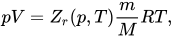
Where - pressure - volume - temperature, - gas compressibility coefficient , - weight, - molar mass , - universal gas constant .





Content
Real Gas Physics
To establish in more detail the conditions when a gas can turn into a liquid and vice versa, simple observations of the evaporation or boiling of a liquid are not enough. It is necessary to carefully monitor the change in pressure and volume of real gas at different temperatures.
We will slowly compress the gas in the vessel with the piston, for example sulfur dioxide (SO 2 ). Compressing it, we do work on it, as a result of which the internal energy of the gas will increase. When we want the process to take place at a constant temperature , we need to compress the gas very slowly so that the heat has time to transfer from the gas to the environment.
Performing this experiment, one can notice that at first with a large volume the pressure increases with decreasing volume according to the Boyle – Marriott law . In the end, starting with some value, the pressure will not change, despite the decrease in volume. Transparent drops form on the walls of the cylinder and piston. This means that the gas began to condense, that is, go into a liquid state.
Continuing to compress the contents of the cylinder, we will increase the mass of liquid under the piston and, accordingly, will reduce the mass of gas. The pressure that the pressure gauge indicates will remain constant until the entire space under the piston is filled with fluid. Liquids are slightly compressible. Therefore, further, even with a slight decrease in volume, the pressure will increase rapidly.
Since the whole process takes place at a constant temperature , a curve that depicts the pressure dependence from volume are called an isotherm . With volume gas condensation begins, and with volume it ends. If , then the substance will be in a gaseous state, and when - in liquid.
Experiments show that isotherms of all other gases have this form if their temperature is not very high.
In this process, when a gas turns into a liquid when its volume changes from to , the gas pressure remains constant. Each point of the rectilinear part of isotherm 1-2 corresponds to an equilibrium between the gaseous and liquid states of the substance. This means that for certain and the amount of liquid and gas above it remains unchanged. The equilibrium is dynamic: the number of molecules that leave the liquid, on average, is equal to the number of molecules that transfer from gas to liquid in the same time.
There is also such a thing as a critical temperature , if the gas is at a temperature higher than the critical temperature (individual for each gas, for example, carbon dioxide about 304 K ), then it can no longer be turned into a liquid no matter what pressure is applied to it. This phenomenon occurs due to the fact that at a critical temperature the surface tension forces of the liquid are equal to zero. If we continue to slowly compress the gas at a temperature greater than critical, then after it reaches a volume equal to approximately four natural volumes of the molecules that make up the gas, the compressibility of the gas begins to drop sharply.
Boyle points, Boyle curve, Boyle temperature
Consider the deviation of the properties of a real gas from the properties of an ideal gas using diagrams. It follows from the Clapeyron-Mendeleev equation that the isotherms of an ideal gas are represented by horizontal lines in such a diagram. We use the equation of state of a real gas in virial form . For one mole of gas [2]
| {\ displaystyle PV = RT + BP + CP ^ {2} + DP ^ {3} + ...} | (Virial equation of state of a real gas) |
Where and - respectively, the second, third and fourth virial coefficients, depending only on temperature. It follows from the virial equation of state that on -chart ordinate axis ( ) corresponds to the ideal gas state of the substance: at the virial equation of state turns into the Clapeyron-Mendeleev equation and, therefore, the positions of the intersection points of the isotherms with the ordinate in the diagram under consideration correspond to the values for each of the isotherms.
From the virial equation of state we find:
| (Second virial coefficient) |
Thus, in the coordinate system under consideration, the slope (i.e., the angular coefficient of the tangent) of the gas isotherm at the intersection of this isotherm with the ordinate gives the value of the second virial coefficient.
On -diagram of isotherms corresponding to temperatures lower than a certain value (called the Boyle temperature ) have minima called the Boyle points [3] [4] [5] [6] .
Some authors put different content into the concept of “Boyle point”, namely, they proceed from the uniqueness of the Boyle point, understanding by it a point on -chart with zero pressure and a temperature equal to the Boyle temperature [7] [8] [9] .
At the minimum point
which is always true for perfect gas. In other words, at the Boyle point, the compressibility of the real and ideal gases coincide [8] . The site of the isotherm to the left of the Boyle point corresponds to the conditions when the real gas is more compressible than ideal; the section to the right of the Boyle point corresponds to the conditions of the worst compressibility of real gas compared to ideal [6] .
The line that is the geometrical location of the minimum points of the isotherms on -diagram, called the Boyle curve [2] [4] [5] [6] . The intersection point of the Boyle curve with the ordinate axis corresponds to an isotherm with a temperature equal to the Boyle temperature. This means that at Boyle temperature the second virial coefficient vanishes [10] [2] and Boyle temperature is the root of equation [11] [9]
Below the Boyle temperature, the second virial coefficient is negative, above it is positive [2] [12] . The Boyle temperature is an important characteristic of the inversion curve (at each point of which the throttle effect is equal to zero): at temperatures below the Boyle temperature, partial gas liquefaction during throttling is possible [4] [6] (see the book [13] for more details).
For a gas that obeys the van der Waals equation ,
Where - critical temperature [4] [6] . For many substances, the approximate Boyle temperature gives the following empirical relation [7] [8] [14] [9] :
Of -diagrams, that the initial section of the isotherm with the Boyle temperature, corresponding to relatively low pressures, is quite close to the horizontal line, that is, at a gas temperature equal to or close to the Boyle temperature, the real gas has properties close to the properties of an ideal gas [7] [ 15] .
Real gas equations
The most commonly used equations of state for real gas are:
- Van der Waals equation
- Diterichi equation
- Berthelot's equation
- Clausius equation
- Camerling-onnes equation
Notes
- ↑ Belokon N.I., Basic principles of thermodynamics, 1968 , p. 78 ..
- ↑ 1 2 3 4 Kirillin V.A. et al., Technical Thermodynamics, 2008 , p. 192 ..
- ↑ Bazarov I.P., Thermodynamics, 2010 , p. 34 ..
- ↑ 1 2 3 4 Boyle point // Physical Encyclopedia, vol. 1, 1988, p. 226.
- ↑ 1 2 Thermodynamics. Basic concepts. Terminology. Letter designations of quantities, 1984 , p. 23 ..
- ↑ 1 2 3 4 5 Boyle's Point // Great Soviet Encyclopedia, 3rd ed., Vol. 2, 1970.
- ↑ 1 2 3 Kirillin V.A. et al., Technical Thermodynamics, 2008 , p. 193 ..
- ↑ 1 2 3 Konovalov V.I., Technical Thermodynamics, 2005 , p. 200 ..
- ↑ 1 2 3 Dodge B.F., Chemical Thermodynamics, 1950 , p. 219 ..
- ↑ Bazarov I.P., Thermodynamics, 2010 , p. 35 ..
- ↑ Rem G. D., Technical Thermodynamics, 1977 , p. 197 ..
- ↑ Eremin E.N., Fundamentals of Chemical Thermodynamics, 1978 , p. 21 ..
- ↑ Doctors A. B., Burshtein A. I., Thermodynamics, 2003 , p. 50-56 ..
- ↑ Guigo E.I. et al., Technical Thermodynamics, 1984 , p. 116 ..
- ↑ Andryushchenko A. I., Fundamentals of technical thermodynamics of real processes, 1967 , p. 95 ..
Literature
- Andryushchenko A. I. Fundamentals of technical thermodynamics of real processes. - M .: Higher school, 1967. - 268 p.
- Bazarov I.P. Thermodynamics. - 5th ed. - SPb. — M. — Krasnodar: Doe, 2010 .-- 384 p. - (Textbooks for universities. Special literature). - ISBN 978-5-8114-1003-3 .
- Belokon N.I. Basic principles of thermodynamics. - Moscow: Nedra, 1968 .-- 112 p.
- Rem G. D. Technical Thermodynamics. - M .: Mir, 1977 .-- 519 p.
- Guigo E.I., Danilova G.N., Filatkin V.N. et al. Technical Thermodynamics / Under the general. ed. prof. E.I. Guigo. - L .: Publishing house Leningrad. University, 1984. - 296 p.
- Dodge B.F. Chemical thermodynamics as applied to chemical processes and chemical technology. - M .: Foreign literature, 1950 .-- 786 p.
- Doctors A. B., Burshtein A. I. Thermodynamics. - Novosibirsk: Novosib. state Univ., 2003 .-- 83 p.
- Eremin E. N. Fundamentals of chemical thermodynamics. - 2nd ed., Rev. and add. - M .: Higher school, 1978.- 392 p.
- Kirillin V.A. , Sychev V.V., Sheindlin A.E. Technical thermodynamics. - 5th ed., Revised. and add. - M .: Publishing House House of MPEI, 2008 .-- 496 p. - ISBN 978-5-383-00263-6 .
- Konovalov V.I. Technical Thermodynamics. - Ivanovo: Ivan. state energy Univ., 2005 .-- 620 s. - ISBN 5-89482-360-9 .
- Thermodynamics. Basic concepts. Terminology. Letter designations of quantities / Resp. ed. I.I. Novikov . - Academy of Sciences of the USSR. Committee of scientific and technical terminology. Collection of definitions. Vol. 103.- M .: Nauka, 1984. - 40 p.